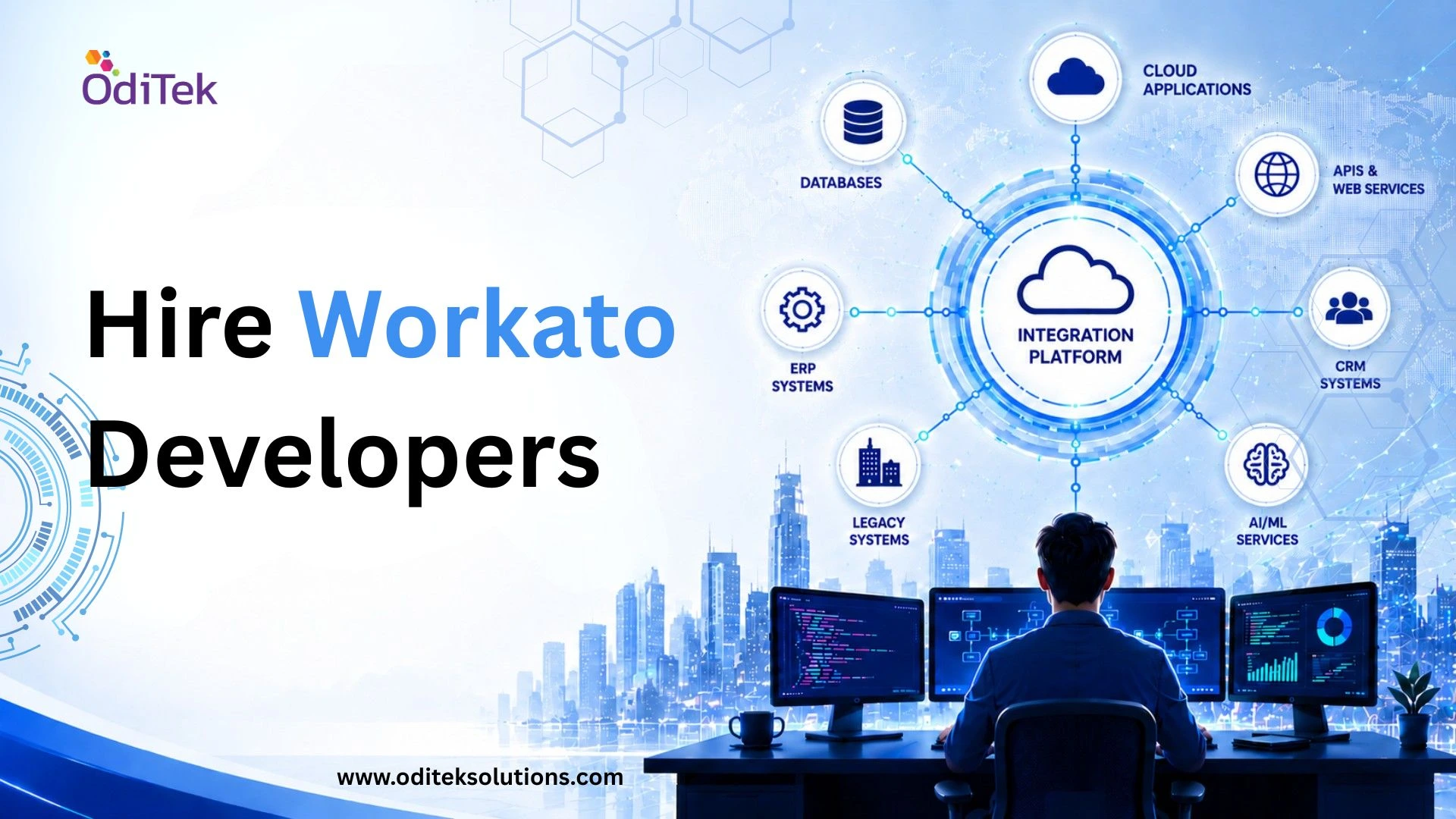
Workato Developers are essential for modern enterprise integration, where API-first and event-driven architectures connect SaaS platforms, on-premises systems, ERPs, CRMs, databases, and microservices. They design scalable integration ecosystems that support real-time data synchronization, workflow automation, and operational resilience.
Workato’s low-code iPaaS replaces heavy middleware coding with faster, secure, and governed enterprise integrations. Whether you want to hire a Workato developer or support modernization, experienced specialists reduce complexity and speed up time-to-value.
What Do Workato Developers Do?
Workato Developers architect, develop, deploy, and optimize enterprise integration solutions using reusable recipes, connectors, APIs, and event-driven workflows. Their role extends beyond application connectivity to designing resilient integration architectures capable of supporting high-volume enterprise transactions.
Their core responsibilities include:
• API orchestration using REST, SOAP, GraphQL, and Webhooks
• Enterprise application integration (ERP, CRM, HRMS, ITSM)
• JSON/XML transformation and data mapping
• OAuth 2.0, JWT, SSO, and API security implementation
• Recipe optimization, monitoring, and governance
• CI/CD deployment and lifecycle management
By implementing reusable integration assets and standardized design patterns, Workato Developers improve scalability, maintainability, and operational efficiency.
Why Enterprise Integration Requires Workato Developers
Modern enterprises operate within heterogeneous IT landscapes where applications continuously exchange transactional and master data. Integrating platforms such as SAP, Salesforce, Oracle, ServiceNow, Workday, Snowflake, NetSuite, and Microsoft Dynamics requires expertise in distributed systems, API management, and data orchestration.
Enterprise integration introduces challenges including:
• API throttling and rate limiting
• Schema transformation and canonical data modeling
• Data consistency across distributed applications
• High availability and fault tolerance
• Monitoring, logging, and observability
Experienced Workato Developers mitigate these challenges by implementing modular integration architectures that support scalability, resilience, and governance across hybrid and multi-cloud environments.
Key Responsibilities of Workato Developers
Professional Workato developers typically handle:
API Integration
Connecting REST, SOAP, GraphQL, and webhook-based services across enterprise environments.
Workflow Automation
Automating repetitive business processes involving approvals, notifications, data synchronization, and task orchestration.
Recipe Development
Designing reusable Workato recipes that improve maintainability and reduce implementation time.
Enterprise Security
Implementing OAuth, API authentication, encryption, role-based access, and governance controls.
Monitoring and Optimization
Tracking integration performance, resolving failures, improving execution efficiency, and ensuring business continuity.
Benefits include:
Faster Deployment
Low-code development enables rapid delivery without sacrificing enterprise-grade capabilities.
Reduced Development Costs
Reusable connectors and recipes significantly lower engineering effort compared to custom middleware.
Improved Data Accuracy
Automated synchronization minimizes manual data entry and reduces operational errors.
Enhanced Business Agility
Teams can automate workflows faster, respond to changing business needs, and launch new integrations with minimal disruption.
Hire Workato Developer for System Integration
System integration often involves multiple enterprise applications communicating across departments. In modern enterprises, this usually means connecting platforms such as Salesforce and SAP, NetSuite and Workday, ServiceNow and Jira, Oracle and Microsoft Dynamics, SAP and Snowflake, Slack and HR systems, or Shopify and ERP platforms.
Each integration must be designed to support reliable data exchange, secure access, and consistent business operations.
An experienced Workato developer for system integration ensures that these connections are built to perform at scale.
Key responsibilities include:
• Reliable API communication
• Secure authentication
• Data consistency
• High availability
• Monitoring and alerting
• Scalable architecture
With the right implementation, these integrations reduce operational downtime, improve cross-department collaboration, and increase overall enterprise productivity.
Why Hire a Workato Expert for Business Automation?
A common question among enterprise leaders is why hire a Workato expert for business automation?
Business automation requires much more than connecting applications. Enterprise workflows involve conditional logic, approval chains, API orchestration, SLA monitoring, exception routing, and real-time notifications across multiple business functions.
Workato experts automate processes such as:
• Employee onboarding and offboarding
• Procure-to-Pay (P2P)
• Order-to-Cash (O2C)
• Customer support automation
The result is improved operational efficiency, reduced manual intervention, standardized workflows, and greater business agility.
Best Practices for Hiring Workato Developers
To ensure project success:
• Define clear integration requirements.
• Assess experience with enterprise-scale implementations.
• Review API and middleware expertise.
• Evaluate knowledge of security and governance.
• Test problem-solving and troubleshooting skills.
• Consider long-term support and optimization capabilities.
Hiring based on technical competency rather than platform familiarity leads to more resilient integration solutions.
Future of Workato Developers
As organizations adopt AI, event-driven architectures, and API-first ecosystems, demand for Workato developers continues to grow.
Future integration initiatives will increasingly center on intelligent automation and connected systems. As enterprises adopt AI and expand across cloud environments, integration teams will need to support faster decision-making, seamless data flow, and more autonomous operations.
Key areas will include:
• AI-powered workflow automation
• Intelligent document processing
• Real-time event orchestration
• Multi-cloud integration
• Enterprise data synchronization
Developers who combine integration expertise with automation strategy will play a pivotal role in enabling digital transformation.
Why Choose OdiTek?
At OdiTek, our experienced Workato developers help enterprises build secure, scalable, and high-performance integration solutions. From API integrations and workflow automation to legacy modernization and managed support, we deliver end-to-end Workato services tailored to your business needs.
Why OdiTek?
• Certified and experienced Workato developers
• Enterprise-grade API and system integration expertise
• Scalable workflow automation solutions
• Legacy middleware modernization
• End-to-end implementation and ongoing support
Looking to hire a Workato developer? Visit our Workato Skill Page or contact us today.
Conclusion
Modern enterprises need scalable, secure, and API-driven integration solutions to connect complex application ecosystems. Workato Developers help organizations streamline operations, automate workflows, and build resilient integration architectures.
Whether you’re modernizing legacy systems or accelerating business automation, hiring experienced Workato developers ensures faster implementation, reliable integrations, and long-term scalability.
FAQs
What do Workato developers do?
Workato developers build, deploy, and maintain enterprise integrations and automation workflows using the Workato platform. They connect applications, automate business processes, and ensure secure, scalable data exchange.
Why should I hire a Workato developer?
Hiring a Workato developer helps reduce development time, improve integration reliability, automate manual tasks, and accelerate digital transformation initiatives.
What skills should a Workato developer have?
A skilled Workato developer should understand APIs, REST services, data transformation, enterprise integration patterns, workflow automation, security, monitoring, and cloud integration architectures.
Where can I find Workato developers for integration projects?
You can find Workato developers through certified consulting partners, enterprise integration firms, specialized staffing agencies, technology consulting companies, or dedicated integration service providers.
Is Workato suitable for enterprise integration?
Yes. Workato is designed for enterprise-grade integration, offering API connectivity, workflow automation, governance, security, and scalable orchestration across cloud and on-premises applications.