The eCommerce landscape has evolved significantly over the last decade, and few platforms have experienced a transformation as impactful as Magento to Adobe Commerce. Once known primarily as an open-source solution for online stores, Magento has grown into the foundation of one of the world’s leading enterprise eCommerce platforms.
Understanding this journey helps businesses choose the right platform for their digital commerce strategy. In this blog, we’ll explore the Magento evolution, explain the relationship between Magento and Adobe, and highlight what this transformation means for modern businesses.
Magento Evolution: From Open Source to Enterprise
Magento was introduced as an open-source eCommerce platform that gave businesses complete control over their online stores. Its extensive customisation options, strong developer community, and vast extension marketplace quickly made it one of the most widely adopted eCommerce platforms.
A major milestone came in 2018 when Adobe acquired Magento. Rather than replacing the platform, Adobe expanded its capabilities, transforming Magento Commerce into Adobe Commerce and integrating it with Adobe Experience Cloud.
Today, businesses benefit from:
• AI-powered product recommendations
• Personalised shopping experiences
• Cloud-based infrastructure
• Advanced B2B functionality
• Improved security and performance
• Seamless integration with Adobe’s digital ecosystem
This Magento evolution reflects the increasing demand for enterprise-ready digital commerce solutions that support long-term business growth.
Magento to Adobe Commerce: A Journey Driven by Business Needs
This transition was shaped by the changing demands of digital commerce rather than a complete shift in platform direction. As businesses expanded across multiple sales channels and customer expectations continued to evolve, commerce platforms needed to deliver greater scalability, flexibility, and long-term adaptability. The move from Magento to Adobe reflects this progression, allowing businesses to continue building on a familiar foundation while embracing the capabilities required for modern commerce.
What Changed After Magento Became Adobe Commerce?
Adobe’s acquisition brought significant enhancements while retaining Magento’s flexible architecture.
Some of the biggest improvements include:
• Cloud hosting with improved scalability and reliability
• AI-powered merchandising and personalised customer experiences
• Advanced Page Builder for creating engaging storefronts
• Built-in B2B capabilities such as company accounts, shared catalogues, and custom pricing
• Enhanced security, monitoring, and performance optimisation
• Native integration with Adobe Analytics, Adobe Experience Manager, and Adobe Target
These additions allow businesses to manage complex commerce operations while delivering seamless customer experiences across multiple channels.
What Is the Difference Between Magento Open Source and Adobe Commerce?
Although both platforms share the same foundation, they are designed for different business requirements.
| Feature | Magento Open Source | Adobe Commerce |
|---|---|---|
| Licensing | Free and open-source | Commercial enterprise platform |
| Target Audience | Startups and small to mid-sized businesses | Growing businesses and enterprises |
| Hosting | Self-hosted | Cloud and on-premises deployment options |
| Personalisation | Basic capabilities through extensions | Built-in AI-powered personalisation |
| B2B Features | Limited or extension-based | Advanced built-in B2B functionality |
| Support | Community support | Adobe enterprise support |
| Scalability | Suitable for standard eCommerce stores | Designed for high-volume, enterprise commerce |
| Integrations | Third-party integrations available | Native integration with Adobe Experience Cloud |
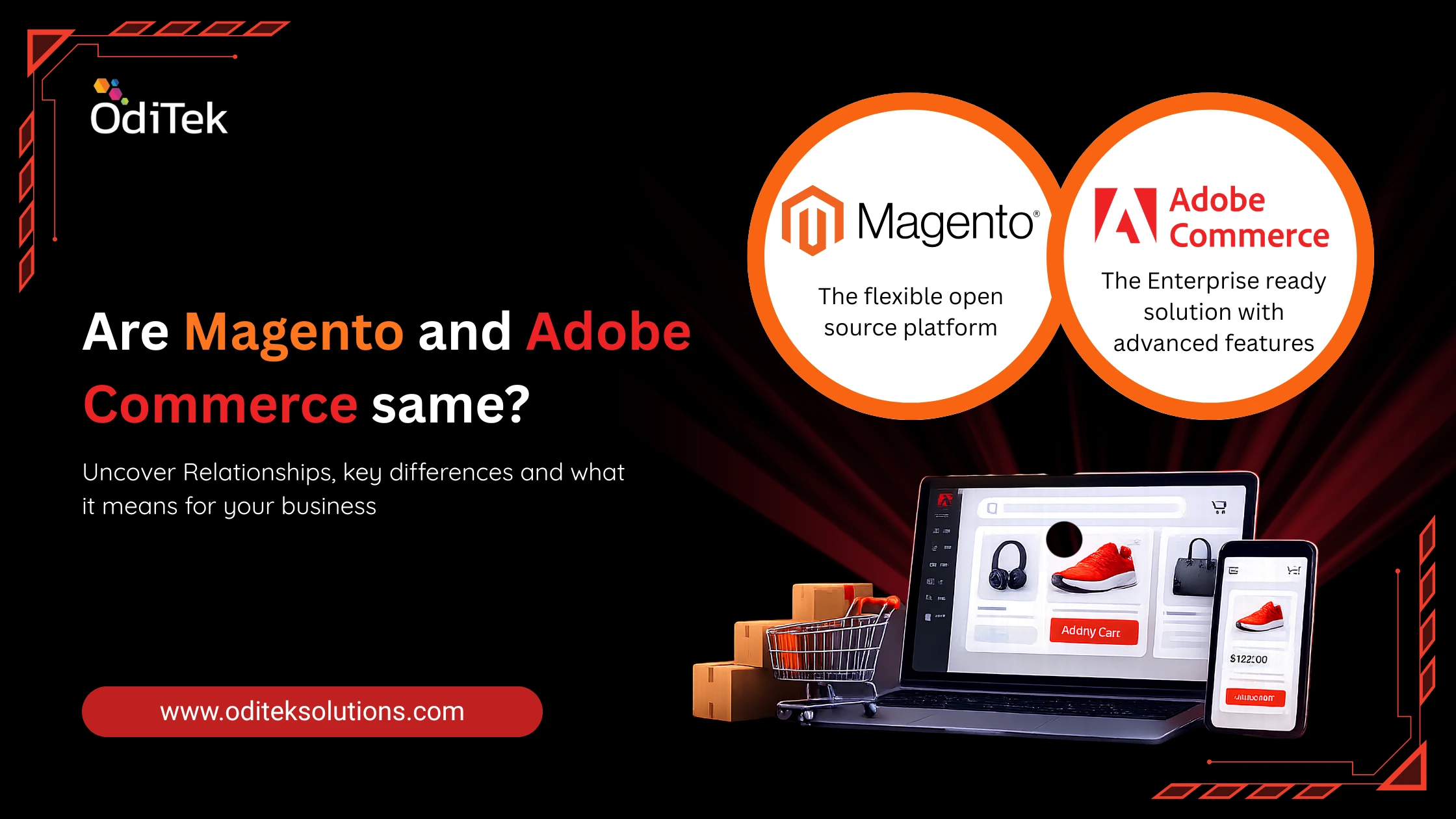
Magento Open Source is ideal for businesses looking for flexibility with lower upfront costs, while Adobe Commerce is designed for organisations that require advanced automation, personalisation, scalability, and multi-store management.
Is Adobe Commerce the Same as Magento?
This enterprise commerce is built on Magento’s core technology, which is why the two platforms are often associated with one another. However, Adobe offers significantly more enterprise functionality than Magento Open Source.
In simple terms:
• Magento Open Source remains the free, community-supported edition.
• Adobe Commerce is the enterprise version built on the Magento framework.
• Both share the same technical foundation, but Adobe includes additional enterprise tools, cloud services, and AI-driven capabilities.
For growing businesses, Adobe provides the flexibility of Magento combined with the enterprise features needed to support long-term digital transformation.
Why Choose OdiTek?
Implementing or upgrading an eCommerce platform requires the right technical expertise. At OdiTek Solutions, we help businesses maximise the value of both Magento Open Source and Adobe enterprise Commerce through tailored implementation and integration services.
Our expertise includes:
• Magento to Adobe Commerce migration
• Adobe enterprise Commerce development and customisation
• ERP, CRM, and third-party API integrations
• Performance optimisation and security enhancements
• Ongoing maintenance and technical support
• Scalable B2B and B2C commerce solutions
Whether you’re modernising an existing Magento store or launching a new Adobe Commerce implementation, our team delivers solutions that are secure, scalable, and aligned with your business goals.
Frequently Asked Questions (FAQs)
1. When did Magento become Adobe Commerce?
1. When did Magento become Adobe Commerce?
Adobe acquired Magento in 2018 and later rebranded Magento Commerce as Adobe Commerce. Magento Open Source continues to exist as the free, open-source edition.
2. Is Magento Open Source still supported?
Yes. Magento Open Source is actively maintained by Adobe and the open-source community. It continues to receive updates, security patches, and new releases.
3. Who should use Adobe Commerce?
Adobe Commerce is ideal for medium and large enterprises that need advanced B2B features, AI-powered merchandising, cloud infrastructure, multi-store management, and enterprise-level support.
4. Can you upgrade from Magento Open Source to Adobe Commerce?
Yes. Businesses can upgrade from Magento Open Source to Adobe Commerce when they require enterprise features, greater scalability, and deeper integrations with Adobe Experience Cloud.
5. What are the main benefits of Adobe Commerce?
Adobe Commerce provides advanced personalisation, AI-driven product recommendations, B2B functionality, cloud deployment, enhanced security, and seamless integration with Adobe’s digital experience ecosystem.
6. Why is Adobe Commerce considered an enterprise eCommerce platform?
Adobe Commerce is designed to handle complex business requirements, including high transaction volumes, multiple storefronts, global operations, advanced customer segmentation, and enterprise-grade security.
Conclusion
The evolution from Magento to Adobe Commerce reflects how digital commerce has adapted to meet the growing demands of modern businesses. As customer expectations continue to evolve, organisations need a platform that not only supports their current operations but also provides the flexibility and scalability to grow alongside their business.
Whether choosing Magento Open Source for its customisation capabilities or Adobe Commerce for its enterprise-ready features, the right platform should align with your long-term business goals and digital strategy. By making an informed decision and partnering with an experienced implementation team, businesses can build a future-ready commerce ecosystem that delivers exceptional customer experiences, streamlines operations, and supports sustainable growth in an increasingly competitive digital marketplace.
To learn more about our Magento development services, visit our Magento Skill page.
Contact us today to build a scalable Magento eCommerce solution that drives growth and delivers exceptional customer experiences.