AI face recognition is changing the way businesses verify identities, manage access, and strengthen security. Instead of relying only on passwords, ID cards, or access badges, organizations can use facial features as a digital identity to authenticate people quickly and automatically.
From unlocking secure entrances to searching surveillance footage and managing employee access, facial recognition is becoming an important part of modern security infrastructure. When combined with artificial intelligence and computer vision, it can help organizations make authentication faster while reducing manual intervention.
But how does the technology actually work, how accurate is it in real-world environments, and where can businesses use it effectively?
What Is AI Face Recognition and How Does It Work?
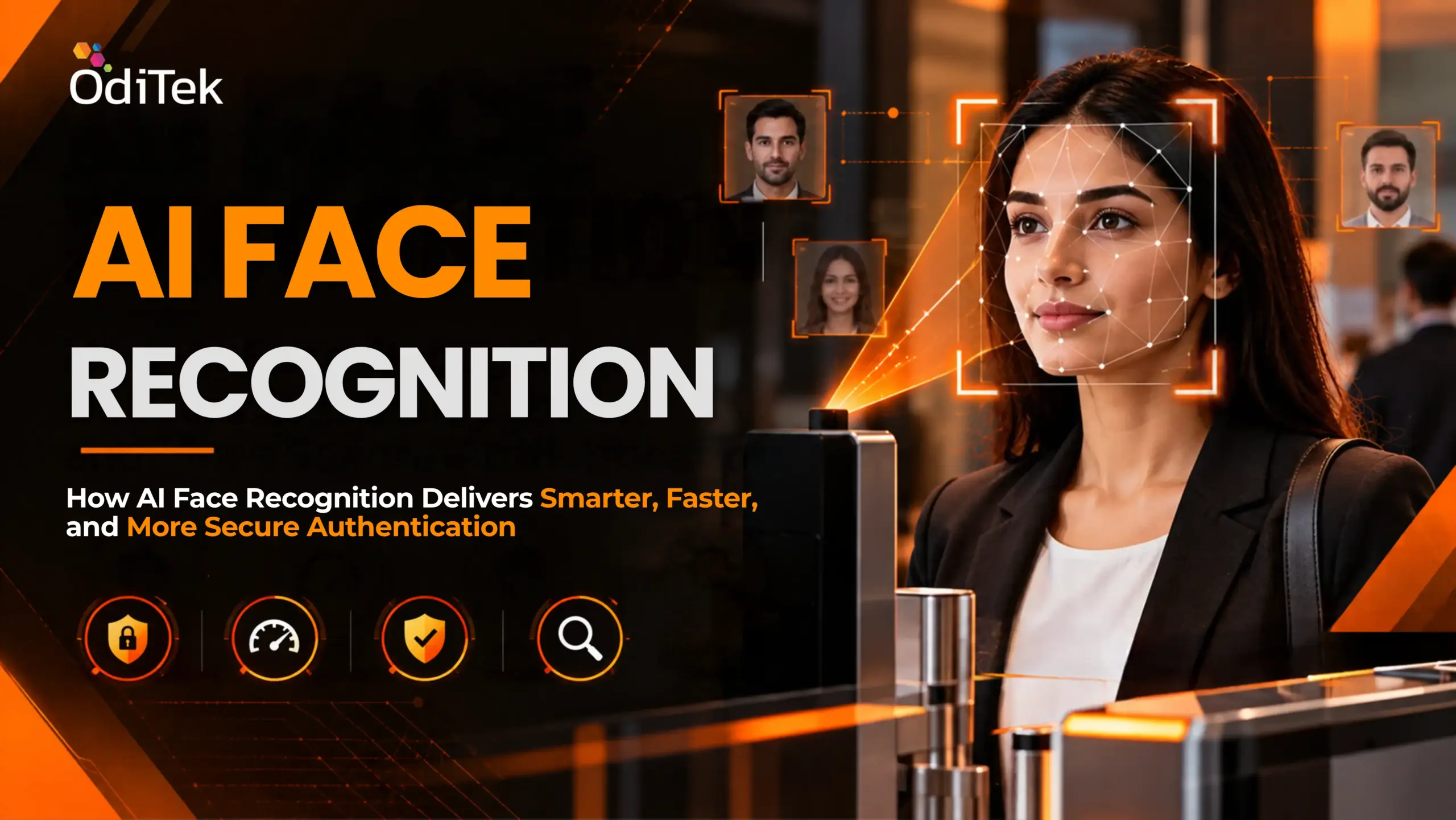
AI face recognition is a biometric technology that uses artificial intelligence and computer vision to detect, analyze, and match a person’s facial features with registered identities.
The process generally begins when a camera captures an individual’s face. The system detects the face, extracts distinctive facial characteristics, and creates a digital representation. This representation is then compared with stored facial profiles to identify or verify the person.
A typical workflow involves:
• Face Detection – Identifies faces in images or videos.
• Feature Extraction – Analyzes unique facial characteristics.
• Face Matching – Compares facial features with registered profiles.
• Identity Verification – Confirms whether a potential match exists.
• Automated Action – Triggers access, alerts, attendance, or other workflows.
This approach allows organizations to automate identity-related processes without requiring users to remember passwords or carry physical credentials.
How AI Face Recognition Makes Authentication Faster and Smarter
Traditional authentication can create bottlenecks when large numbers of employees, visitors, or customers need to be verified. Manual ID checks and physical access cards can also add additional steps to the process.
An AI face recognition app can automate facial verification through connected cameras and devices. When integrated with access-control systems, the technology can verify an authorized individual and trigger the appropriate action.
For example, at a secured facility, the system can:
1. Capture the person’s face through a camera.
2. Detect and analyze facial features.
3. Compare the face against registered identities.
4. Verify the person’s access permissions.
5. Trigger the connected access-control system.
6. Record the authentication event.
The same technology can be integrated with CCTV, visitor management, employee databases, access-control systems, and enterprise applications.
This makes facial recognition useful not only for authentication but also for creating connected security workflows.
AI Face Recognition Search for Smarter Video Investigation
Security teams can spend hours reviewing surveillance footage when investigating an incident. Finding a specific person manually across multiple cameras and recordings can be particularly time-consuming.
An AI face recognition search capability can help authorized security personnel locate potential appearances of a particular individual across available video footage or facial databases.
A typical search can involve selecting a reference image and allowing the system to identify potential facial matches across relevant footage.
Potential applications include:
• Security Incident Investigation
• Visitor Identification
• Restricted-Area Monitoring
• Employee Verification
• Missing-Person Searches
• Access Monitoring
• Post-Incident Investigation
However, a facial recognition result should not automatically be treated as a confirmed identity. Lighting, camera angle, image quality, movement, facial occlusion, and system configuration can affect the result. Human review remains important, particularly for sensitive security decisions.
How Accurate Is AI Face Recognition in Real-World Applications?
How accurate is AI face recognition in real-world applications? There is no single accuracy percentage that applies to every system or environment.
Performance can vary depending on the camera, lighting, distance, facial angle, image quality, database, recognition model, and operating conditions.
For example, a camera providing a clear frontal view in a well-lit environment can produce different results from a camera capturing faces at a distance or under poor lighting.
Organizations evaluating AI face recognition software should consider factors such as:
• Camera Resolution & Placement
• Lighting Conditions
• Subject Distance
• Facial Angle & Movement
• Masks, Helmets, Glasses & Other Obstructions
• Quality of Registered Facial Images
• Recognition Thresholds
• Database Quality
• Processing Infrastructure
Liveness detection is another important capability. It can help determine whether the system is interacting with a live person rather than a photograph, video, or other presentation attempt.
For this reason, businesses should evaluate facial recognition using their actual operating environment instead of relying solely on generalized accuracy claims.
Which Industries Benefit Most from AI Face Recognition Technology?
Which industries benefit most from AI face recognition technology? The answer depends on the organization’s security requirements, operational environment, and applicable privacy and biometric regulations.
1. Manufacturing
Industrial facilities can use facial recognition for employee authentication, attendance, restricted-area access, visitor management, and security monitoring.
2. Corporate Offices
Businesses can integrate facial recognition with access-control systems to streamline employee entry and manage secure areas.
3. Banking and Financial Services
Financial organizations can explore facial authentication for selected identity-verification and secure-access workflows, subject to applicable regulations.
4. Healthcare
Hospitals can use the technology for staff authentication, visitor management, and controlled access to designated areas where appropriate.
5. Airports and Transportation
Transportation facilities can use facial recognition for selected passenger-processing and identity-verification applications.
6. Education
Schools and educational institutions can explore facial recognition for selected access-control and identity-management use cases, depending on institutional policies and applicable requirements.
7. Smart Infrastructure
Large facilities can combine facial recognition with AI-powered video analytics to help security teams monitor and investigate events across extensive camera networks.
Why Choose Us?
At Oditek Solutions, we develop technology solutions that combine AI, computer vision, video analytics, and enterprise application integration to address real-world business and security requirements.
Our AI face recognition software can be integrated into broader intelligent video management and security ecosystems, connecting facial recognition with cameras, access-control systems, enterprise applications, and operational workflows.
Our solution approach can support capabilities such as:
• Real-Time Face Detection & Recognition
• AI-Based Identity Verification
• Face-Based Video Search
• Access-Control Integration
• CCTV & Video-Stream Integration
• Real-Time Alerts & Event Management
• Centralized Monitoring
• Enterprise Application Integration
• Scalable Deployment for Industrial & Enterprise Environments
Rather than treating facial recognition as an isolated feature, we focus on integrating it into the organization’s broader security and operational ecosystem.
Conclusion
AI face recognition is reshaping how organizations approach identity verification, access control, and video-based security. By combining artificial intelligence with computer vision, businesses can automate authentication processes while reducing dependence on traditional credentials.
From an AI face recognition app used for authentication to AI face recognition search for video investigation, the technology can support a wide range of applications across manufacturing, offices, healthcare, transportation, and other environments.
However, successful implementation requires more than choosing AI face recognition software. Organizations should consider accuracy, environmental conditions, privacy, data security, regulatory requirements, system integration, and human oversight.
When implemented responsibly, AI-powered facial recognition can become an important component of a smarter, faster, and more secure authentication ecosystem.
Frequently Asked Questions
1. What is AI face recognition?
AI face recognition is a biometric technology that uses artificial intelligence and computer vision to detect, analyze, and match a person’s facial features with registered identities for authentication or identification.
2. How does AI face recognition improve security?
AI face recognition can strengthen security by enabling automated identity verification, access control, real-time alerts, and video-based identity searches. It can also reduce dependence on easily shared or lost credentials such as passwords and access cards.
3. How accurate is AI face recognition in real-world applications?
The accuracy of AI face recognition depends on factors such as camera quality, lighting, facial angle, image resolution, distance, facial obstructions, database quality, and the recognition algorithm. Real-world performance should be evaluated in the specific environment where the system will be deployed.
4. Where can AI face recognition be used?
AI face recognition can be used across industries such as manufacturing, corporate offices, healthcare, banking, transportation, education, and large infrastructure facilities for applications including access control, identity verification, visitor management, and security monitoring.
5. What is the difference between AI face recognition software and an AI face recognition app?
AI face recognition software refers to the broader technology platform used to detect, identify, and verify faces, while an AI face recognition app is typically a user-facing application that provides specific facial recognition capabilities through a mobile device or connected system.