AI-Powered Security System: Building Safer, Smarter, and Future-Ready Residential Communities
The concept of residential security has evolved dramatically over the last decade. Apartment societies are no longer focused only on preventing unauthorized entry—they are also expected to provide residents with a secure, seamless, and technology-driven living experience. With increasing urbanization and the rapid growth of gated communities, managing the movement of residents, visitors, delivery personnel, domestic staff, and vehicles has become more complex than ever before.
Traditional security methods such as manual visitor registers, conventional CCTV cameras, and physical verification at entry gates have served residential communities for years.
However, these systems largely depend on human observation and are often reactive rather than preventive. Security personnel can monitor only a limited number of cameras simultaneously, making it difficult to identify suspicious activities before they become security incidents.
This is where an AI-Powered Security System is changing the future of residential security. By combining Artificial Intelligence, intelligent surveillance, automated monitoring, and real-time analytics, these advanced systems help apartment societies detect threats faster, automate routine security tasks, and make informed decisions based on live data.
As smart residential communities continue to expand, AI-powered security is becoming the foundation of safer, more connected, and more efficient apartment living.
What is an AI-Powered Security System?
An AI-Powered Security System is an intelligent security solution that uses Artificial Intelligence, machine learning, smart surveillance cameras, and automated monitoring technologies to strengthen the safety of residential communities.
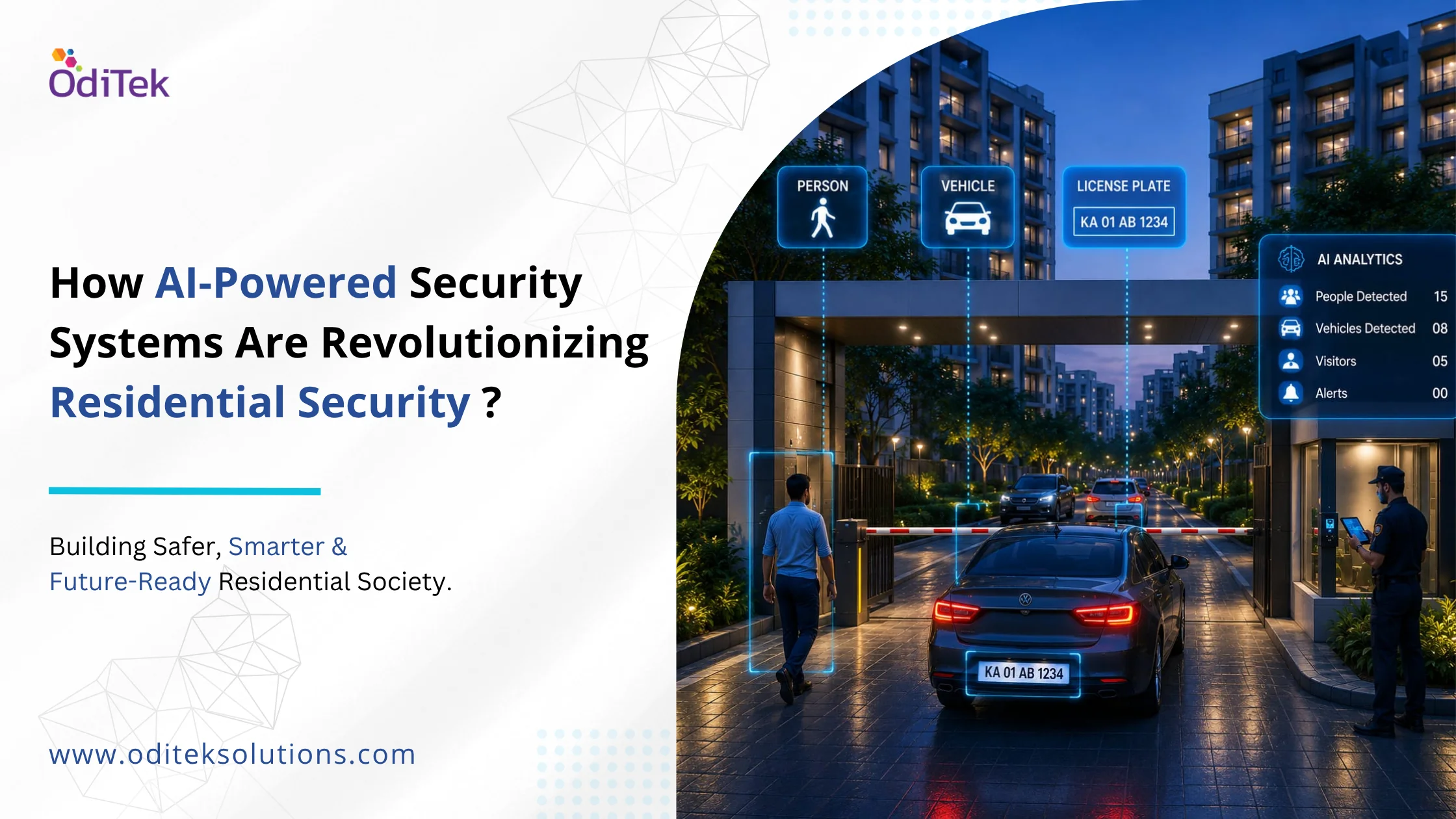
Unlike traditional surveillance systems that simply record video footage, AI-enabled systems continuously analyze live activities across the property. They can identify unusual movement, detect potential security threats, generate instant alerts, and assist security personnel in responding quickly to incidents.
A modern AI-powered security ecosystem typically includes:
• AI-enabled surveillance cameras
• Intelligent monitoring software
• Smart access management
• Automated visitor verification
• Vehicle monitoring capabilities
• Real-time alerts and notifications
• Digital reporting and analytics
Together, these technologies create a proactive security environment where potential threats can be identified before they escalate.
Why Are Residential Societies Moving Towards AI-Based Security?
The expectations of residents have changed significantly in recent years. People no longer want security systems that only record events—they expect solutions that actively protect their homes and families.
Modern apartment societies experience constant activity throughout the day. Residents leave for work, visitors arrive, delivery partners make frequent stops, and service providers enter the premises regularly. Managing this level of activity manually can increase the chances of errors and delayed responses.
An AI-Powered Security System addresses these challenges by automating routine security operations while continuously monitoring the property.
Some of the key reasons residential societies are adopting AI include:
• Growing resident populations
• Increased vehicle and visitor movement
• Rising demand for contactless security
• Faster emergency response
• Reduced dependence on manual monitoring
• Improved operational efficiency
• Better security visibility
These advantages make AI an essential component of modern residential security.
What is the Future of AI in Residential Security?
Artificial Intelligence is transforming security from a reactive process into a predictive and intelligent ecosystem. The future of residential security will not simply involve monitoring activities—it will involve understanding patterns, identifying risks, and responding automatically to potential threats.
Let’s explore how AI is shaping the future of apartment security.
1. Smarter AI-Based Surveillance
Traditional surveillance systems require security personnel to constantly monitor multiple camera feeds. This process is both time-consuming and prone to human error.
An AI-Based Surveillance System continuously analyzes live video streams, automatically identifying activities that require immediate attention.
Future AI surveillance systems will provide:
• Continuous 24/7 monitoring
• Automatic detection of suspicious behavior
• Faster emergency response
• Reduced false alarms
• Improved monitoring accuracy
Instead of reviewing incidents after they occur, security teams can respond while situations are still developing.
2. Intelligent Threat Detection
Artificial Intelligence can recognize patterns that may indicate potential security risks.
By analyzing movement, behavior, and historical data, AI systems can identify suspicious activities much earlier than traditional surveillance systems.
Some examples include:
• Unauthorized entry attempts
• Loitering near restricted areas
• Unusual movement patterns
• Suspicious visitor behavior
• Repeated access attempts
This proactive approach significantly improves the overall safety of residential societies.
3. Smart Building Security Systems
Modern apartment communities are gradually becoming connected smart buildings where every security component communicates through a centralized platform.
A Smart Building Security System integrates surveillance, access management, visitor monitoring, and security analytics into a single ecosystem.
This integration allows apartment management to:
• Monitor the entire property from one dashboard
• Receive instant notifications
• Generate comprehensive security reports
• Improve operational efficiency
• Simplify day-to-day security management
A connected security infrastructure enables better coordination and quicker decision-making.
4. Automated Security Operations
One of the biggest advantages of AI is automation.
Routine security tasks that previously required manual intervention can now be performed automatically, allowing security personnel to focus on more critical responsibilities.
Automation helps residential societies by:
• Simplifying visitor management
• Monitoring entry and exit points
• Maintaining digital security records
• Reducing paperwork
• Improving response time
• Enhancing operational efficiency
This improves both resident convenience and security performance.
5. Data-Driven Security Decisions
AI doesn’t just collect information—it transforms it into actionable insights.
Modern security systems generate reports that help apartment management understand trends, evaluate security performance, and improve operational planning.
Useful insights include:
• Visitor activity
• Vehicle movement trends
• Peak entry and exit hours
• Security event summaries
• Incident history
• Operational performance reports
These analytics help management committees make informed decisions regarding security improvements.
How Can Gated Communities Improve Security?
As residential communities continue to grow, security must become more intelligent rather than simply increasing manpower. AI provides gated communities with tools that improve protection while simplifying everyday operations.
Some of the most effective ways gated communities can improve security include:
• Deploying AI-powered surveillance across common areas
• Implementing centralized monitoring systems
• Automating visitor verification
• Digitally maintaining security records
• Monitoring vehicle movement
• Receiving real-time security alerts
• Improving emergency response coordination
• Using analytics for better security planning
These measures help create safer residential environments while reducing operational complexity.
Benefits of AI-Powered Security Systems
Investing in an AI-Powered Security System offers benefits that extend well beyond surveillance. It strengthens safety while improving the overall management of residential societies.
Some of the biggest advantages include:
• Intelligent 24/7 monitoring
• Faster detection of security threats
• Reduced manual workload
• Improved visitor management
• Better operational transparency
• Accurate digital records
• Real-time alerts and notifications
• Scalable security infrastructure
• Greater peace of mind for residents
These capabilities make AI one of the most valuable investments for future-ready apartment communities.
The Future of Smart Residential Communities
The future of residential security lies in connected, intelligent ecosystems where surveillance, access management, visitor monitoring, analytics, and building operations work together seamlessly.
Emerging technologies such as predictive AI, cloud-based monitoring, intelligent automation, and advanced analytics will continue to reshape apartment security. Instead of responding to incidents after they occur, future security systems will identify risks early and help prevent them altogether.
For residential societies looking to provide a safer, smarter, and more efficient living environment, adopting AI-powered security is no longer just an upgrade—it is becoming a necessity.
Why Choose us?
Creating a future-ready residential security ecosystem requires more than installing cameras—it requires an intelligent technology partner with expertise in AI-driven security solutions. We deliver advanced AI-powered security systems that combine intelligent surveillance, smart monitoring, and automated security management to protect residential societies with greater efficiency and accuracy.
Here are some reasons why residential societies choose us:
• AI-powered surveillance for proactive monitoring and intelligent threat detection.
• Smart Building Security solutions designed for comprehensive property protection.
• Centralized monitoring dashboard with real-time alerts and complete operational visibility.
• Comprehensive reporting and analytics for visitor activity, security events, and operational insights.
• Easy integration with existing surveillance and security infrastructure.
• Complete implementation support, including consultation, deployment, integration, user training, and ongoing technical assistance.
• Reliable AI-driven performance built to meet the evolving security needs of modern residential communities.
With a commitment to innovation, quality, and customer satisfaction, We empower residential societies to build intelligent security ecosystems that enhance safety, simplify operations, and prepare communities for the future.
Are you ready to secure your apartment, then do visit our Skill page and Connect with us.
Frequently Asked Questions (FAQs)
1. What is an AI-Powered Security System?
An AI-Powered Security System uses Artificial Intelligence, smart surveillance, and automated monitoring to detect threats, improve security operations, and provide real-time protection for residential communities.
2. What is the future of AI in residential security?
The future of AI in residential security includes predictive threat detection, intelligent surveillance, automated monitoring, centralized security management, and data-driven decision-making that create safer and smarter apartment communities.
3. How can gated communities improve security?
Gated communities can improve security by adopting AI-powered surveillance, centralized monitoring, automated visitor management, vehicle monitoring, and intelligent analytics to strengthen safety and improve operational efficiency.
4. What is an AI-Based Surveillance System?
An AI-Based Surveillance System continuously analyzes live video footage to detect suspicious activities, unusual movement, unauthorized access, and potential security threats while generating real-time alerts.
5. What is a Smart Building Security System?
A Smart Building Security System integrates surveillance, access management, monitoring, analytics, and automation into one centralized platform to provide comprehensive protection for residential communities.
6. Why should residential societies invest in AI-powered security?
Residential societies should invest in AI-powered security because it improves threat detection, enhances operational efficiency, reduces manual monitoring, provides intelligent analytics, strengthens resident safety, and prepares communities for future security challenges.