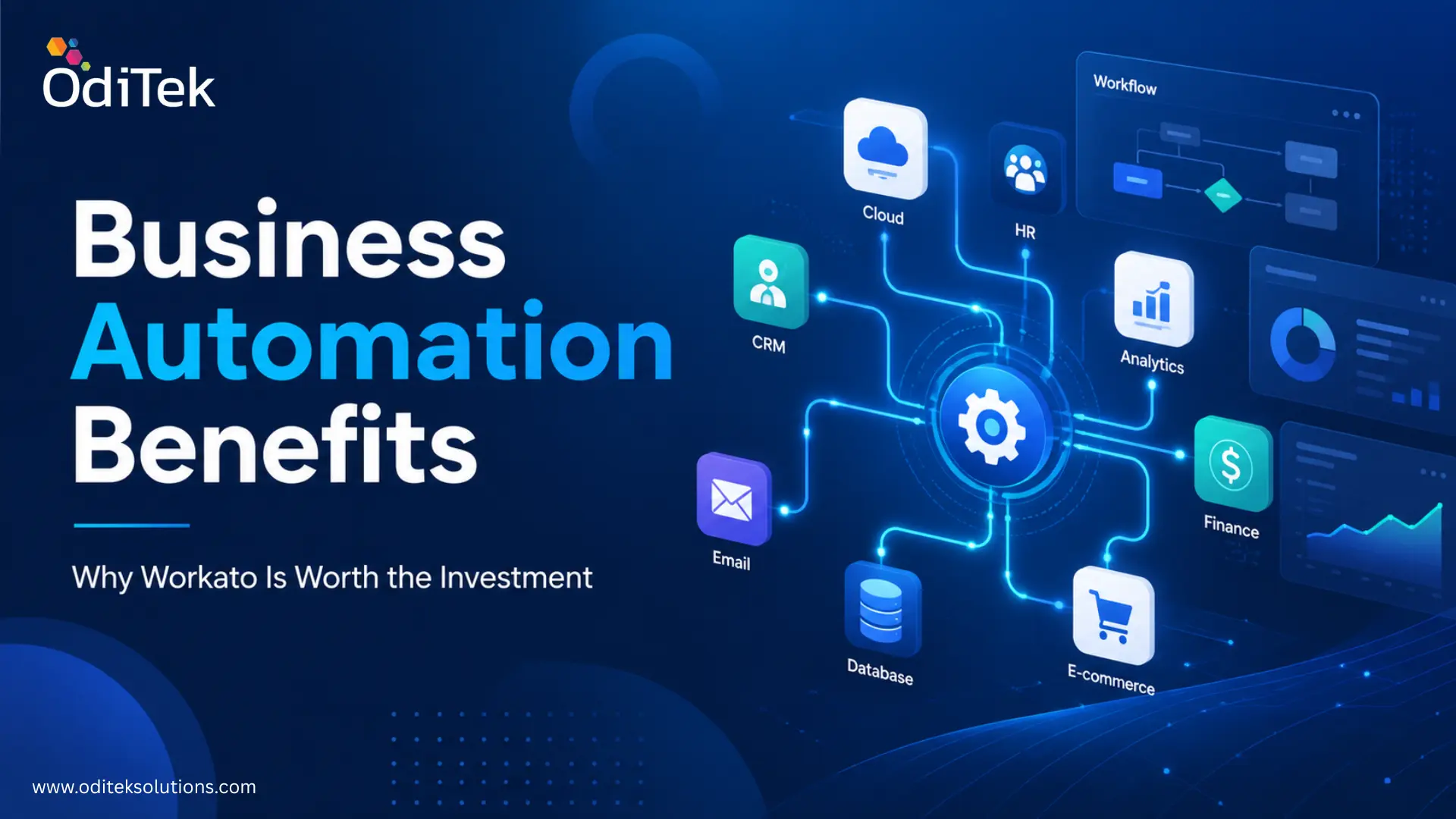
Automation has become more than just a way to save time, it’s now a key driver of business growth. As organizations manage increasing amounts of data, applications, and workflows, manual processes often slow operations, increase costs, and create room for errors. Understanding the business automation benefits of a modern integration platform can help companies make smarter technology investments.
Workato is designed to connect applications, automate repetitive tasks, and streamline business processes without requiring extensive development effort. In this article, we’ll explore how automation improves return on investment (ROI), where businesses see the biggest gains, and why Workato continues to be a valuable solution for organizations looking to scale efficiently.
Understanding ROI in Business Automation
Return on investment (ROI) measures the value a business gains compared to what it spends. When it comes to automation, ROI isn’t limited to financial savings—it also includes increased productivity, improved accuracy, faster operations, and better customer experiences.
Instead of focusing only on reducing expenses, businesses should evaluate how automation improves overall performance. Time saved on repetitive work allows employees to focus on innovation, customer service, and strategic decision-making.
Beyond Direct Cost Savings
Many organizations initially adopt automation to reduce manual labor. However, the long-term value often comes from:
• Faster business processes
• Reduced operational errors
• Improved compliance
• Better collaboration across departments
• Increased scalability without significantly expanding the workforce
These improvements collectively create measurable business value over time.
Key Business Automation Benefits with Workato
Automation delivers the greatest impact when it connects systems that previously operated independently. Workato enables organizations to automate workflows across cloud and on-premise applications using a low-code approach, making enterprise automation accessible to both technical and business teams.
1. Reduced Manual Work
Employees often spend hours transferring information between CRM systems, ERP platforms, finance software, HR tools, and communication apps. Workato automates these repetitive tasks, allowing teams to focus on work that requires human expertise.
2. Improved Data Accuracy
Manual data entry increases the likelihood of mistakes that can affect reporting, customer records, and financial operations. Automated workflows ensure information is transferred consistently between systems, reducing costly errors.
3. Faster Business Processes
Automation removes unnecessary delays by triggering actions instantly. For example, when a customer submits an order, Workato can automatically update inventory, notify the finance team, generate invoices, and inform customer support—all within seconds.
4. Scalable Operations
As businesses grow, manual processes become harder to manage. Workato allows organizations to automate increasing workloads without proportionally increasing staffing costs, making growth more sustainable.
How Workato Improves Productivity Across Teams
One of the biggest contributors to ROI is improved employee efficiency. Instead of switching between multiple applications or completing repetitive administrative work, teams can spend more time on activities that directly contribute to business success.
The result is significant Workato productivity improvements across departments.
1. Sales Teams
Sales representatives can automatically sync leads from marketing platforms into CRM systems, receive instant notifications, and trigger follow-up activities without manual intervention.
2. Human Resources
HR departments can automate employee onboarding by creating accounts, assigning equipment requests, sending welcome emails, and updating payroll systems from a single workflow.
3. Finance
Finance teams can automate invoice approvals, payment notifications, expense processing, and reporting, reducing administrative effort while maintaining accuracy.
4. Customer Support
Support teams benefit from automated ticket routing, customer notifications, and system updates that help resolve issues faster while maintaining consistent communication.
How Workato Reduces Operational Costs
One of the most common questions organizations ask is, How does Workato reduce costs? The answer lies in eliminating repetitive work, minimizing human error, and optimizing resource utilization.
Instead of hiring additional staff to manage increasing workloads, businesses can automate routine operations while maintaining service quality.
1. Lower Labor Costs
Automation reduces the number of hours employees spend on repetitive administrative tasks, allowing existing teams to handle higher workloads more efficiently.
2. Reduced Error-Related Expenses
Incorrect data entries often result in delayed orders, compliance issues, or customer dissatisfaction. Automated workflows reduce these risks by ensuring data moves accurately between systems.
3. Lower Integration Maintenance
Traditional custom integrations often require ongoing maintenance whenever applications change. Workato’s low-code architecture simplifies updates and reduces long-term maintenance costs.
These improvements contribute directly to Workato cost savings, helping businesses achieve greater efficiency while controlling operational expenses.
Business Benefits That Deliver Long-Term ROI
While immediate savings are valuable, sustainable ROI comes from continuous operational improvements. Automation creates long-term advantages that extend beyond individual workflows.
Some of the most impactful benefits include:
• Increased employee productivity by eliminating repetitive manual work.
• Faster decision-making through real-time data synchronization.
• Improved customer experiences with quicker response times.
• Better compliance through standardized workflows and audit trails.
• Easier scalability without major infrastructure changes.
• Reduced operational bottlenecks across departments.
• More accurate reporting for strategic planning.
• Greater collaboration through connected business applications.
These practical improvements help organizations build more resilient operations while creating measurable business value year after year.
Real-World Use Cases of Workato Automation
Businesses across industries use Workato to solve everyday operational challenges while improving efficiency and customer experiences.
Retail and E-commerce
Retail businesses automate inventory updates, order processing, shipping notifications, and customer communications across multiple platforms. This reduces fulfillment delays and improves customer satisfaction.
1. Healthcare
Healthcare organizations streamline appointment scheduling, patient record synchronization, billing workflows, and communication between clinical and administrative systems while supporting data accuracy.
2. Financial Services
Banks and financial institutions automate compliance reporting, customer onboarding, document approvals, and transaction notifications to improve operational efficiency while reducing manual processing.
3. Human Resources
Organizations simplify hiring and onboarding by automatically creating employee accounts, provisioning software access, generating onboarding tasks, and keeping HR systems synchronized.
4. IT Operations
IT teams automate user provisioning, incident management, application monitoring, and service desk workflows, reducing response times while improving service reliability.
How Oditek Solutions Helps Businesses Maximize Workato ROI
Implementing an automation platform is only part of the journey. To achieve lasting ROI, businesses need well-designed workflows, seamless integrations, and a strategy that aligns with their operational goals. This is where Oditek Solutions adds value.
Oditek Solutions helps organizations implement and optimize Workato integrations that connect business-critical applications, automate repetitive processes, and improve data flow across departments. Whether you’re integrating CRM, ERP, HR, finance, or customer support systems, the focus is on building scalable automation that delivers measurable business outcomes.
Rather than replacing existing software, Workato works alongside your current technology stack to eliminate manual work and improve collaboration between systems. With the right implementation approach, businesses can reduce operational complexity while creating workflows that support future growth.
Conclusion
Investing in automation is no longer just about reducing manual work—it’s about building a smarter, more efficient business. From improved productivity and lower operational costs to better data accuracy and faster decision-making, the business automation benefits of Workato extend across every department.
Organizations that embrace automation today are better positioned to scale, adapt to changing business needs, and deliver exceptional customer experiences. By implementing the right automation strategy, businesses can achieve stronger ROI while creating a foundation for long-term growth.
If you’re looking to improve operational efficiency with intelligent automation, explore Oditek Solutions’ Workato Integration services to discover how connected workflows can help your business scale with confidence.
Frequently Asked Questions
1. Is Workato worth the investment?
Yes. For organizations managing multiple applications and repetitive workflows, Workato helps reduce manual effort, improve accuracy, and increase operational efficiency, making it a worthwhile long-term investment.
2. What are the main business automation benefits of Workato?
The primary business automation benefits include reduced manual tasks, improved productivity, fewer data errors, faster workflows, better collaboration between systems, and easier scalability as the business grows.
3. How does Workato reduce costs?
Workato reduces costs by automating repetitive processes, minimizing manual errors, lowering integration maintenance efforts, and enabling employees to focus on higher-value work instead of routine administrative tasks.
4. How does automation improve business ROI?
Automation improves business ROI by increasing employee productivity, shortening process completion times, reducing operational expenses, improving data quality, and enabling faster, more informed business decisions.
5. Can Workato integrate with existing business applications?
Yes. Workato supports integrations with hundreds of popular business applications, including CRM, ERP, HR, finance, marketing, and collaboration platforms, allowing organizations to automate workflows without replacing existing systems.
6. Which businesses benefit the most from Workato?
Organizations in industries such as healthcare, retail, finance, manufacturing, logistics, and technology benefit significantly from Workato because they often manage multiple applications and complex workflows that require seamless automation.