Every click on an eCommerce website tells a story. A customer lands on a homepage, explores a category, reads a buying guide, compares products, and eventually decides whether to make a purchase. Behind this seemingly effortless journey lies a combination of compelling content, accurate product information, and seamless commerce. When these elements operate in isolation, businesses often struggle with inconsistent experiences, slower campaign execution, and missed conversion opportunities.
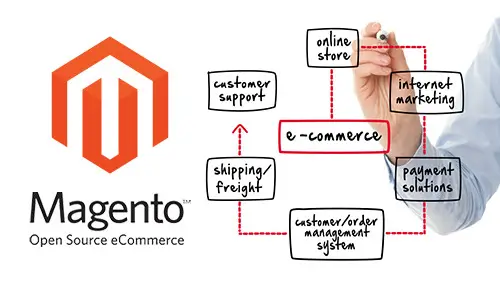
Magento CMS brings these essential elements together within a unified ecosystem. As a core capability of Magento Commerce, it enables businesses to manage engaging content, dynamic product experiences, and promotional campaigns without switching between multiple platforms. By connecting content with commerce, organizations can simplify operations, strengthen customer engagement, and build digital experiences that support long-term business growth.
What is Magento CMS?
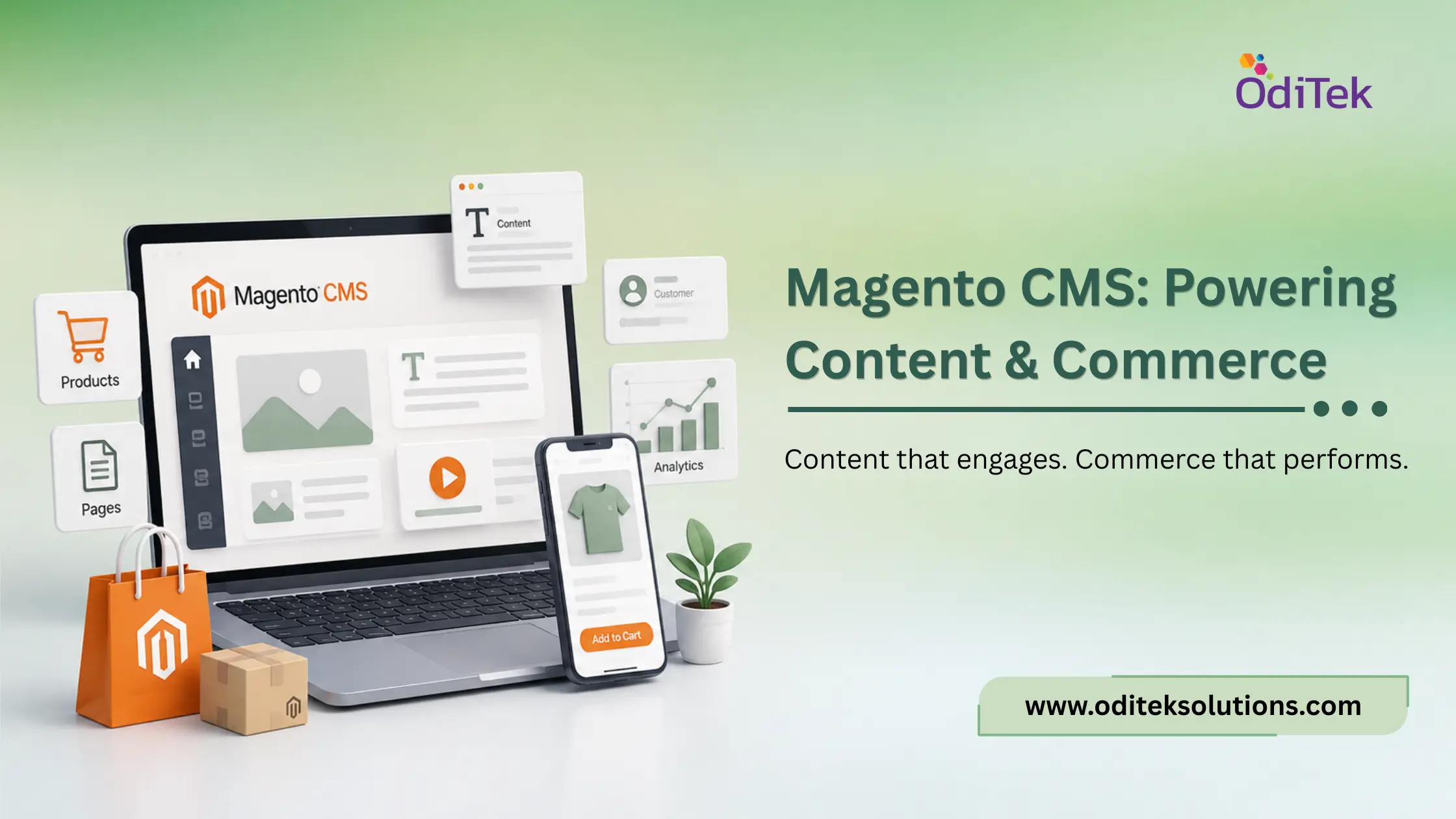
Magento CMS is the built-in content management capability of Magento Commerce that allows businesses to create and manage web pages, landing pages, banners, content blocks, product information, and promotional campaigns—all from the same platform that powers their online store.
Unlike traditional content management systems that require separate integrations for eCommerce, Magento CMS keeps everything connected. Marketing teams can launch campaigns, merchandising teams can update products, and developers can customize functionality without relying on multiple disconnected systems.
Some of the core capabilities include:
• Content pages and landing page management
• Dynamic content blocks and widgets
• Product catalogue integration
• Customer segmentation and personalization
• Multi-store and multi-language support
• SEO-friendly content management
• Integration with third-party business applications
This unified approach reduces operational complexity while ensuring every customer interaction remains consistent.
How does Magento unify content commerce and customer experiences?
One of the biggest advantages of Magento Commerce is its ability to bring marketing, merchandising, and customer engagement together on a single platform.
Rather than maintaining separate systems for content, product management, and promotions, businesses can manage everything from one centralized dashboard. This allows different teams to work collaboratively while ensuring customers receive a consistent experience across every touchpoint.
Here’s how Magento CMS achieves this:
• Centralized content management for pages, banners, and promotions
• Integrated product catalogue connected directly with content
• Customer segmentation for personalized shopping experiences
• Targeted promotions based on customer behaviour
• Consistent branding across multiple websites and storefronts
• Real-time content updates without disrupting the shopping experience
By connecting content with commerce, businesses can reduce operational silos while delivering more relevant customer experiences.
What Are the Benefits of Using Magento as an Enterprise CMS?
For enterprise organizations, content plays a strategic role in driving customer engagement and revenue.
The platform offers several advantages beyond traditional content management.
Centralized Operations
Managing products, content, promotions, and customer experiences from one platform improves collaboration and reduces administrative effort.
Personalized Experiences
Magento Commerce enables businesses to deliver personalized content and product recommendations based on customer behaviour, purchase history, and audience segmentation.
Multi-Store Management
Businesses operating multiple brands or regional websites can manage them through a single dashboard while maintaining unique catalogues, pricing, and localized content.
Enterprise Flexibility
Whether serving B2B buyers, distributors, wholesalers, or retailers, Magento CMS supports complex business requirements through extensive customization and integrations.
Marketing Agility
Marketing teams can create landing pages, promotional campaigns, seasonal offers, and content updates without depending on lengthy development cycles.
Strong SEO Capabilities
The platform supports search visibility through features such as:
• Custom URLs
• Meta titles and descriptions
• XML sitemaps
• Canonical tags
• Structured content organization
• Mobile-friendly experiences
These capabilities make Magento CMS a reliable choice for organizations looking to strengthen both customer engagement and operational efficiency.
Magento eCommerce Solutions That Grow with Your Business
Every business has unique operational needs. A retailer may prioritize personalized shopping experiences, while a manufacturer may require ERP integration and customer-specific pricing. Choosing the right platform means selecting one that adapts to these evolving requirements.
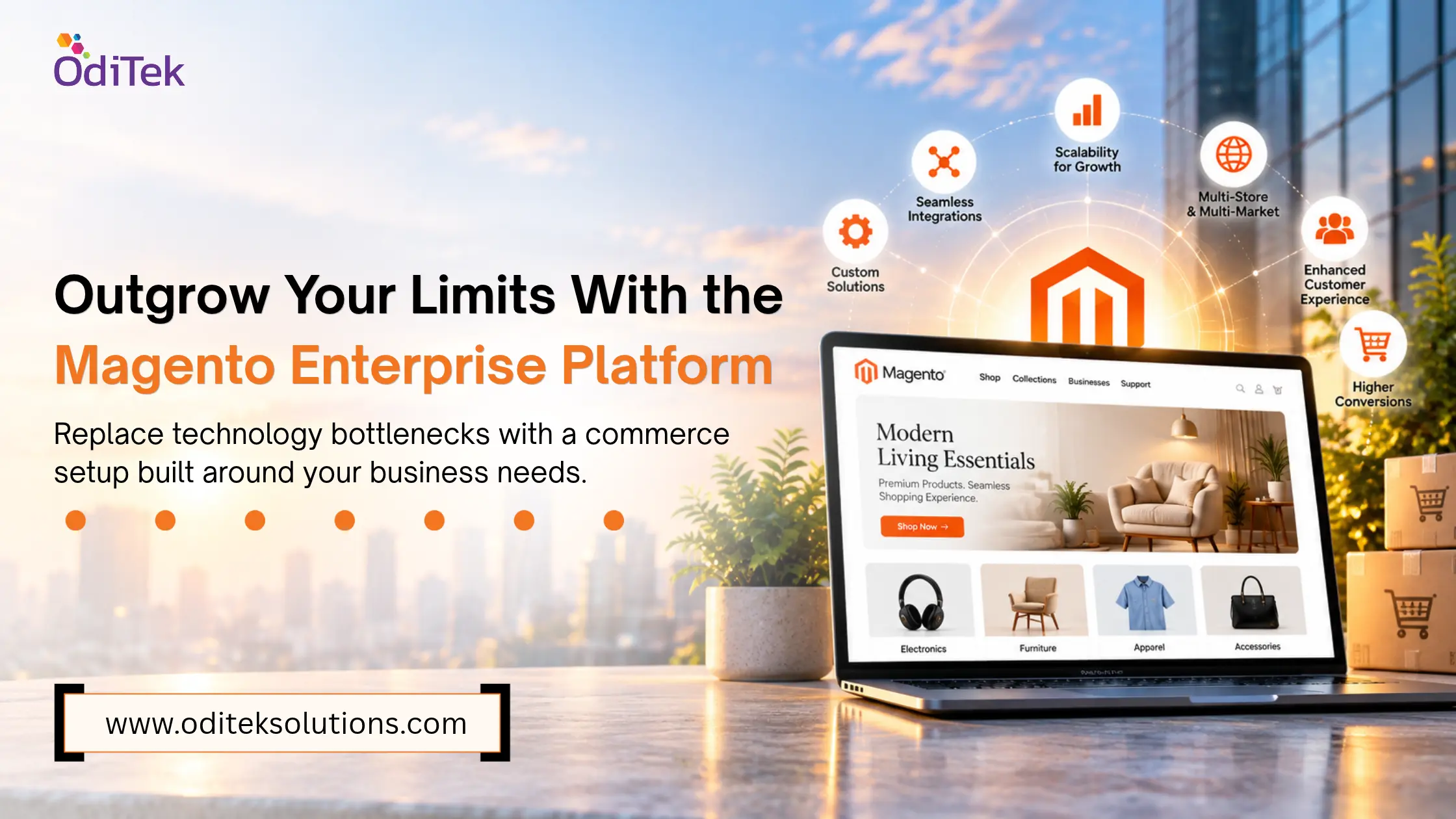
This is where Magento ecommerce solutions stand out. Their flexibility allows businesses to build tailored commerce experiences without compromising performance or scalability.
Organizations commonly use Magento ecommerce solutions for:
• B2B Commerce
• Retail eCommerce
• Wholesale Distribution
• Manufacturing
• Healthcare
• Fashion and Lifestyle
• Consumer Electronics
• Multi-brand Commerce
Beyond industry-specific use cases, Magento integrates with payment gateways, CRM platforms, ERP systems, inventory management software, and marketing automation tools, creating a connected digital ecosystem instead of isolated business applications.
Best Practices for Maximizing Magento CMS
Implementing Magento CMS is only the beginning. To maximize its value, businesses should adopt strategies that improve both customer experience and operational efficiency.
Some recommended best practices include:
• Create content that supports every stage of the buying journey.
• Keep product information accurate and regularly updated.
• Build dedicated landing pages for campaigns and promotions.
• Personalize experiences for different customer segments.
• Optimize pages for SEO and mobile performance.
• Monitor customer behaviour to refine content strategies.
• Integrate third-party business systems for streamlined operations.
These practices help businesses deliver more meaningful customer experiences while making content management more efficient.
Why Choose OdiTek?
A successful Magento Commerce implementation requires more than technical expertise—it requires an understanding of how content, commerce, and business operations work together.
At OdiTek, we help businesses build high-performing Magento ecommerce solutions that align with their long-term digital strategy. From custom development and Adobe Commerce implementation to ERP integrations, migration services, performance optimization, and ongoing support, our team delivers solutions tailored to your business goals.
Our Magento expertise includes:
• Magento Website Development
• Adobe Commerce Development
• Custom Module Development
• Theme Customization
• Third-Party Integrations
• ERP & CRM Integration
• Migration to Magento
• Performance Optimization
• Maintenance & Technical Support
Whether you’re launching a new online store or modernizing an existing one, OdiTek helps you unlock the full potential of Magento CMS with secure, flexible, and future-ready commerce solutions.
Conclusion
Content and commerce are no longer independent functions—they work together to influence every stage of the customer journey. Businesses that manage them through a unified platform are better equipped to deliver consistent experiences, respond quickly to market changes, and create meaningful interactions that drive long-term customer loyalty.
Magento CMS brings this vision to life by combining content management with powerful commerce capabilities, enabling organizations to build digital experiences that are as efficient behind the scenes as they are engaging for customers. As businesses continue to invest in digital transformation, choosing a platform that connects every touchpoint becomes a strategic advantage rather than just a technology decision.
To learn more about our Magento development services, visit our Magento Skill page.
Contact us today to build a scalable Magento eCommerce solution that drives growth and delivers exceptional customer experiences.
Frequently asked Questions (FAQs)
1. How is Magento CMS different from a traditional CMS?
Magento CMS combines content management with built-in eCommerce capabilities, allowing businesses to manage content, products, and customer experiences from a single platform.
2. Can Magento CMS support multiple websites?
Yes. Magento supports multi-store management, enabling businesses to manage multiple websites, brands, languages, and currencies from one admin panel.
3. Does Magento integrate with third-party systems?
Yes. Magento integrates with ERP, CRM, payment gateways, shipping providers, marketing automation tools, and other business applications.
4. Is Magento CMS suitable for large product catalogues?
Absolutely. Magento is built to handle extensive product catalogues, complex product structures, and enterprise-level inventory management.
5. Can Magento CMS be customized for specific business needs?
Yes. Magento offers extensive customization options, allowing businesses to tailor features, workflows, themes, and integrations to their requirements.
6. Why choose OdiTek for Magento development?
OdiTek provides end-to-end Magento services, including consulting, custom development, integrations, migration, optimization, and ongoing support to build high-performing eCommerce solutions.