
An ecommerce website has a direct influence on how customers discover products, evaluate their options, and complete purchases. A slow page, confusing navigation, or complicated checkout can interrupt that journey and affect business results. At the same time, customers increasingly expect relevant experiences, convenient shopping, and consistent interactions across devices.
This makes the development approach behind an ecommerce website an important business consideration. Magento web development brings together storefront functionality, performance, user experience, integrations, and customization to create an online store that meets both customer expectations and business requirements.
For Magento businesses, the focus is not simply on launching a functional website. It is about creating an ecommerce experience where technical performance supports easier shopping, better conversions, and stronger customer relationships.
How Magento Web Development Builds a Strong Ecommerce Foundation
A reliable Magento store starts with a well-structured technical foundation. The website needs to efficiently manage products, customer activity, transactions, integrations, and content while maintaining consistent performance.
A strong Magento web development approach can address:
• Website architecture and code structure
• Product and category organization
• Database and caching performance
• Extension selection and configuration
• Third-party integrations
• Image and media optimization
• Mobile responsiveness
• Security and maintenance
During Magento site development, these areas should be planned around the business requirements rather than treated as separate technical components. A structured foundation also makes future updates and improvements easier to manage.
How can Magento improve the product discovery experience?
Product discovery has a direct influence on customer engagement. When shoppers can quickly find relevant products and compare their options, they can move through the buying journey with less friction.
Magento provides functionality that can support effective product discovery, including:
• Advanced product search
• Category and subcategory navigation
• Product filters and attributes
• Related product recommendations
• Recently viewed products
• Product comparison
The effectiveness of these features depends on how they are implemented. Search results should be relevant, filters should reflect customer needs, and categories should follow a logical structure.
Effective Magento site development can organize these elements around customer behaviour, making it easier for visitors to move from browsing to product evaluation.
How can businesses optimize Magento websites for higher conversions?
Conversion optimization focuses on removing obstacles that can prevent customers from completing a purchase. Even when visitors find the right product, unclear information or a complicated checkout can lead to abandonment.
Businesses can improve the buying journey through:
Product pages: Present pricing, specifications, images, availability, reviews, and calls to action clearly.
Navigation: Use logical menus and categories to help visitors reach relevant products quickly.
Checkout: Reduce unnecessary steps and make delivery costs, payment methods, and order information easy to understand.
Trust elements: Display reviews, return policies, shipping information, and payment details clearly.
Mobile experience: Ensure product pages, buttons, forms, navigation, and checkout work smoothly across mobile devices.
These elements are important parts of Magento web development because technical functionality and customer experience need to work together to support conversions.
Improving Magento Website Performance
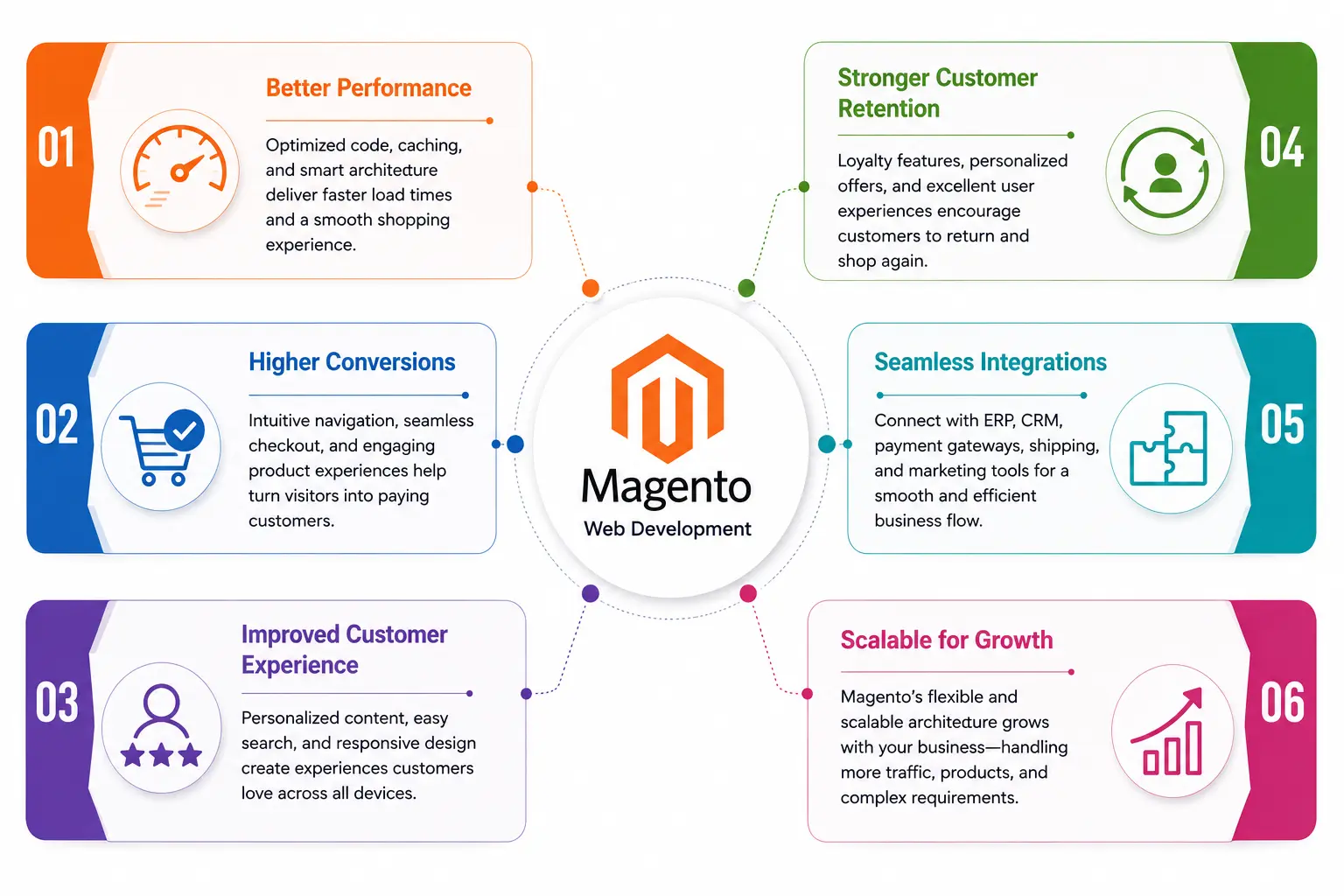
Website speed affects how customers browse products and interact with an ecommerce store. Delays during searches, filtering, cart updates, or checkout can interrupt the buying journey.
Performance improvements can include:
• Optimizing product images
• Reducing unnecessary scripts and code
• Reviewing extensions and third-party modules
• Improving caching
• Optimizing database performance
• Addressing inefficient custom functionality
• Improving mobile loading times
Extension management is especially important. While extensions can add useful functionality, unnecessary or poorly configured extensions can increase complexity and affect performance.
Experienced Magento website developers can review the technical environment and identify opportunities to improve performance while maintaining essential functionality.
Using Magento to Encourage Customer Retention
The customer experience after the first purchase can influence whether shoppers return. Convenience, personalization, and easy access to previous interactions can make future purchases more valuable.
Magento can support retention through:
• Customer accounts and order history
• Personalized product recommendations
• Related product suggestions
• Reorder functionality
• Relevant promotions
• Personalized shopping experiences
• Consistent experiences across devices
Businesses can also integrate Magento with CRM, ERP, marketing, payment, and other systems. These connections can create a more consistent customer journey while helping internal teams manage information more efficiently.
A thoughtful Magento site development strategy can ensure these integrations work effectively with the storefront and support wider business processes.
Making Mobile Commerce Part of the Development Strategy
Mobile commerce needs to be considered throughout the development process. Customers should be able to search, browse, compare, add products to their cart, and complete purchases comfortably from their smartphones.
Important areas include:
• Responsive layouts
• Simple navigation
• Fast-loading pages
• Touch-friendly controls
• Readable product information
• Easy search and filtering
• Convenient checkout forms
Mobile optimization is closely connected to both performance and conversions. Even a visually responsive website can create problems if pages load slowly or customers need to navigate through too many steps.
Magento site development should therefore consider mobile usability alongside the wider performance and conversion strategy.
Choosing the Right Magento Website Developers
The quality of implementation can have a significant effect on the final ecommerce experience. The right Magento website developers can help businesses make informed decisions about architecture, custom functionality, integrations, extensions, performance, and maintenance.
When choosing a development partner, businesses should consider:
• Experience with Magento ecommerce projects
• Understanding of ecommerce user experience
• Performance optimization capabilities
• Custom functionality development
• Third-party integration experience
• Security and maintenance practices
• Understanding of business-specific requirements
Experienced Magento website developers should be able to connect technical decisions with business objectives. This means understanding not only how a feature works but also how it contributes to customer experience and ecommerce performance.
The right team can also help businesses prioritize functionality instead of adding features without a clear purpose.
Why Choose OdiTek for Magento Web Development?
OdiTek combines technical expertise with ecommerce development capabilities to help businesses build and improve Magento websites according to their specific requirements.
The team can support:
• Magento website development and customization
• Custom ecommerce functionality
• Third-party integrations
• Performance optimization
• User experience improvements
• Website maintenance and support
OdiTek focuses on understanding business requirements before selecting the appropriate technical approach. This helps align the website with customer expectations, operational needs, and ecommerce objectives.
Final Thoughts
A successful ecommerce website requires more than a collection of features. Performance, product discovery, usability, conversion, and customer retention need to work together throughout the customer journey. A thoughtful Magento web development strategy can bring these areas together, creating an online store that is easier to navigate, more efficient to use, and better positioned to support long-term ecommerce objectives. With the right technical foundation and development expertise, Magento can provide businesses with an ecommerce experience that continues to deliver value as customer expectations and business requirements evolve.
Discover our Magento development expertise and see how we can support your eCommerce goals.
Talk to our team to get started with a Magento solution designed around your business requirements.
Frequently Asked Questions(FAQs)
1. Is Magento suitable for large ecommerce stores?
Yes. Magento can support large product catalogs, multiple product variations, customer accounts, and complex ecommerce requirements while providing flexibility for customization.
2. Can Magento integrate with other business systems?
Yes. Magento can connect with CRM, ERP, payment gateways, shipping platforms, marketing tools, and other third-party systems to create a connected ecommerce environment.
3. Can an existing Magento website be improved?
Yes. Businesses can improve an existing Magento website through targeted updates to performance, design, functionality, navigation, integrations, and checkout without necessarily rebuilding the entire store.
4. How important are Magento extensions?
Extensions can add useful functionality to a Magento store, but they should be selected carefully. Too many or poorly maintained extensions can add complexity and affect website performance.
5. Does Magento support personalized shopping experiences?
Yes. Magento can support personalized experiences through relevant product recommendations, customer information, purchase history, and other customer data.
6. What maintenance does a Magento website need?
Regular maintenance can include security updates, extension updates, performance checks, bug fixes, backups, and compatibility testing to keep the website secure and reliable.