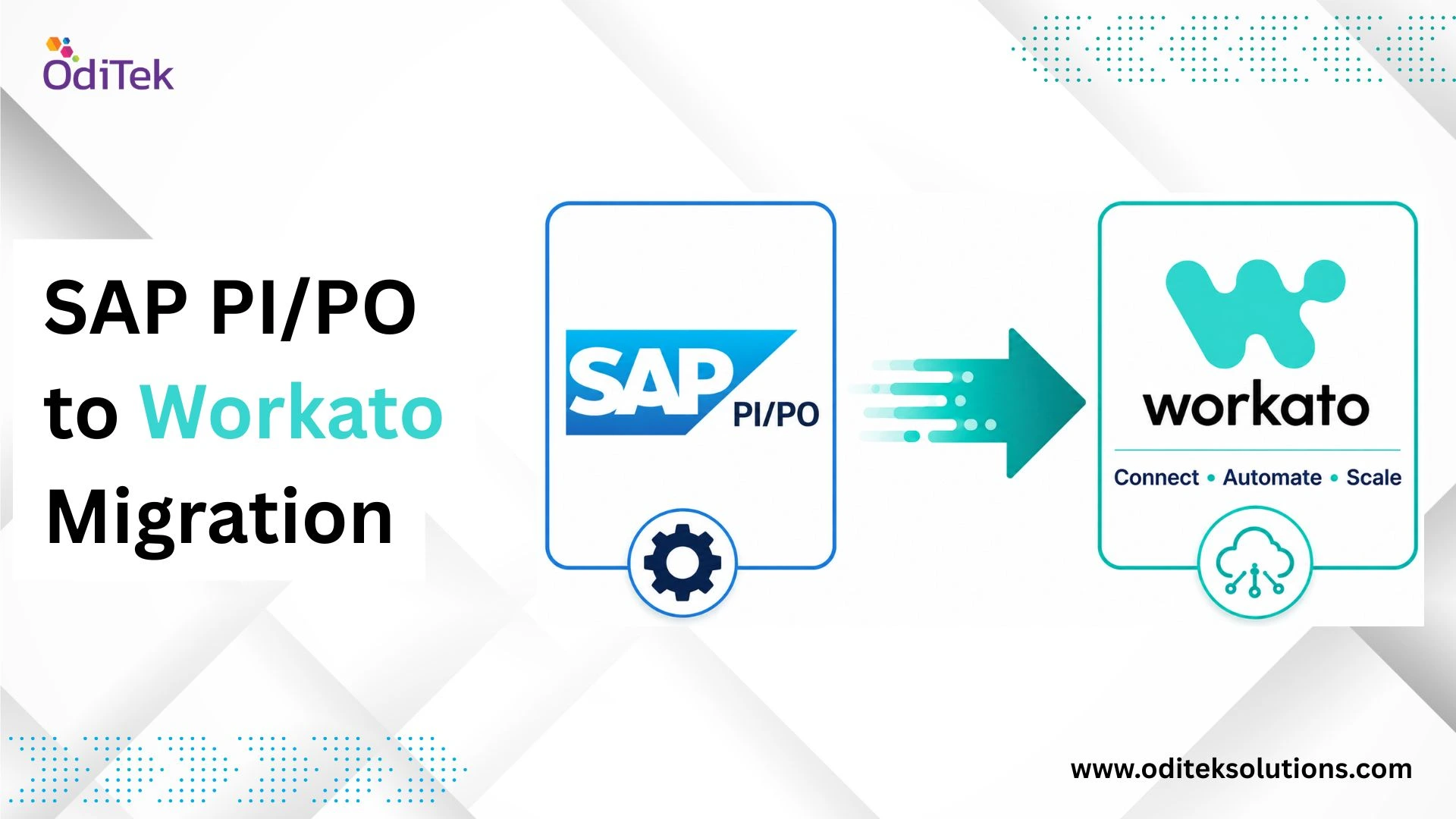
SAP PI/PO to Workato migration is becoming a key modernization initiative for enterprises accelerating their digital transformation journeys. As organizations reassess legacy middleware platforms, many are transitioning from traditional integration architectures to cloud-native, API-driven automation platforms like Workato to improve agility, scalability, and operational efficiency.
SAP Process Integration (PI) and Process Orchestration (PO) have long served as critical components within SAP integration landscapes. However, modern businesses require greater agility, real-time connectivity, API-led integration capabilities, and low-code automation frameworks that can support hybrid and multi-cloud environments.
This is where Workato emerges as a compelling modernization platform.
At OdiTek, we help organizations modernize their integration ecosystems by transforming legacy SAP PI/PO implementations into scalable, cloud-native Workato architectures that support enterprise automation and future growth.
What Is SAP PI/PO Migration to Workato?
SAP PI/PO migration to Workato is the process of transitioning existing integration scenarios, message mappings, orchestration workflows, adapters, and middleware components from SAP PI/PO into Workato’s low-code integration and automation platform.
The objective is not simply to replicate existing interfaces but to redesign integration architectures using modern principles such as:
• API-led connectivity
• Event-driven architecture (EDA)
• Real-time data synchronization
• Cloud-native integration patterns
• Workflow orchestration
• Reusable automation components
Rather than relying on traditional Enterprise Service Bus (ESB) patterns, organizations can leverage Workato to create agile, scalable, and business-driven integrations.
How to Migrate SAP PI/PO to Workato
A successful migration requires a structured modernization roadmap rather than a simple lift-and-shift approach.
Step 1: Integration Landscape Assessment
Begin by analyzing the existing SAP PI/PO environment.
Key assessment areas include:
• Interface inventory
• Message mappings
• Integration flows
• Adapter configurations
• Business process dependencies
• Data transformation logic
This phase helps identify migration complexity and prioritization opportunities.
Step 2: Architecture Rationalization
Before migration, organizations should evaluate whether existing interfaces still provide business value.
Recommended activities include:
• Eliminating redundant interfaces
• Consolidating overlapping integrations
• Identifying modernization opportunities
• Defining API-first integration patterns
This stage significantly reduces migration effort and technical debt.
Step 3: SAP PI/PO to Workato Conversion
The SAP PIPO to Workato conversion phase involves rebuilding integration scenarios using Workato recipes and connectors.
Typical activities include:
• Recreating integration workflows
• Implementing API-based communication
• Designing reusable automation components
• Rebuilding transformation logic
• Configuring SAP connectors and endpoints
Workato’s low-code environment simplifies orchestration while reducing development complexity.
Step 4: Validation and Testing
Comprehensive testing is essential to ensure functional equivalence and data integrity.
Testing activities include:
• End-to-end integration testing
• API validation
• Data reconciliation
• Performance benchmarking
• Error handling verification
Organizations often run parallel environments before production cutover.
Step 5: Production Deployment
After validation, integrations are deployed incrementally to minimize business disruption.
Deployment best practices include:
• Phased migration strategy
• Performance monitoring
• Rollback planning
• Integration observability
• Continuous optimization
What Are the Benefits of SAP PI/PO to Workato Migration?
Organizations migrating to Workato typically realize both technical and operational advantages.
Improved Integration Agility
Workato’s low-code framework enables faster development and deployment compared to traditional middleware platforms.
API-Led Connectivity
Organizations can expose, consume, and orchestrate APIs more efficiently, supporting modern digital initiatives.
Reduced Infrastructure Overhead
Since Workato is cloud-native, organizations eliminate the need for maintaining middleware servers and infrastructure components.
Enhanced Scalability
Workato supports dynamic scaling across enterprise integration workloads and cloud environments.
Faster Time-to-Value
Prebuilt connectors and reusable recipes accelerate implementation and reduce project timelines.
Better Business Process Automation
Workato combines integration and workflow automation capabilities, enabling end-to-end business process orchestration.
Are There SAP PI/PO to Workato Converters?
Many organizations search for SAP PI/PO to Workato converters expecting automated migration tools.
There is no universal one-click converter that can fully migrate SAP PI/PO assets. Critical components such as integration workflows, message mappings, business processes, adapter configurations, custom Java code, and enterprise service definitions typically require manual analysis, redesign, and reconstruction during the migration process.
However, migration accelerators can significantly reduce effort.
At OdiTek, we leverage:
• Migration assessment frameworks
• Interface inventory tools
• Reusable recipe templates
• Integration modernization methodologies
• Best-practice architecture patterns
These accelerators help streamline migration projects while ensuring scalability and maintainability.
Best Practices for SAP PI/PO to Workato Migration
To maximize success, organizations should adopt several key modernization principles.
Recommended Best Practices:
• Prioritize API-first architectures
• Replace batch integrations with event-driven processing
• Design reusable recipes and components
• Implement centralized monitoring and observability
• Establish robust governance frameworks
• Adopt modular integration patterns
• Optimize data transformation logic
• Conduct comprehensive testing before cutover
Following these practices helps reduce risk and improve long-term operational efficiency.
Why Choose OdiTek?
Migrating from SAP PI/PO to Workato requires deep expertise across SAP integration technologies, cloud architecture, APIs, and enterprise automation.
OdiTek’s iPaaS Center of Excellence helps organizations accelerate SAP PI/PO modernization and cloud integration adoption through:
• Migration assessment and modernization planning for SAP PI/PO environments
• Workato implementation and architecture consulting to design scalable integration solutions
• API-led connectivity and governance frameworks for improved agility and control
• Workflow orchestration, monitoring, and managed support services to optimize integration performance and operational efficiency
This enables organizations to modernize legacy middleware, streamline integrations, and accelerate digital transformation initiatives.
Our consultants combine SAP integration expertise with modern iPaaS best practices to deliver scalable, secure, and future-ready integration ecosystems.
Conclusion
SAP PI/PO to Workato migration is more than a technology upgrade—it’s a strategic modernization initiative that enables organizations to transition from traditional middleware architectures to cloud-native integration and automation platforms.
By adopting Workato, enterprises can reduce operational complexity, improve integration agility, accelerate API-led connectivity, and enable intelligent workflow automation across business functions.
With a structured migration roadmap and guidance from OdiTek, organizations can successfully modernize their integration landscape while maximizing scalability, performance, and long-term ROI.
Ready to future-proof your enterprise integrations with Workato? Visit our Workato Skill Page or contact OdiTek today to accelerate your modernization journey.
FAQs
1. What is SAP PI/PO migration to Workato?
It is the process of modernizing existing SAP PI/PO integrations and rebuilding them within Workato’s cloud-native integration and automation platform.
2. How do you migrate SAP PI/PO to Workato?
The process typically includes assessment, architecture rationalization, workflow conversion, testing, and phased production deployment.
3. What are the benefits of SAP PI/PO to Workato migration?
Benefits include reduced infrastructure costs, API-led connectivity, improved scalability, faster deployment, and enhanced business process automation.
4. Is there a direct SAP PI/PO to Workato converter?
No. While migration accelerators exist, there is currently no fully automated converter capable of translating all SAP PI/PO artifacts into Workato.
5. Why are organizations replacing SAP PI/PO?
Organizations seek greater agility, cloud-native scalability, lower maintenance overhead, and stronger support for modern API and SaaS integrations.
6. How long does a SAP PI/PO to Workato migration take?
Migration timelines vary depending on interface complexity, integration volume, transformation logic, and business dependencies.
7. Why choose OdiTek for SAP PI/PO to Workato migration?
OdiTek provides end-to-end migration expertise, Workato implementation services, integration modernization frameworks, and ongoing optimization support.