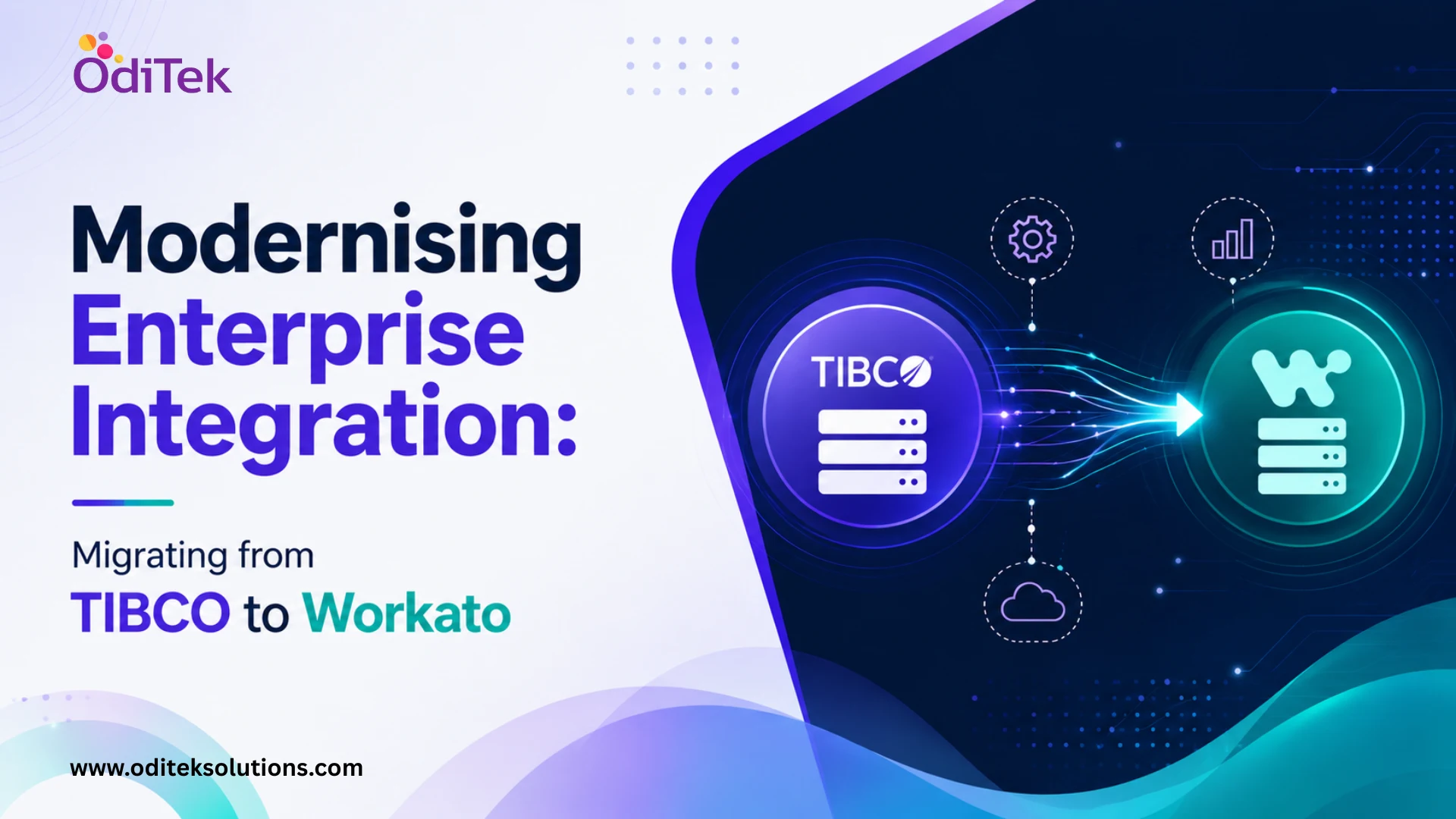
TIBCO to Workato migration is becoming a key priority for enterprises looking to replace legacy integration systems with agile, cloud-native automation platforms that support faster integrations, lower maintenance, and real-time workflow automation.
Traditional platforms like TIBCO have long supported enterprise integration requirements, especially for complex on-premises environments. However, modern businesses require scalable, API-driven, and low-code solutions that adapt quickly to evolving cloud ecosystems.
At OdiTek’s iPaaS Center of Excellence, we help organizations modernize enterprise workflows with streamlined and scalable migration strategies.
Why Organizations Are Moving from TIBCO to Workato?
Modern enterprises are increasingly adopting Workato to support real-time automation, cloud-native scalability, faster deployment cycles, and low-code development. While TIBCO has traditionally been a strong middleware platform, many organizations face several operational and scalability challenges during modernization initiatives:
1. Complex infrastructure management and expensive maintenance costs.
2. Higher dependency on specialized developers.
3. Slower implementation timelines and difficulty scaling integrations quickly.
4. Limited agility for cloud-first environments.
Workato’s cloud-based platform enables faster innovation, simplified automation, and improved business agility, making it the primary driver behind TIBCO to Workato conversion projects.
What is TIBCO to Workato Migration?
Migrate from TIBCO to Workato refers to the process of moving existing TIBCO integrations, workflows, and data processes into Workato’s automation platform.
This migration involves redesigning traditional integration flows into modern Workato recipes that support event-driven and API-based automation.
Instead of relying heavily on scheduled processes and middleware complexity, Workato enables organizations to build lightweight, reusable, and scalable workflows.
Key Difference: TIBCO vs Workato
TIBCO (Traditional Integration Approach)
• Primarily designed for enterprise middleware integrations
• Often dependent on infrastructure setup and management
• Requires specialized development expertise
• Complex workflow orchestration
Workato (Modern Integration Approach)
• Cloud-native and low-code
• Real-time and event-driven automation
• Faster integration development
• Drag-and-drop workflow creation
• Prebuilt connectors for SaaS and enterprise apps
This shift from legacy middleware to modern automation is the primary reason behind the growing demand for tibco to workato conversion projects.
How TIBCO to Workato Migration Typically Works
A structured migration strategy ensures smooth modernization with minimal disruption.
Step 1: Assess Existing Integrations
Identify existing TIBCO workflows, application dependencies, API connections, and data movement patterns to define migration priorities.
Step 2: Identify What Needs Modernization
Not every workflow needs a 1:1 replication. Focus on removing redundant integrations, simplifying complex workflows, and identifying real-time automation opportunities.
Step 3: Rebuild in Workato
During the tibco to workato conversion, recreate integrations using Workato recipes by replacing custom scripts with prebuilt connectors and reusable workflow modules.
Step 4: Testing & Validation
Validate data consistency, workflow accuracy, API reliability, and error handling. Many organizations run parallel systems temporarily before full deployment.
Step 5: Go Live & Optimize
Deploy the workflows, monitor performance, optimize API efficiency, and scale integrations gradually.
Is There a TIBCO to Workato Converter?
Many organizations searching for tibco to workato converters expect a direct, one-click tool that automatically transforms TIBCO workflows into Workato recipes. In reality, there is no fully automated converter available because both platforms follow fundamentally different architectures.
Instead of a magic-button tool, enterprise transitions rely on:
• Reusable migration frameworks and prebuilt integration templates
• Standardized automation patterns and API modernization strategies
• Workflow optimization methodologies and reusable connector configurations
At OdiTek, we utilize these structured methodologies to streamline the transition, reduce manual effort, and ensure long-term integration performance.
Common Modernization Patterns
Organizations modernizing integrations typically adopt these approaches:
Batch to Real-Time Processing
Legacy scheduled jobs are replaced with event-driven automation that triggers instantly.
Monolithic to Modular Workflows
Large TIBCO processes are broken into smaller reusable automations.
Static Data to API-Based Integrations
Manual data exchanges are replaced with live API calls and cloud connectors.
Best Practices for TIBCO to Workato Migration
Successful migrations focus on modernization rather than direct replication.
Recommended Best Practices
1. Simplify workflows during migration
2. Use reusable automation components
3. Prioritize API-led integrations
4. Move toward real-time processing
5. Implement strong monitoring and error handling
6. Validate integrations thoroughly before deployment
Following these best practices for tibco to workato migration helps organizations improve scalability and reduce operational complexity.
What is the Best TIBCO Replacement?
When businesses ask, “what is the best tibco replacement?”, the answer depends on integration goals, scalability needs, and cloud adoption strategies.
Workato stands out because of its:
• Low-code automation capabilities
• Extensive SaaS connectivity
• Enterprise-grade scalability
• AI-powered workflow automation
• Faster deployment cycles
• Strong support for hybrid integrations
For organizations modernizing enterprise automation, Workato provides a future-ready alternative to traditional middleware platforms.
Why Choose OdiTek for Migration?
OdiTek delivers end-to-end expertise for organizations planning to modernize their enterprise integrations and automate workflows through Workato. Our migration approach focuses not just on replacing legacy systems, but on building scalable, cloud-ready integration ecosystems that improve efficiency and long-term business agility.
With extensive experience in enterprise integration modernization, we help businesses simplify complex workflows, reduce migration risks, and accelerate deployment timelines.
Our Capabilities Include:
• Complete migration lifecycle support from assessment to deployment
• Deep expertise in Workato integrations and automation
• Tailored migration strategies aligned with business goals
• Minimal disruption to ongoing operations
• Workflow optimization and post-migration support
• Scalable and reusable integration design approaches
• Real-time automation enablement using APIs and cloud connectors
By combining proven migration methodologies with strong Workato capabilities, OdiTek helps enterprises transition from legacy integration environments to modern cloud-native automation platforms efficiently and securely.
Conclusion
A successful tibco to workato migration is more than just replacing tools—it’s about transforming how your business operates.
By modernizing integrations with Workato and OdiTek, organizations can eliminate infrastructure complexity, accelerate automation initiatives, and build a future-ready enterprise ecosystem.With the right migration strategy and expert guidance, enterprises can successfully modernise legacy integration environments and unlock the full potential of intelligent automation.
Ready to drive integration efficiency? Visit workato skill page, or contact us today to see how OdiTek can accelerate your cloud-native transition.
FAQs
1. What is TIBCO to Workato migration?
TIBCO to Workato migration is the process of transferring legacy TIBCO integrations, middleware workflows, and data processes over to Workato’s cloud-native, low-code automation platform.
2. Why are companies migrating from TIBCO to Workato?
Companies migrate to Workato to eliminate complex on-premise infrastructure management, achieve real-time event-driven automation, reduce dependency on specialized developers, and lower operational costs.
3. Is there a direct TIBCO to Workato converter tool?
No, there is no automated, one-click TIBCO to Workato converter. Because the two platforms use different architectures, migrations are performed using structured migration frameworks, prebuilt templates, and workflow redesigns.
4. How long does a TIBCO to Workato migration take?
The migration timeline depends entirely on the volume of integrations, the complexity of the TIBCO workflow orchestration, and the data validation requirements.
5. What are the benefits of Workato over TIBCO?
Workato provides a cloud-native, low-code environment with thousands of prebuilt SaaS connectors, AI-assisted workflow creation, and rapid deployment cycles that traditional TIBCO middleware cannot match.
6. What are the best practices for TIBCO to Workato migration?
The best practices include simplifying and optimizing workflows during the transition, adopting an API-led integration approach, utilizing reusable recipes, and executing rigorous parallel testing before go-live.