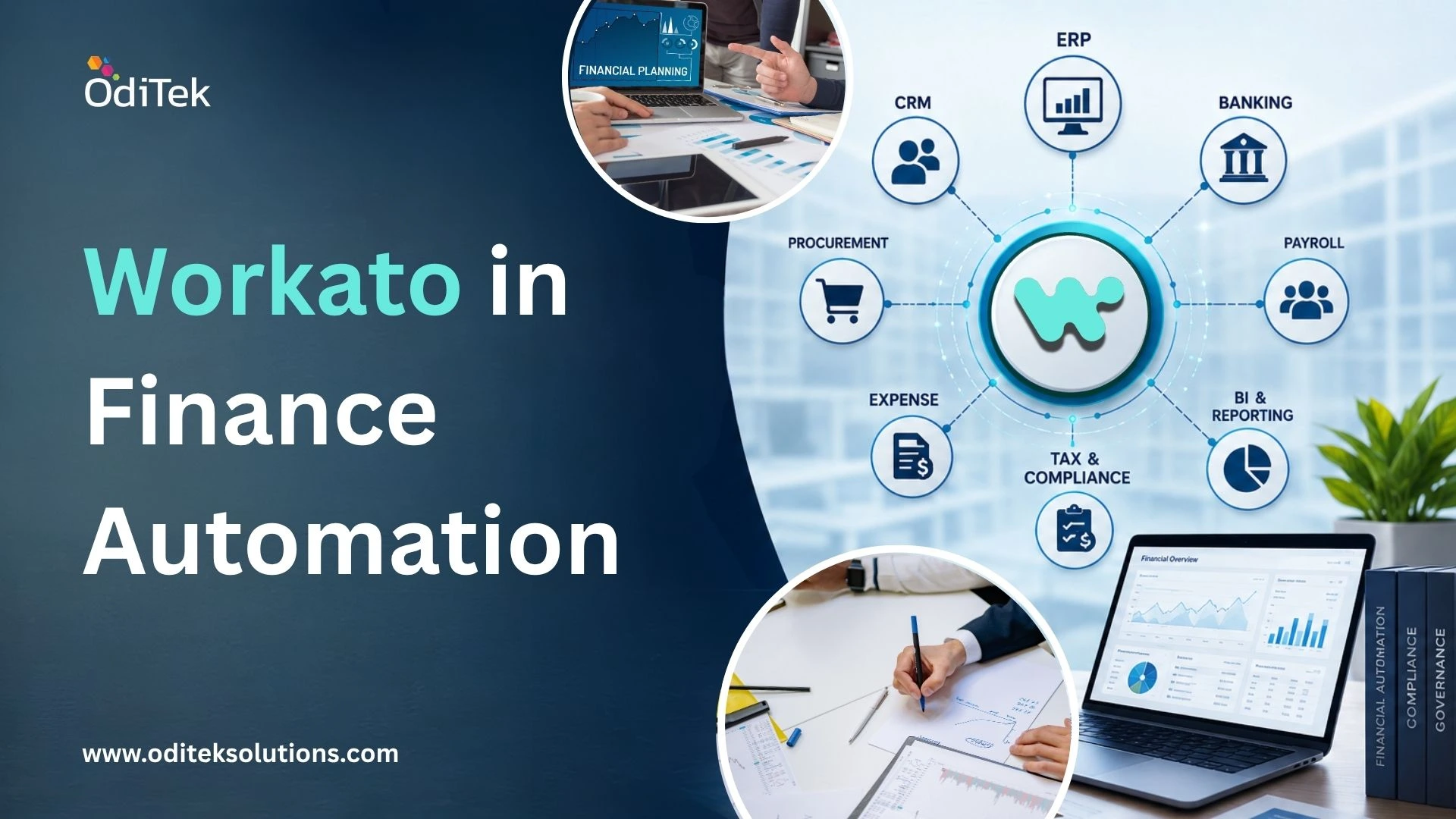
Workato in Finance enables organizations to overcome growing transaction volumes and complex regulatory requirements by integrating disparate systems, automating workflows, and maintaining robust security and compliance across the financial ecosystem.
As finance operations become more complex, Workato helps teams replace manual processes with scalable and efficient automation solutions.
Why Workato Matters in Finance?
Modern finance ecosystems include applications such as ERP, CRM, banking platforms, procurement systems, payroll solutions, tax software, and business intelligence tools. These systems often operate independently, resulting in duplicate data, manual data entry, delayed approvals, and inconsistent reporting.
Workato eliminates these silos through:
• API-first integration architecture
• Pre-built enterprise connectors
• Event-driven workflow automation
• Low-code recipe development
• Secure cloud and hybrid integrations
Instead of scheduling batch jobs, Workato enables real-time synchronization between applications. Changes made in one system automatically trigger actions across connected platforms, ensuring consistent financial data throughout the organization.
How Does Workato Automate Finance Workflows?
Workato uses reusable recipes, connectors, and workflow orchestration to automate critical financial processes, including:
• Invoice and payment processing
• Procure-to-Pay (P2P) and Order-to-Cash (O2C) cycles
• Financial close and reconciliation
• Expense approvals and compliance checks
• Vendor onboarding and master-data synchronization
Automation reduces manual intervention, minimizes errors, and ensures that transactions move seamlessly across systems.
How Does Workato Improve Finance Operations?
Finance departments require timely, accurate, and secure financial information for strategic decision-making. Workato enhances operations by integrating applications and automating business rules across the enterprise.
Key improvements include:
1. Real Time Financial Data Synchronization
ERP, CRM, payroll, procurement, treasury, and banking systems remain continuously synchronized through APIs, ensuring consistent master data across departments.
2. Intelligent Workflow Orchestration
Workato supports conditional branching, approval routing, retry mechanisms, and exception management, enabling organizations to automate even complex financial processes.
3. Master Data Governance
Vendor, customer, chart of accounts, and employee master records remain synchronized across multiple enterprise applications, improving data quality and reducing inconsistencies.
4. Automated Compliance Controls
Finance workflows automatically enforce approval hierarchies, segregation of duties (SoD), validation rules, and policy checks before transactions proceed.
5. Faster Financial Reporting
By eliminating manual reconciliation and data consolidation, finance teams generate accurate reports more quickly while improving forecasting and cash-flow visibility.
Benefits of Workato in Finance
Organizations implementing Workato in Finance achieve measurable improvements across operational efficiency, compliance, and scalability.
1. Reduced Manual Processing
Automation minimizes repetitive administrative tasks, allowing finance professionals to focus on planning, forecasting, and business analysis.
2. Improved Data Accuracy
API-driven synchronization reduces duplicate records, manual entry errors, and reconciliation discrepancies across systems.
3. Faster Financial Close
Automate journal postings, reconciliations, and reporting workflows reduce month-end and year-end closing timelines.
4. Enterprise Scalability
Workato supports cloud, hybrid, and on-premises integrations, allowing organizations to expand automation as business requirements evolve.
5. Better Audit Readiness
Every workflow execution is logged, providing complete traceability for internal governance and regulatory audits.
6. Lower Operational Costs
Reduced manual effort, fewer processing errors, and streamlined workflows lower operational expenses while increasing productivity.
Is Workato Integration Secure for Financial Services?
Security is a critical requirement for finance automation. Workato integration is designed with enterprise-grade security controls that align with financial governance and compliance requirements.
Key security capabilities include:
1. End-to-End Encryption
Financial data is encrypted both in transit using TLS protocols and at rest using strong encryption standards.
2. API Authentication
Secure API communication supports:
• OAuth 2.0
• API Keys
• JWT Authentication
• Mutual TLS
• Token-based authentication
3. Identity and Access Management
Organizations can enforce:
• Role-Based Access Control (RBAC)
• Single Sign-On (SSO)
• Multi-Factor Authentication (MFA)
• Least-Privilege Access
4. Audit Logging
Every API request, workflow execution, approval, and system interaction is recorded for complete operational visibility and compliance reporting.
5. Compliance Support
Workato helps organizations meet enterprise governance requirements by supporting security frameworks, data governance policies, and regulatory compliance initiatives through secure integration practices and comprehensive monitoring.
Oditek’s Expertise in Workato Finance Automation
At Oditek Solutions, we build secure, scalable, and API-driven automation solutions using Workato in Finance. Our Workato specialists design intelligent workflows that integrate enterprise finance applications, automate business processes, and ensure secure data orchestration across your financial ecosystem.
How do we automate invoice and accounts payable workflows?
We build event-driven Workato Recipes that automate invoice ingestion, approval routing, PO matching, and ERP posting using pre-built connectors and REST APIs, eliminating manual intervention and reducing processing time.
How does Oditek integrate ERP, CRM, and finance applications?
Our team develops API-led integrations that synchronize data between ERP, CRM, banking, procurement, and payroll systems using Workato connectors, custom APIs, and real-time data mapping for seamless financial operations.
How do we automate financial reporting and reconciliation?
We orchestrate automated workflows that consolidate financial data, trigger journal entries, perform reconciliations, and deliver real-time reports by integrating multiple finance platforms into a unified automation pipeline.
How do we improve compliance and governance?
Our solutions implement role-based access controls (RBAC), audit logging, exception handling, and workflow governance to ensure secure financial transactions and compliance with enterprise security standards.
How do we build scalable finance automation?
We design reusable Workato Recipes, modular integrations, and API orchestration frameworks that enable organizations to scale automation across finance functions while minimizing maintenance and accelerating deployment.
Conclusion
As finance organizations accelerate digital transformation, disconnected systems and manual workflows can no longer support operational demands. Workato in Finance enables secure API integration, intelligent workflow automation, and real-time data synchronization across the financial ecosystem.
By implementing Workato Finance Automation, businesses can automate procure-to-pay, order-to-cash, financial close, reconciliations, and compliance workflows while improving accuracy, reducing operational costs, and strengthening governance.
With OdiTek Solutions’ expertise in enterprise integration and Workato implementation, organizations can build resilient, scalable, and secure finance operations prepared for future growth.
Transform your finance operations with secure Workato automation, visit our workato integration service page or contact us to get started today.