Businesses rarely rely on a single application anymore. Sales, finance, HR, customer support, marketing, analytics, and operations often run on different platforms. When these systems do not communicate properly, employees end up moving data manually, checking multiple systems, and fixing errors that could have been avoided.
Choosing the right workato integration partner can make a significant difference in how successfully these systems work together. The right partner should understand more than Workato itself. They should understand your business processes, integration architecture, data requirements, security needs, and long-term automation goals.
This guide explains the key things to consider when evaluating a Workato partner and how to identify the capabilities that matter before starting an integration project.
Understand Your Business Requirements First
Before comparing partners, clearly define what you want to achieve. A partner cannot design the right solution if the business problem has not been properly identified.
Start by looking at the processes that currently require manual work. For example, a sales team may manually move customer information from a CRM to an ERP, while the finance team separately updates billing information. These disconnected steps can create delays and duplicate work.
Consider questions such as:
• Which applications need to communicate?
• Which processes are currently manual?
• Does data need to move in real time or on a schedule?
• What security and compliance requirements apply?
• How many workflows need to be automated?
• Will the number of integrations increase over time?
Having clear answers makes it easier to discuss your requirements with potential partners and compare their proposed approaches.
What to Look for in a Workato Integration Partner
Not every integration provider has the same level of experience. Look beyond general claims about automation and examine the specific capabilities a partner can bring to your project.
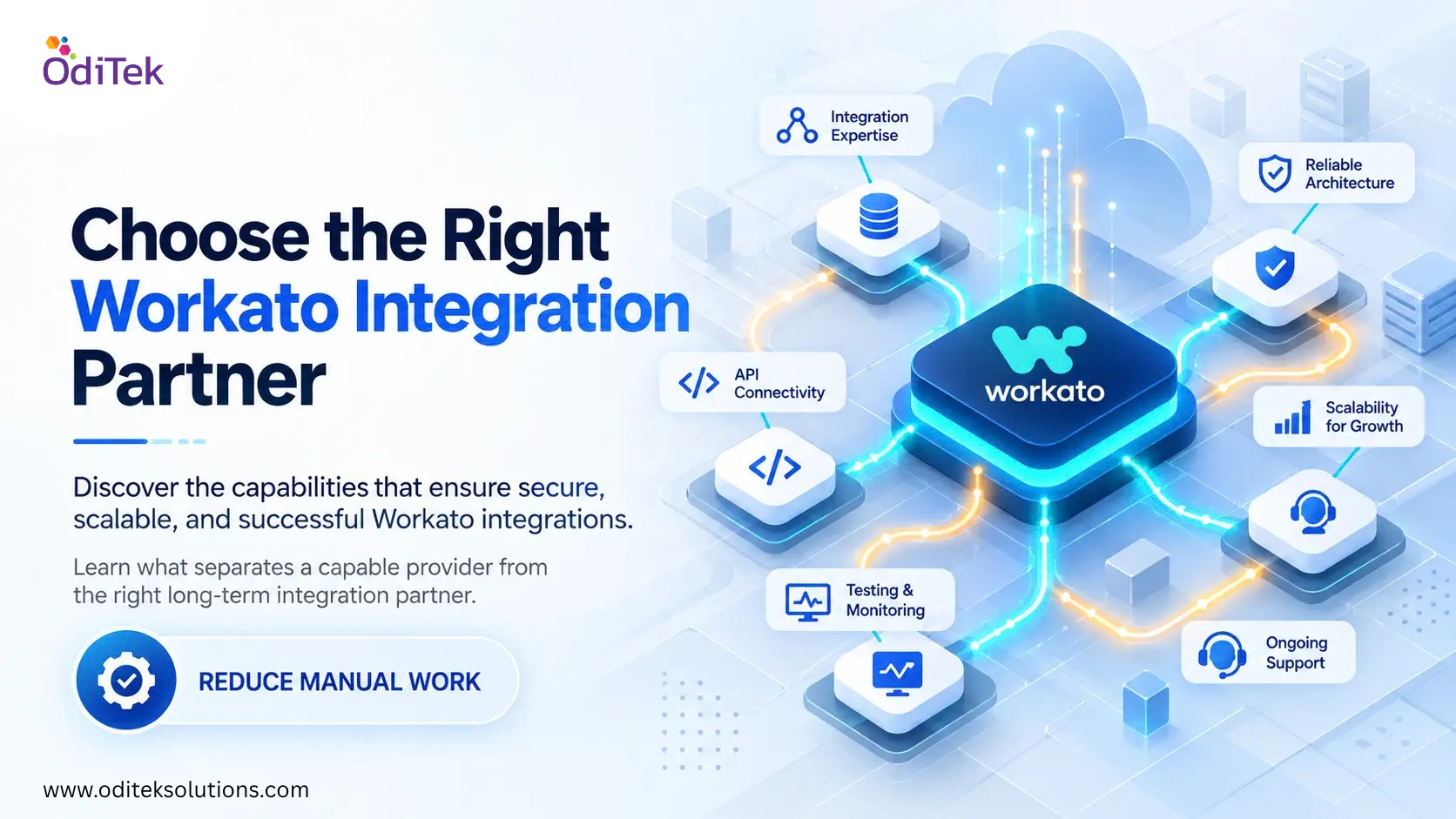
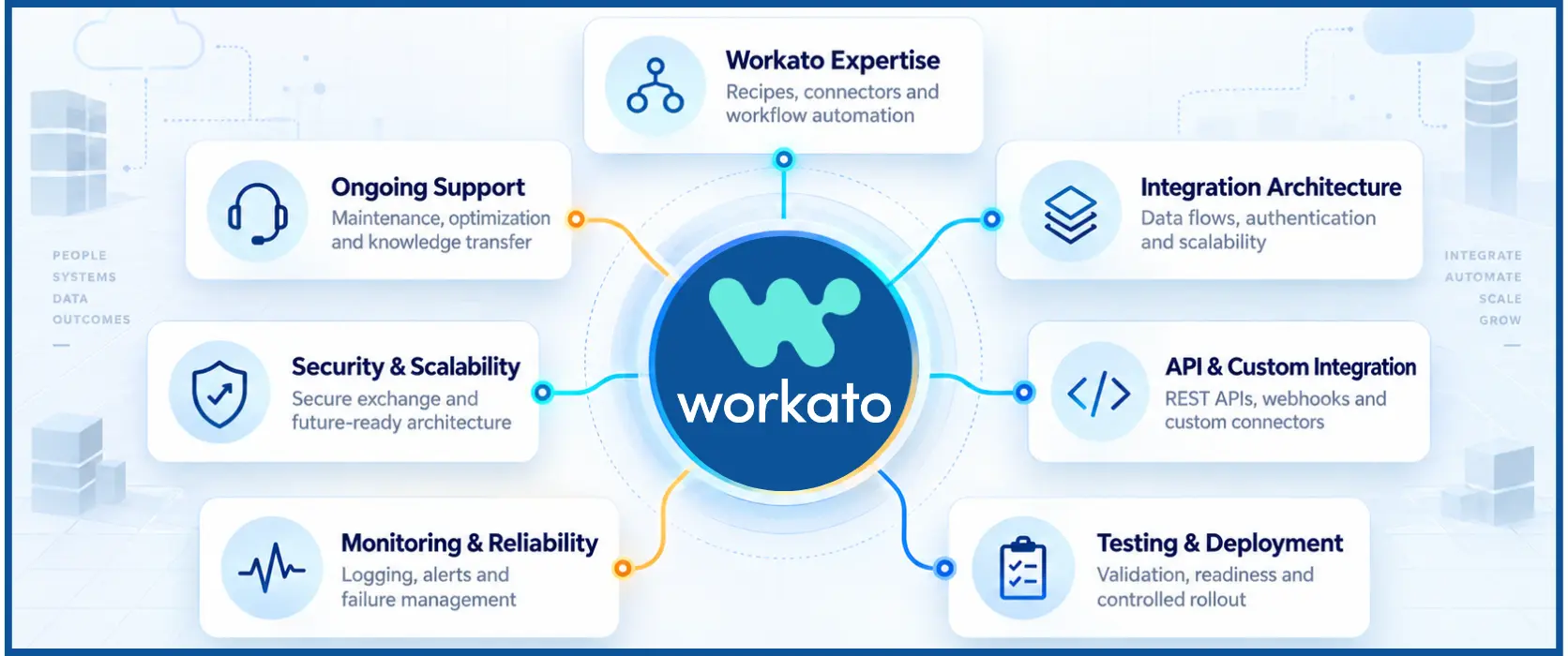
Workato experience Look for practical experience with Workato recipes, connectors, APIs, data transformation, workflow automation, and enterprise applications. A partner should be able to explain how it would approach your requirements rather than simply describe what Workato can do.
Integration architecture knowledge Complex environments require more than individual workflows. The partner should understand integration patterns, system dependencies, data flows, APIs, authentication, error handling, and scalability.
API and custom integration capabilities Pre-built connectors can simplify many integrations, but some business systems require APIs or custom development. Experience with REST APIs, webhooks, custom connectors, and data transformation can become important when standard connectors are not enough.
Testing and monitoring An integration is not finished when the workflow starts running. Testing, error handling, alerts, logging, monitoring, and troubleshooting should be part of the implementation plan.
Long-term support Applications and business processes change over time. Ask whether the partner can provide ongoing maintenance, performance improvements, troubleshooting, and support after deployment.
Why a Workato Consulting Partner Can Add Value
A workato consulting partner can help businesses make decisions before development begins. This can include reviewing the current environment, identifying suitable integration patterns, prioritizing automation opportunities, and defining a practical implementation roadmap.
This planning stage is particularly useful when an organization has many applications or legacy systems. Without a structured approach, businesses can end up creating isolated workflows that solve individual problems but become difficult to manage later.
Good consulting should connect technical decisions with measurable business outcomes. For example, instead of simply recommending an integration between two systems, the partner should explain how that connection can reduce manual data entry, improve process speed, or make information more consistent.
Key Benefits of Choosing the Right Partner
The value of a strong integration partner goes beyond getting workflows deployed. The partner’s technical and implementation approach can influence how reliable and maintainable the environment becomes.
Practical benefits can include:
Higher productivity: Employees spend less time repeating data-entry and system-update tasks.
Better data consistency: Automated data movement can reduce discrepancies between applications.
Faster processes: Event-driven workflows can trigger actions without waiting for manual intervention.
Improved scalability: A well-designed integration architecture can support additional applications and workflows.
Better operational visibility: Monitoring and error handling can help teams identify integration problems.
Lower long-term costs: Reusable workflows and structured architecture can reduce unnecessary maintenance.
The important point is that these benefits depend on how the integrations are designed and managed. Simply connecting applications does not automatically create an efficient business process.
Real-World Use Cases to Discuss With a Partner
A potential partner should be able to relate Workato capabilities to practical business situations.
1. Sales and CRM automation When a deal is closed, customer information can move from the CRM to billing, ERP, customer success, or other systems. Notifications and follow-up tasks can also be triggered automatically.
2. Finance and ERP workflows Businesses can automate processes involving orders, invoices, payments, procurement, and financial data. This can reduce repetitive updates between sales and finance systems.
3. Employee onboarding When a new employee is added to an HR platform, automated workflows can initiate account creation, access requests, collaboration-tool setup, and other onboarding tasks.
4. Customer support Customer information can be synchronized between CRM, support, communication, and service platforms. Support teams can then access relevant information without repeatedly checking separate systems.
5. Data and analytics Operational information can be moved into data warehouses or analytics environments to support reporting and business intelligence. This can reduce reliance on manually consolidated spreadsheets.
When discussing these use cases, ask the partner to explain how the workflow would be designed, monitored, tested, and maintained.
Questions to Ask Before Selecting a Partner
A useful evaluation should go beyond asking whether a company works with Workato. Ask questions that reveal how the partner approaches real projects.
For example:
• What types of Workato integrations have you implemented?
• How do you approach integration architecture and data mapping?
• Can you work with custom APIs and connectors?
• How do you test and monitor production workflows?
• What happens when an automated workflow fails?
• Do you provide post-deployment support?
• How will the solution scale when more applications are added?
• How will project documentation and knowledge transfer be handled?
The answers can help you understand whether a potential partner is prepared for the full lifecycle of an integration project.
What Does a Workato Partner Provide?
The exact scope depends on the project, but a capable Workato partner may provide consulting, architecture, workflow design, development, API integration, data transformation, testing, deployment, monitoring, maintenance, and ongoing support.
A workato technology partner may also help organizations evaluate how Workato fits into a broader integration strategy. The important consideration is whether the partner’s services match your actual requirements rather than whether the provider offers the largest possible list of services.
How to Choose a Workato Integration Partner?
When evaluating providers, look at the complete project lifecycle rather than focusing only on development. The right questions are about experience, architecture, implementation, support, security, scalability, and communication.
You should also consider how clearly the partner explains technical decisions. A strong integration project requires collaboration between business and technical teams, so the provider should be able to explain complex integration concepts in practical business terms.
Building a Long-Term Integration Strategy With OdiTek
Choosing an integration partner is ultimately about finding the right combination of technical expertise, implementation support, and long-term thinking. A successful solution should not only solve today’s integration problem but also provide a foundation for future applications, workflows, and automation initiatives.
OdiTek provides Workato-focused consulting, architecture, implementation, development, design, managed services, support, and maintenance capabilities. Its Workato services cover areas such as workflow automation, data integration, API management, custom integrations, data transformation, testing, monitoring, and ongoing support.
When evaluating a workato integration partner, consider:
Business value: Focus on measurable improvements in productivity, efficiency, and process speed.
Expertise: Look for practical experience with Workato, APIs, automation, data, and enterprise applications.
Implementation support: Confirm that testing, deployment, troubleshooting, and optimization are covered.
Scalability: Make sure the architecture can support additional systems and workflows.
Long-term benefits: Consider monitoring, maintenance, security, and future changes from the beginning.
Looking to connect your business applications and automate complex workflows? Explore OdiTek’s Workato integration capabilities to discuss a secure, scalable, and maintainable approach for your business.
Frequently Asked Questions
1. What does a Workato partner provide?
A Workato partner can provide consulting, integration architecture, workflow development, API integration, testing, deployment, monitoring, maintenance, and ongoing support depending on project requirements.
2. What should I check before hiring a Workato integration partner?
Check their Workato experience, integration architecture skills, API capabilities, testing approach, security practices, scalability planning, and post-deployment support.
3. How to choose a Workato integration partner?
Compare partners based on relevant Workato experience, technical capabilities, understanding of your business processes, implementation approach, communication, and long-term support.
4. When should a business use a Workato consultant?
A consultant can be useful when integrations involve multiple applications, complex workflows, custom APIs, large data volumes, legacy systems, or specific security and architecture requirements.
5. Can Workato automate processes across different departments?
Yes. Workato can coordinate workflows across areas such as sales, finance, HR, customer support, operations, and analytics by connecting the applications used by those teams.
6. Should integration support continue after implementation?
Yes. Ongoing monitoring, troubleshooting, maintenance, testing, and updates can help keep integrations reliable as applications, APIs, and business requirements change.