Workato Licence Cost is often one of the primary evaluation criteria for organizations assessing enterprise integration and automation platforms. As a leading cloud-native Integration Platform as a Service (iPaaS), Workato enables businesses to orchestrate complex workflows, automate cross-functional business processes, and establish seamless connectivity across SaaS applications, on-premises systems, databases, APIs, and enterprise applications through a low-code development environment.
Unlike traditional middleware solutions that typically follow fixed licensing structures, Workato operates on a consumption-based pricing model. Understanding the underlying components of Workato pricing is essential for organizations planning digital transformation initiatives, API-led connectivity strategies, and enterprise-scale automation programs.
What Is the Workato Pricing Model?
To accurately evaluate Workato license cost, organizations must first understand the Workato pricing architecture. Workato utilizes a subscription-based licensing framework that scales according to platform utilization and automation throughput.
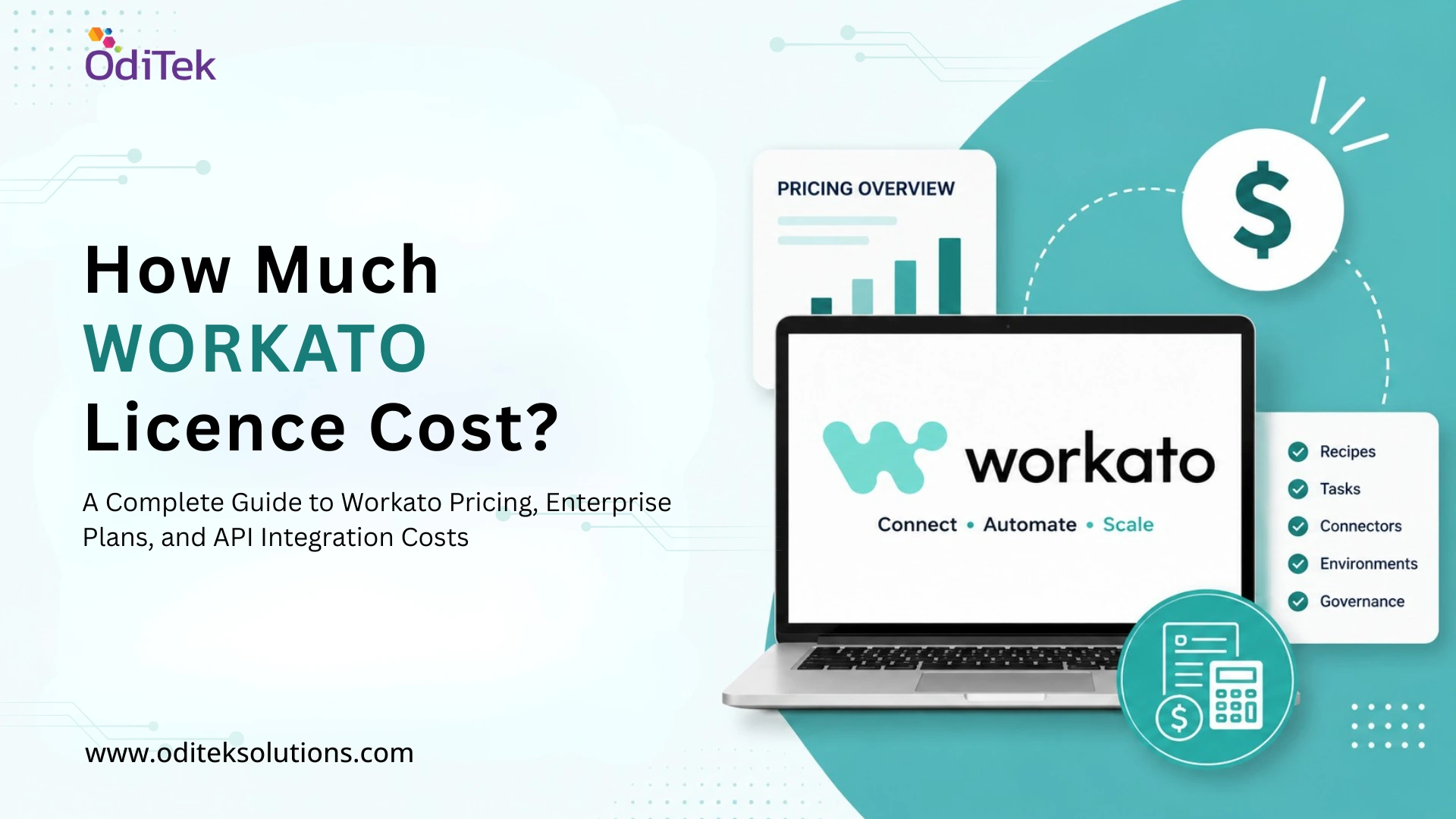
Key pricing variables typically include:
• Number of active recipes (workflow automations)
• Monthly task execution volume
• Connected applications, systems, and endpoints
• Environment provisioning (Development, QA/UAT, Production)
• API transaction volume and integration throughput
• Advanced governance, security, and monitoring requirements
This consumption-driven model allows organizations to align platform costs with actual integration workloads. However, pricing can vary significantly depending on automation complexity, transaction frequency, data processing requirements, and enterprise scalability needs.
How Much Does Workato Cost?
One of the most common questions organizations ask is: How much does Workato cost?
Workato does not publicly disclose standard pricing tiers because most implementations require customized licensing based on integration architecture, workflow complexity, and transaction volumes.
Organizations typically fall into one of the following categories:
• Small Business & Departmental Automation – Designed for teams implementing lightweight workflow automation and limited system integrations.
• Mid-Market Integration Programs – Suitable for businesses managing multiple SaaS applications, API integrations, and cross-departmental process automation.
• Enterprise Automation Ecosystems – Built for large organizations requiring enterprise-scale integrations, high-volume automation, advanced governance, security, and complex multi-system orchestration.
Tailored licensing for organizations requiring enterprise-grade orchestration, large-scale API management, advanced governance controls, and high-volume transaction processing.
Depending on the number of integrations, automation workloads, and operational requirements, Workato platform pricing can range from several thousand dollars annually to significant enterprise-level investments supporting mission-critical integration ecosystems.
Workato Pricing Details: Key Cost Components
Several technical and operational factors influence overall Workato licensing costs.
1.Recipe-Based Pricing
Recipes are Workato’s core automation assets and function as workflow orchestration engines that execute business logic across connected applications.
Licensing considerations often include:
• Conditional logic and branching requirements
• Multi-system integration dependencies
Organizations implementing enterprise-wide automation programs often maintain hundreds of interconnected recipes, increasing overall platform utilization.
2.Task Consumption
Every operation executed within a recipe generates task consumption.
Typical examples include:
• API requests and responses
• Data transformation operations
• System synchronization activities
As transaction volumes increase, task consumption becomes one of the most significant contributors to Workato license cost, particularly in high-throughput integration environments.
3.Connector Utilization
Workato provides an extensive library of prebuilt connectors supporting enterprise applications such as Salesforce, SAP, NetSuite, ServiceNow, Microsoft Dynamics 365, Workday, Oracle, and other business-critical systems.
Connector-related licensing considerations may include:
• Integration frequency
• Data ingestion and synchronization volumes
• Real-time versus batch processing requirements
Leveraging prebuilt connectors accelerates integration delivery while reducing custom development and maintenance overhead.
4.Environment Management
Enterprise-grade integration programs typically require multiple isolated environments to support the Software Development Lifecycle (SDLC).
Common environment configurations include:
• Development (DEV)
• Quality Assurance (QA)
• User Acceptance Testing (UAT)
Additional environments provide stronger governance, release management, testing validation, and deployment control but may impact overall licensing requirements.
Understanding Workato Enterprise Pricing
For large-scale organizations, Workato enterprise pricing is customized according to automation maturity, integration complexity, and operational scale.
Enterprise licensing packages often include:
• Enterprise-grade security architecture
• Role-based access control (RBAC)
• SOC 2 and compliance support
• SLA-backed support models
• Advanced observability and monitoring
Enterprise pricing is commonly influenced by:
• Number of business units onboarded
• Integration landscape complexity
• Data processing throughput
• Multi-region deployment considerations
As a result, enterprise Workato deployments are highly tailored to organizational architecture and business objectives.
Workato Pricing for API Integrations
Modern integration strategies increasingly rely on API-first architectures, making Workato pricing for API integrations a critical consideration.
Organizations should evaluate:
• API call volume
• Throughput requirements
• Real-time synchronization demands
• External API dependency management
Businesses operating API-centric ecosystems often experience higher platform utilization, making API governance and optimization essential for controlling licensing costs and maintaining operational efficiency.
Workato Pricing vs Business Value
Although some organizations initially perceive Workato pricing as a significant investment, the platform’s value extends beyond simple integration capabilities.
Workato enables:
• Accelerated application integration delivery
• API-led connectivity
• Reduced technical debt
• Improved operational resilience
• Faster digital transformation initiatives
• Enhanced scalability and maintainability
For many organizations replacing legacy ESBs, middleware platforms, or manual integration processes, the productivity gains and operational efficiencies often generate a strong return on investment.
Why Choose OdiTek?
Maximizing the value of a Workato investment requires strategic integration architecture, governance frameworks, and automation best practices.
OdiTek helps organizations accelerate their automation journey through:
• Integration architecture consulting
• Legacy middleware modernization
• Workflow orchestration optimization
• Cloud integration and migration services
Our integration specialists combine deep Workato expertise with enterprise architecture best practices to deliver scalable, secure, and future-ready automation ecosystems.
Conclusion
Understanding Workato license cost requires evaluating more than just subscription fees. Organizations must consider workflow orchestration complexity, API consumption, task execution volumes, connector utilization, governance requirements, and long-term scalability objectives.
While Workato’s consumption-based pricing model may appear complex initially, it provides the flexibility needed to support modern integration architectures, event-driven automation, and enterprise-scale digital transformation initiatives. By aligning licensing decisions with business objectives and leveraging expert guidance from OdiTek, organizations can maximize platform ROI while building resilient, scalable, and cloud-native integration ecosystems.
Ready to optimize your integration strategy and maximize your Workato investment? Visit workato skill page, or contact us today.
FAQs
1.What is Workato Licence Cost?
Workato license cost varies based on recipes, task consumption, integrations, API usage, and environment requirements.
2.How much does Workato cost for businesses?
Costs depend on business size and usage. Small deployments may cost a few thousand dollars annually, while enterprise implementations can be significantly higher.
3.What is the Workato pricing model?
Workato uses a subscription-based, consumption-driven pricing model that factors in tasks, workflows, integrations, and platform usage.
4.Does Workato offer enterprise pricing?
Yes. Workato enterprise pricing is customized and includes advanced security, governance, scalability, and support features.
5.What impacts Workato pricing the most?
The biggest factors include task volume, number of recipes, API usage, connected applications, and enterprise requirements.
6.Is Workato suitable for small businesses?
Yes, but it is often most cost-effective for mid-sized and enterprise organizations that require extensive automation capabilities.
7.How does Workato pricing for API integrations work?
API integration costs are influenced by API call volume, synchronization frequency, real-time processing requirements, and data transfer volumes.