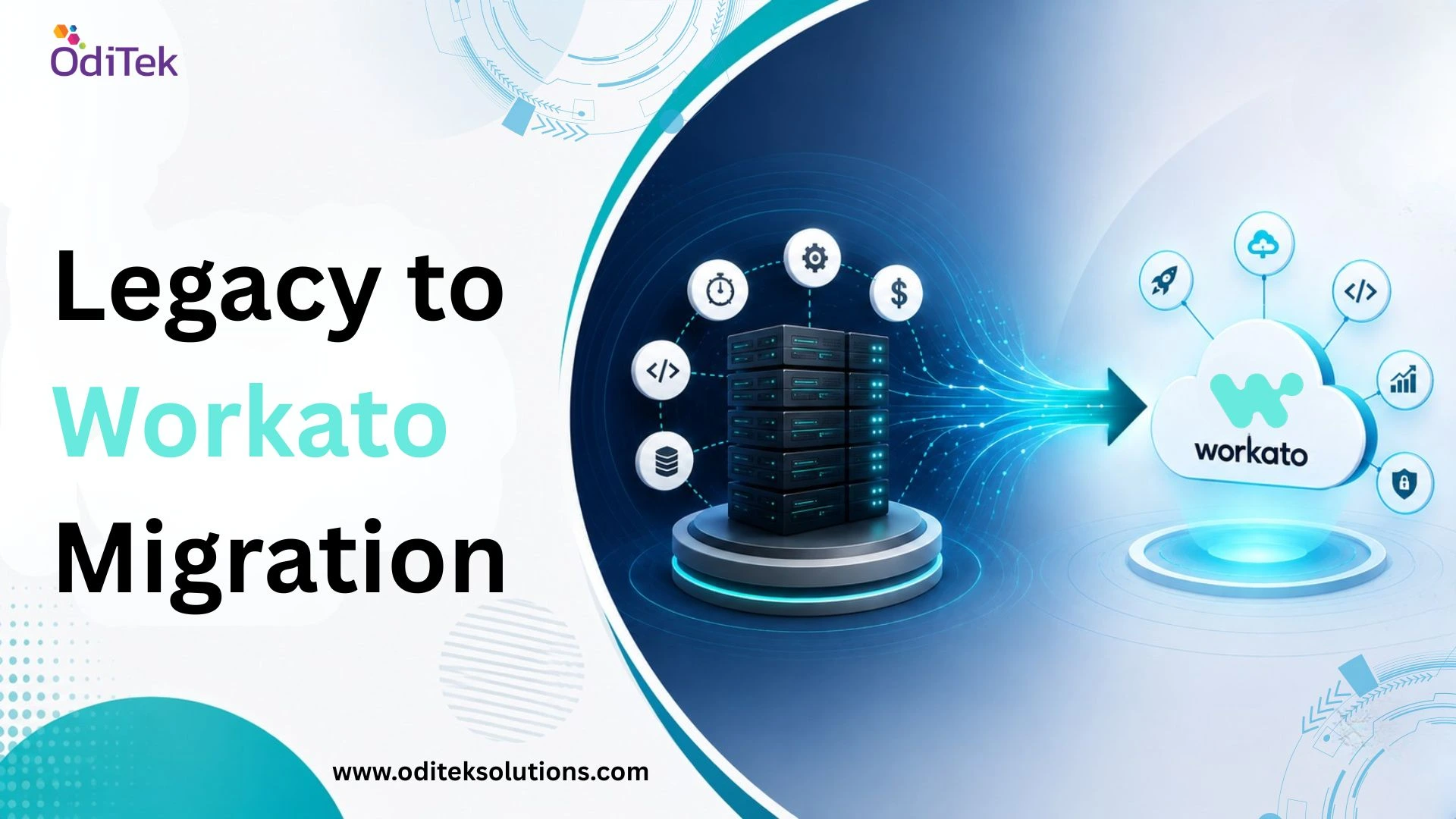
Legacy to Workato Migration has become a strategic priority for enterprises looking to modernize integration architecture, improve operational efficiency, and accelerate digital transformation.
As businesses continue adopting SaaS applications, cloud platforms, AI-powered workflows, and hybrid environments, traditional middleware solutions often struggle to meet modern integration demands.
Many organizations still rely on legacy middleware that was designed for static, on-premise systems. While these platforms may continue to function, they often introduce complexity, higher maintenance costs, slower deployments, and limited scalability.
Modern Integration Platform as a Service (iPaaS) solutions like Workato eliminate these limitations through low-code automation, cloud-native architecture, AI-powered capabilities, and enterprise-grade integrations.
What Is Legacy Middleware?
Legacy middleware refers to traditional Enterprise Service Bus (ESB), message brokers, and integration platforms designed primarily for on-premises systems and batch-oriented processing. These platforms often rely on tightly coupled architectures, extensive custom scripting, XML-based transformations, and manual infrastructure management.
As organizations increasingly adopt microservices, RESTful APIs, event-driven architectures, and AI-enabled business applications, Legacy Middleware Modernization becomes essential to maintain operational efficiency, security, and scalability.
7 Signs of Outdated Middleware That Demand Modern Integration
1. Integration Projects Take Too Long
One of the most critical indicators that your integration landscape is becoming outdated is the increasing time required to deliver new integrations.
Traditional ESB platforms often depend on heavy custom development, including Java coding, manual XML configuration, XSLT-based data transformations, extensive QA cycles, and complex multi-stage deployment pipelines.
This typically results in several operational challenges:
• Slow and rigid integration delivery timelines
• Heavy reliance on niche technical expertise
• Complicated version control, testing, and release management
• Poor reusability of existing integration assets
In contrast, Workato streamlines enterprise integration through low-code development using reusable Recipe Functions, pre-built connectors, API Collections, and visual workflows, reducing development effort, accelerating deployment, and enabling IT and business teams to build integrations faster.
2. High Maintenance and Infrastructure Costs
Legacy middleware requires continuous investment in infrastructure, middleware licensing, server maintenance, database administration, patch management, and disaster recovery planning, which significantly limits IT agility and increases long-term operational burden.
Organizations frequently encounter:
• Increasing Total Cost of Ownership (TCO)
• Frequent hardware refresh cycles
• Ongoing performance tuning and optimization efforts
• Complex and risky middleware upgrade processes
• High dependency on specialized infrastructure teams
A cloud-native iPaaS like Workato removes infrastructure overhead with fully managed services, automatic updates, built-in security, and elastic scalability, enabling enterprises to focus on strategic integration and innovation.
3. Difficulty Integrating Cloud Applications
Digital enterprises rely on seamless communication between ERP, CRM, HRMS, ITSM, Finance, Data Warehouses, and third-party SaaS platforms. However, legacy middleware environments often lack the flexibility and modern capabilities required to support this level of interconnectedness.
As a result, organizations face increasing challenges when working with outdated integration platforms, including:
• Limited support for REST and GraphQL APIs
• Complex or outdated authentication mechanisms instead of modern OAuth 2.0 standards
• Inability to efficiently handle webhooks and real-time event triggers
• Poor support for event-driven and asynchronous integrations
• Difficulties in enabling secure and scalable hybrid cloud connectivity
These limitations slow digital transformation and increase integration complexity. This is why migrating from legacy middleware to Workato is a strategic priority for IT leaders. Workato enables API-led connectivity, reusable APIs, webhooks, and enterprise-grade security while improving integration speed and system agility.
4. Limited Scalability for Business Growth
Scalability is a key limitation of traditional middleware, which was designed for steady, predictable workloads rather than today’s high-volume, dynamic environments.
As enterprises scale, they often face issues like:
• Integration latency during peak loads
• Resource contention
• Limited horizontal scaling
• Performance drops during traffic spikes
Workato’s cloud-native architecture overcomes these challenges with elastic scalability, ensuring high availability, fault tolerance, and consistent performance across all integrations.
5. Manual Processes Continue Across Departments
Many organizations continue performing repetitive business processes manually despite having multiple enterprise systems.
Examples include:
• Employee onboarding
• Invoice approvals
• Procurement workflows
• CRM synchronization
Workato orchestrates these cross-functional workflows using intelligent automation, event triggers, conditional logic, and reusable recipes, significantly reducing manual intervention while improving operational consistency.
6. Limited Visibility and Monitoring
Older middleware platforms often provide fragmented monitoring capabilities, making troubleshooting both reactive and time-consuming.
IT teams frequently struggle with:
• Integration failures
• API throttling
• Data synchronization issues
• Limited execution visibility
• Delayed incident resolution
Modern observability features, including centralized dashboards, distributed logging, SLA monitoring, retry mechanisms, and execution analytics, help organizations maintain governance while improving integration reliability. These capabilities are fundamental to successful Legacy Middleware Modernization initiatives.
7. Your Integration Platform Cannot Support AI and Future Technologies
Enterprise integration is rapidly evolving beyond simple application connectivity.
Organizations increasingly require:
• AI-assisted workflow automation
• LLM integrations
• Intelligent document processing
• MCP-enabled AI orchestration
• Event-driven decision-making
Traditional middleware platforms were never designed for these intelligent automation capabilities.
Migrating to Workato provides enterprises with an AI-ready integration architecture capable of supporting modern automation strategies while future-proofing enterprise technology investments.
Benefits of Legacy to Workato Migration
Migrating from legacy middleware delivers benefits that extend beyond technical improvements.
1. Faster Integration Delivery
Visual development, reusable recipes, and pre-built connectors reduce implementation timelines.
2. Lower Total Cost of Ownership
Cloud-native architecture minimizes infrastructure, maintenance, and operational expenses.
3. Greater Business Agility
Business teams can automate processes faster without relying heavily on custom development.
4. Enterprise-Grade Security
Workato supports secure authentication, governance, role-based access, compliance, and encrypted data exchange.
5. AI-Ready Architecture
Organizations gain a future-proof integration platform capable of supporting intelligent automation initiatives.
Conclusion
Legacy middleware platforms can become significant barriers to enterprise agility, innovation, and digital transformation. If your organization is experiencing slow integration delivery, rising infrastructure costs, limited API connectivity, scalability challenges, poor observability, or difficulty adopting AI-driven automation, these are clear indicators that modernization should no longer be delayed.
A carefully planned Legacy to Workato Migration empowers organizations to replace outdated integration infrastructure with a scalable, cloud-native, and intelligent automation platform that supports modern enterprise architecture and long-term business growth.
Ready to modernize your enterprise integrations? Visit our Workato Service Page or contact us Today.
How OdiTek Solves Legacy to Workato Migration Challenges?
1. What is Legacy to Workato Migration, and how can OdiTek help?
Legacy to Workato Migration is the process of moving from outdated middleware platforms to a modern, cloud-native iPaaS like Workato. OdiTek helps businesses assess existing middleware, identify integration gaps, migrate critical workflows, and rebuild scalable Workato recipes for faster and more reliable enterprise automation.
2. How does OdiTek support legacy middleware replacement?
OdiTek supports legacy middleware replacement by converting complex ESB, message broker, and custom-coded integrations into low-code Workato workflows. Our team uses pre-built connectors, REST APIs, reusable recipes, and secure data mapping to reduce dependency on old infrastructure and improve integration performance.
3. Why migrate from legacy middleware to Workato with OdiTek?
Businesses should migrate from legacy middleware to Workato with OdiTek to reduce integration complexity, lower operational costs, improve agility, and enable real-time automation. OdiTek ensures a structured migration approach that protects business continuity while modernizing integrations for cloud, SaaS, AI, and hybrid environments.
4. How does OdiTek handle Legacy Middleware Modernization?
OdiTek handles Legacy Middleware Modernization by analyzing existing workflows, redesigning integrations with Workato recipes, implementing API-led connectivity, and enabling centralized monitoring. This helps organizations move from rigid, custom-coded middleware to flexible, scalable, and future-ready automation.
5. How does OdiTek make Workato migration secure and scalable?
OdiTek builds secure and scalable Workato migration solutions using role-based access control, encrypted data exchange, audit logging, exception handling, and reusable automation components. This ensures enterprise integrations remain reliable, governed, and ready to support future business growth.