
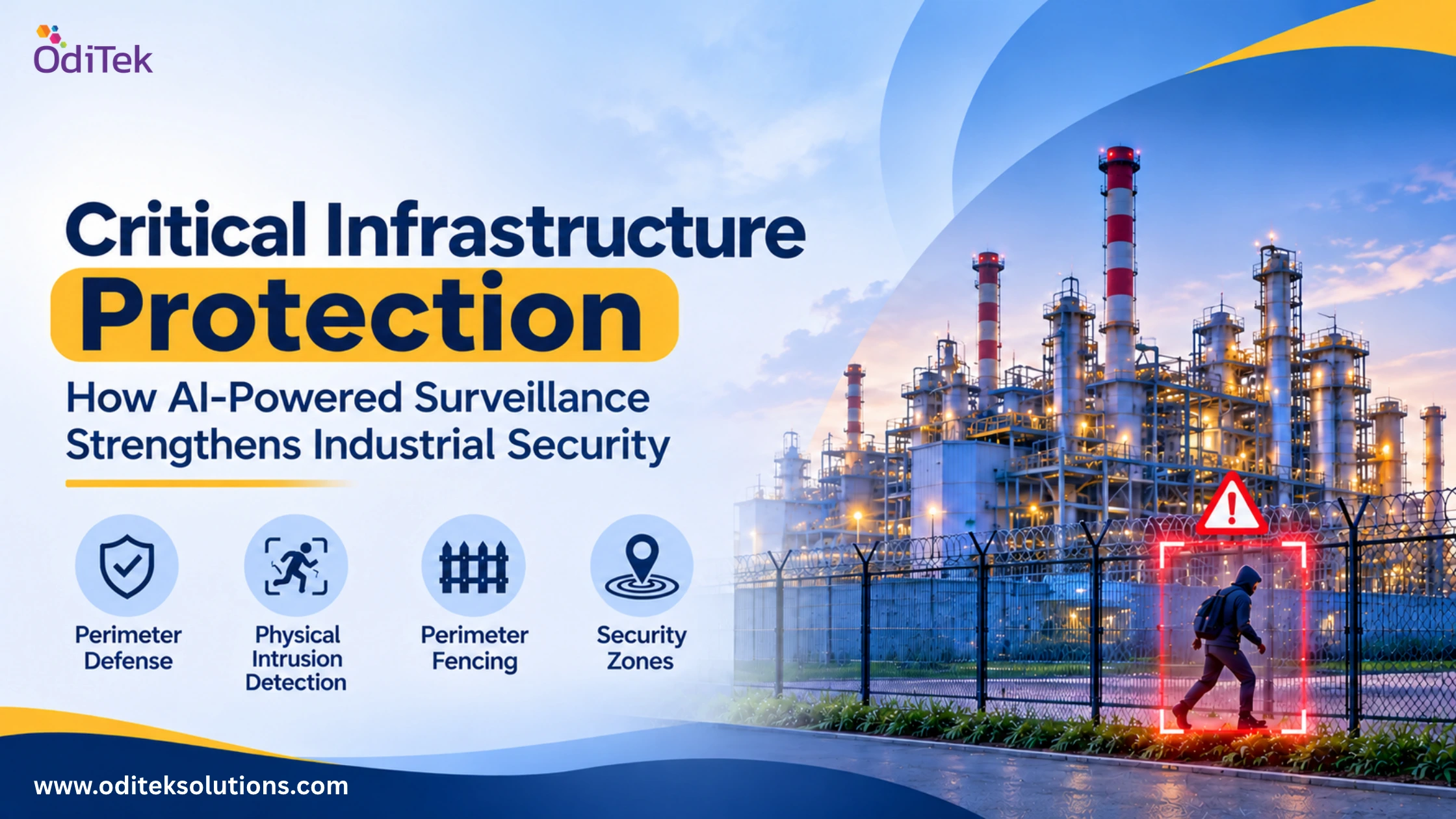
Critical Infrastructure Protection forms the backbone of modern economies. Power plants, manufacturing facilities, transportation networks, warehouses, ports and other industrial establishments play an essential role in maintaining everyday operations. However, these facilities also face increasing security challenges, including unauthorized access, physical intrusion, theft, vandalism and operational disruptions.
Traditional security arrangements such as perimeter fencing, CCTV cameras and manual monitoring provide an important foundation for facility protection. However, monitoring large industrial premises through conventional surveillance systems can be challenging, particularly when security teams need to monitor multiple locations simultaneously.
This is where AI-powered surveillance is transforming Critical Infrastructure Protection. By combining computer vision, intelligent video analytics and real-time alerts, organizations can strengthen their security infrastructure and identify potential threats more efficiently.
With solutions such as REG-EYE by OdiTek Solutions, businesses can move towards smarter, proactive and technology-driven security operations.
Understanding Critical Infrastructure Protection
Critical Infrastructure Protection (CIP) refers to the strategies, technologies and security measures implemented to protect essential facilities, assets and operations against physical and operational threats.
Industrial facilities often contain valuable machinery, sensitive equipment, restricted operational areas and extensive external boundaries. A security breach in these locations can result in financial losses, safety incidents and interruptions to business operations.
Some common security challenges include:
• Unauthorized access to restricted operational areas
• Physical intrusion through damaged or vulnerable boundaries
• Limited visibility across large industrial premises
• Delayed identification of suspicious activities
• Dependence on continuous manual CCTV monitoring
• Difficulty monitoring remote and isolated infrastructure
Addressing these challenges requires an integrated security approach that combines physical protection with intelligent monitoring technologies.
The Role of AI in Critical Infrastructure Protection
Artificial Intelligence is changing how organizations approach industrial security. Instead of relying exclusively on security personnel to observe CCTV footage, AI-powered video analytics can automatically analyze camera feeds and identify predefined security events.
Computer vision technology enables surveillance systems to detect people, vehicles and specific activities within monitored areas.
Key applications include:
1. Physical Intrusion Detection
Physical intrusion detection identifies unauthorized movement within designated security areas. AI-powered systems can detect individuals entering restricted locations, crossing virtual boundaries or moving through prohibited zones.
Security teams can receive automated alerts, helping them investigate potential security incidents promptly.
2. Intelligent Perimeter Defense
Perimeter defense focuses on protecting the external boundaries of industrial facilities. AI-enabled surveillance can monitor vulnerable boundary locations and identify unauthorized movement near designated perimeter areas.
This is particularly useful for power plants, manufacturing facilities, warehouses and other large industrial premises.
3. Security Zone Monitoring
Organizations can define virtual security zones around sensitive equipment, restricted buildings and operational areas. AI-based video analytics can monitor these designated zones and generate alerts when unauthorized movement is detected.
4. Existing CCTV Infrastructure Optimization
Many industrial facilities already have extensive CCTV networks. Integrating AI-powered analytics with compatible existing cameras can help organizations improve surveillance capabilities without necessarily replacing their entire camera infrastructure.
Why Traditional Security Systems Need Intelligent Surveillance?
Traditional security arrangements generally combine physical barriers, security personnel and CCTV cameras. While these measures remain essential, they have certain limitations.
For example, perimeter fencing can restrict physical access but cannot independently identify someone attempting to climb over it or enter through a damaged section.
Similarly, conventional CCTV cameras record activities, but security personnel may need to monitor multiple video feeds simultaneously to identify suspicious movement.
Integrating AI-powered surveillance addresses these limitations by introducing automated video analysis.
A combined approach involving perimeter fencing, CCTV cameras, physical intrusion detection and virtual security zones enables organizations to establish a more comprehensive security framework.
Industries That Benefit from Critical Infrastructure Protection
AI-powered surveillance can support security operations across several industries.
1. Power and Energy Facilities
Power plants and substations require continuous monitoring of restricted infrastructure, external boundaries and sensitive operational areas. Intelligent surveillance helps identify unauthorized movement and potential security breaches.
2. Manufacturing Plants
Large manufacturing facilities contain expensive machinery, production equipment and restricted operational zones. AI-based monitoring helps improve visibility and identify unauthorized access.
3. Warehouses and Logistics Centres
Warehouses require protection against theft, unauthorized entry and suspicious movement around storage and loading areas. Intelligent surveillance can support monitoring across multiple locations.
4. Ports and Transportation Facilities
Ports and transportation hubs operate across extensive premises with multiple access points. AI-powered video analytics can strengthen perimeter monitoring and restricted-area surveillance.
5. Mining and Industrial Sites
Remote industrial locations often have extensive boundaries that are difficult to monitor manually. Intelligent camera-based surveillance can improve security visibility across vulnerable locations.
Key Benefits of AI-Powered Critical Infrastructure Security
Implementing intelligent surveillance provides several operational advantages:
• Early Threat Identification: Detects predefined suspicious activities and potential intrusion events
• Reduced Manual Monitoring: Automates video analysis and helps security personnel focus on relevant alerts
• Improved Situational Awareness: Provides better visibility across multiple monitored locations
• Faster Incident Response: Automated notifications help security teams investigate potential threats promptly
• Cost Optimization: Maximizes the potential of compatible existing CCTV infrastructure
• Scalable Security: Supports the expansion of surveillance coverage as organizational requirements grow
REG-EYE: Smarter Security for Critical Infrastructure
REG-EYE by OdiTek Solutions is an AI-powered video analytics platform designed to transform conventional surveillance into intelligent security monitoring.
By leveraging computer vision and AI-based video analytics, REG-EYE helps organizations strengthen their security infrastructure and improve operational visibility.
Relevant capabilities include:
• Zone Intrusion Detection: Identifies unauthorized movement within predefined restricted areas
• Perimeter Monitoring: Supports intelligent surveillance of designated boundary locations
• Real-Time Alerts: Generates notifications when configured security events are detected
• Centralized Surveillance: Supports monitoring across multiple camera locations
• Existing Camera Integration: Helps organizations maximize their existing CCTV infrastructure, subject to compatibility and deployment requirements
Whether it is a manufacturing plant, warehouse, power facility or large industrial establishment, REG-EYE helps organizations move towards a smarter approach to critical infrastructure protection.
Conclusion
Protecting critical infrastructure requires more than conventional security arrangements. As industrial environments become increasingly complex, organizations need intelligent technologies that can identify potential threats and support faster security responses.
AI-powered surveillance, physical intrusion detection, perimeter defense and virtual security zones together create a stronger and more proactive security ecosystem.
With REG-EYE, OdiTek Solutions aims to help organizations enhance their surveillance capabilities, strengthen facility security and build smarter industrial environments.
Looking to strengthen your organization’s security infrastructure? Connect with OdiTek Solutions to explore how REG-EYE can support your critical infrastructure protection requirements.
Frequently Asked Questions (FAQs)
1. What is critical infrastructure protection and why is it important?
Critical infrastructure protection involves safeguarding essential facilities such as power plants, manufacturing units, warehouses, transportation networks and other important assets against physical and operational threats. It is important for maintaining business continuity, preventing security breaches and protecting valuable infrastructure.
2. How does AI-powered surveillance improve critical infrastructure security?
AI-powered surveillance improves security by automatically analyzing CCTV footage, detecting unauthorized movement, monitoring restricted areas and generating real-time alerts. It helps security teams identify potential threats more efficiently and reduces dependence on continuous manual monitoring.
3. What is physical intrusion detection in industrial security?
Physical intrusion detection is the identification of unauthorized entry or suspicious movement within protected areas. AI-based systems use camera feeds and video analytics to detect predefined intrusion events and notify security personnel.
4. Can AI surveillance work with existing perimeter fencing and CCTV cameras?
Yes. AI-powered surveillance can complement existing perimeter fencing and compatible CCTV infrastructure. Video analytics can monitor designated boundary areas, detect unauthorized movement and generate alerts without necessarily requiring complete infrastructure replacement.
5. Which industries need critical infrastructure protection?
Power and energy, manufacturing, transportation, ports, mining, logistics and warehousing are among the industries that benefit from critical infrastructure protection measures and intelligent surveillance technologies.