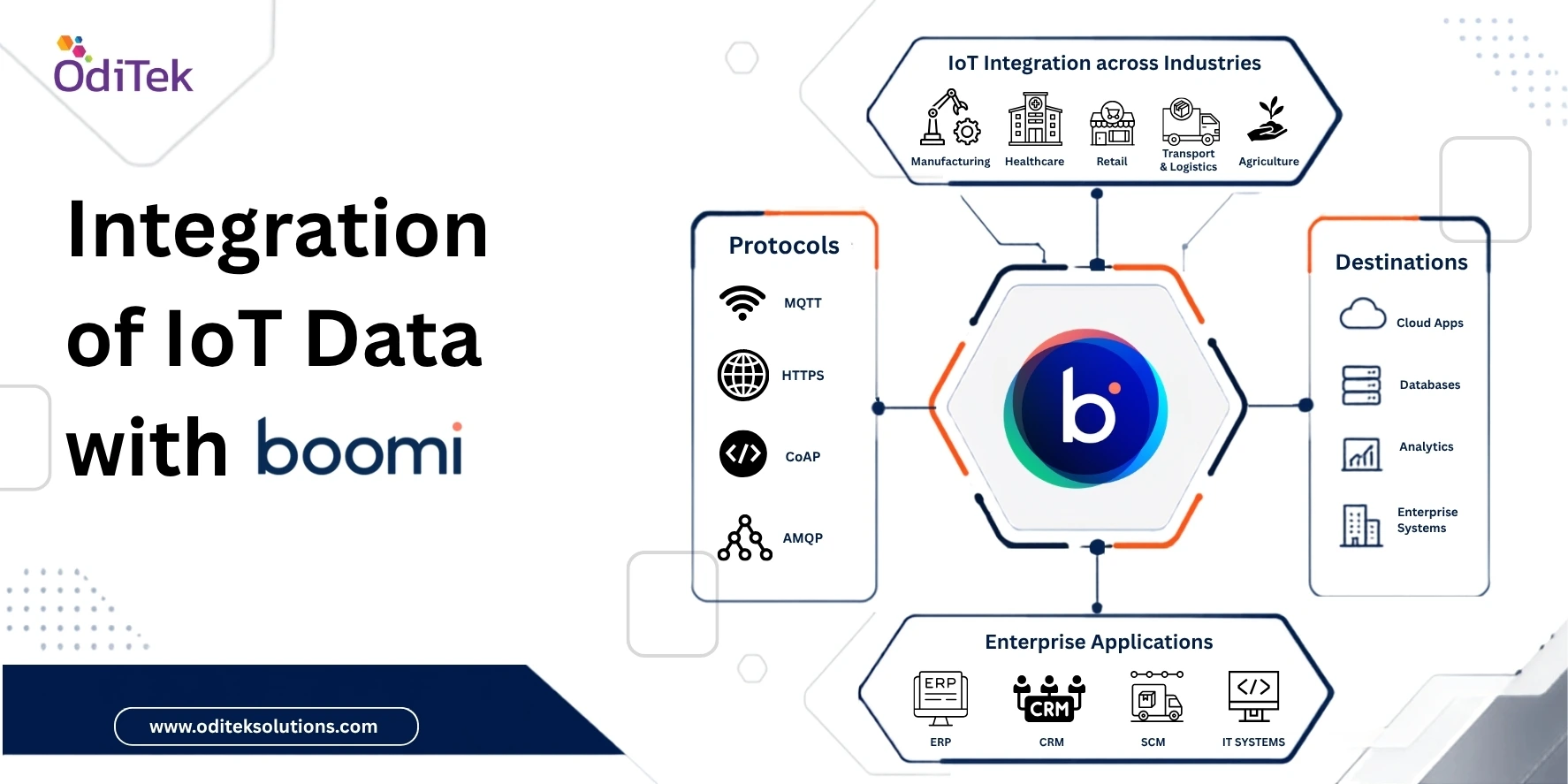
Boomi integration enables organizations to connect IoT devices, applications, databases, and cloud systems so that data can move efficiently across the enterprise. As businesses adopt connected devices at scale, the ability to collect, transform, and use IoT data effectively has become increasingly important.
IoT devices continuously generate data related to equipment performance, environmental conditions, user behavior, location, and operational activities. However, collecting this data is only the first step. Organizations also need an integration layer that can connect IoT data with business applications and turn it into actionable information.
This is where Dell Boomi software can help. Its cloud-based integration capabilities allow organizations to connect different systems, automate data flows, transform information between formats, and support real-time business processes.
Understanding IoT Data Integration
The Internet of Things (IoT) connects physical devices and systems to collect and exchange data. Sensors, connected equipment, wearables, vehicles, smart meters, and industrial machines can continuously generate information that can be used for monitoring, analytics, automation, and decision-making.
However, IoT environments often contain devices and applications using different technologies, protocols, and data formats. Without an effective integration approach, organizations may struggle to move this information into CRM, ERP, analytics, data warehouses, or other enterprise systems.
Dell Boomi Data Integration provides an integration layer that can help connect these different sources and destinations. Organizations can use integration processes to collect data, transform it into the required format, and deliver it to the appropriate business system.
Why Integrate IoT Data with Boomi?
Connecting IoT data with enterprise applications can help businesses move beyond simply collecting device information. Integrated data can support automation, operational visibility, analytics, and faster decision-making.
Key benefits include:
1. Centralized Data Flow – IoT data can originate from thousands of connected devices. An integration platform can help establish consistent data flows between devices, applications, databases, and cloud services.
2. Real-Time Data Processing – Many IoT use cases depend on timely information. Integration processes can help organizations move event-driven data to systems that require immediate updates or actions.
3. Data Transformation – IoT devices may produce information in different structures and formats. Data transformation and mapping can help convert information into a format that downstream applications can understand.
4. Process Automation – Integrated IoT data can trigger automated business processes. For example, equipment data indicating a potential issue could initiate a notification, service request, or workflow.
5. Scalability – As the number of connected devices increases, the integration architecture needs to accommodate growing data volumes without creating unnecessary complexity.
Types of IoT Data That Can Be Integrated
IoT environments generate different types of information depending on the device and industry.
Some common examples include:
1. Sensor data: Temperature, pressure, humidity, vibration, and other environmental measurements.
2. Device status data: Information about equipment health, availability, and performance.
3. Location data: GPS and other location-related information from vehicles and connected devices.
4. Motion data: Movement, acceleration, and activity information.
5. Multimedia data: Images, video, and audio generated by connected devices.
6. User-generated data: Information related to user interactions, preferences, and behavior.
Common Challenges in IoT Data Integration
IoT integration projects can become complex as the number of devices and data sources increases. Organizations should consider several challenges before designing their integration architecture.
1. High Data Volumes – Connected devices can generate large amounts of data continuously. The integration architecture must be designed to process and route this information efficiently.
2. Multiple Data Formats – Different devices and applications may produce data in different formats. Transformation and mapping are often required before information can be consumed by another system.
3. Real-Time Requirements – Some IoT use cases require near-real-time processing. Delays in transmitting or processing critical information can affect operational decisions.
4. Security – IoT data may contain sensitive operational or customer information. Authentication, secure connectivity, access controls, and appropriate security practices should be considered throughout the integration lifecycle.
5. System Interoperability – IoT ecosystems commonly involve legacy applications, cloud platforms, databases, APIs, and specialized devices. Ensuring that these systems can exchange information reliably is a key integration requirement.
6. Data Quality – Incomplete, duplicated, or inconsistent device data can affect downstream analytics and business processes. Validation and error-handling mechanisms can help maintain data quality.
Dell Boomi Deployment Best Practices for IoT Integration
Following Dell Boomi Best Practices can help organizations create integration processes that are easier to manage, scale, monitor, and maintain.
1. Define the Integration Architecture – Identify systems, devices, APIs, and data flows. Document data formats, dependencies, security, processing, and error-handling requirements.
2. Use Reusable Components – Use reusable components and integration patterns to improve consistency, reduce duplication, and simplify maintenance.
3. Standardize Data Transformation – Standardize mapping and transformation rules to ensure consistent data across different formats such as JSON, XML, and CSV.
4. Design for Scalability – Plan for increasing devices and data volumes by considering transaction loads, processing needs, and future growth.
5. Implement Strong Error Handling – Build processes to identify failures, capture errors, retry transactions, prevent data loss, and notify responsible teams.
6. Prioritize Security – Implement authentication, authorization, encryption, credential management, and access controls throughout the integration lifecycle.
7. Monitor Integration Processes – Monitor integrations for failures, performance issues, data anomalies, and connectivity problems to enable faster troubleshooting.
8. Test Before Deployment – Test data mapping, transformations, error handling, high-volume scenarios, connectivity issues, and system failures before production deployment.
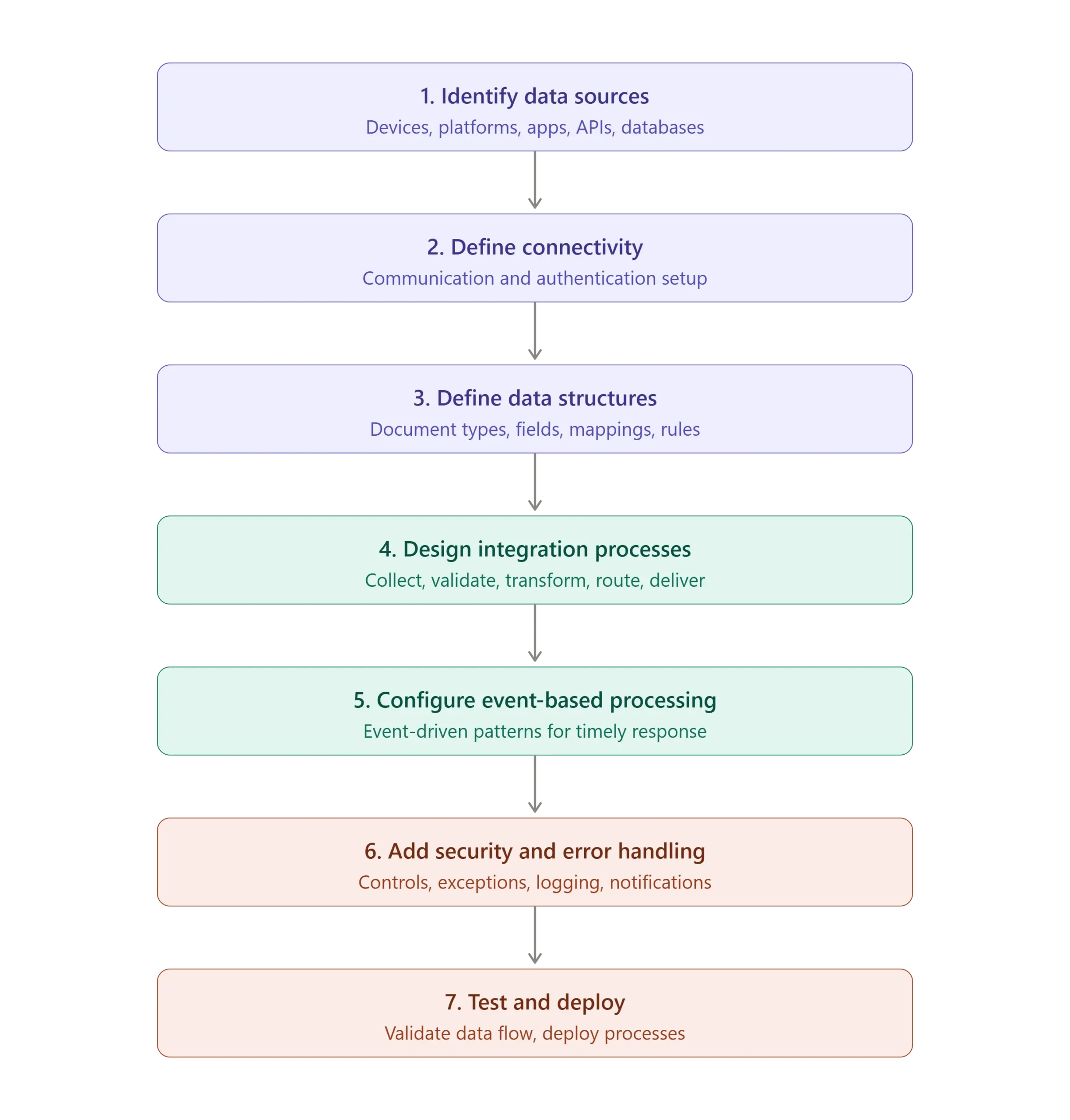
How to Set Up an IoT Integration Environment?
A structured implementation approach can make IoT integration easier to manage.
Below is the flowchart structure for IoT integration phases.
IoT Integration Use Cases Across Industries
1. Manufacturing – Manufacturers can connect equipment and sensor data with enterprise applications to monitor machine performance, identify anomalies, and support predictive maintenance.
2. Healthcare – Connected medical devices and wearable technologies can generate patient-related information that can be integrated with healthcare applications and monitoring systems.
3. Retail – Smart shelves, connected devices, beacons, and point-of-sale systems can provide information that supports inventory management and customer experience initiatives.
4. Transportation and Logistics – Vehicle and fleet data can be connected with logistics and business systems to improve shipment visibility, route management, and operational monitoring.
5. Energy and Utilities – Smart meters and connected infrastructure can provide information for monitoring consumption, identifying issues, and improving resource management.
6. Agriculture – Connected sensors can provide information about soil conditions, weather, irrigation, and crop environments to support more efficient agricultural operations.
Why a Structured Boomi Integration Strategy Matters?
IoT projects often involve multiple devices, applications, APIs, cloud services, and enterprise systems, making a structured Boomi integration strategy essential for managing connectivity, data transformation, automation, security, monitoring, and scalability.
By leveraging Dell Boomi Data Integration, organizations can connect IoT data with their broader technology ecosystem through streamlined integration processes, reducing the complexity of point-to-point connections while supporting reliable and scalable data exchange.
Conclusion
Boomi integration can help organizations connect IoT ecosystems with enterprise applications and make connected-device data more useful across the business. From data transformation and automation to scalability, monitoring, and secure connectivity, a well-designed integration architecture can support a wide range of IoT initiatives.
Following Dell Boomi Deployment Best Practices can further improve the reliability and maintainability of these integration processes. Organizations should focus on reusable architecture, standardized data transformation, scalability, security, monitoring, error handling, and thorough testing.
At OdiTek, our Boomi expertise helps businesses build scalable, secure, and reliable integration solutions. Explore our Boomi expertise to simplify connectivity and accelerate digital transformation.
Contact OdiTek to explore how an effective IoT integration strategy can support your digital transformation goals.