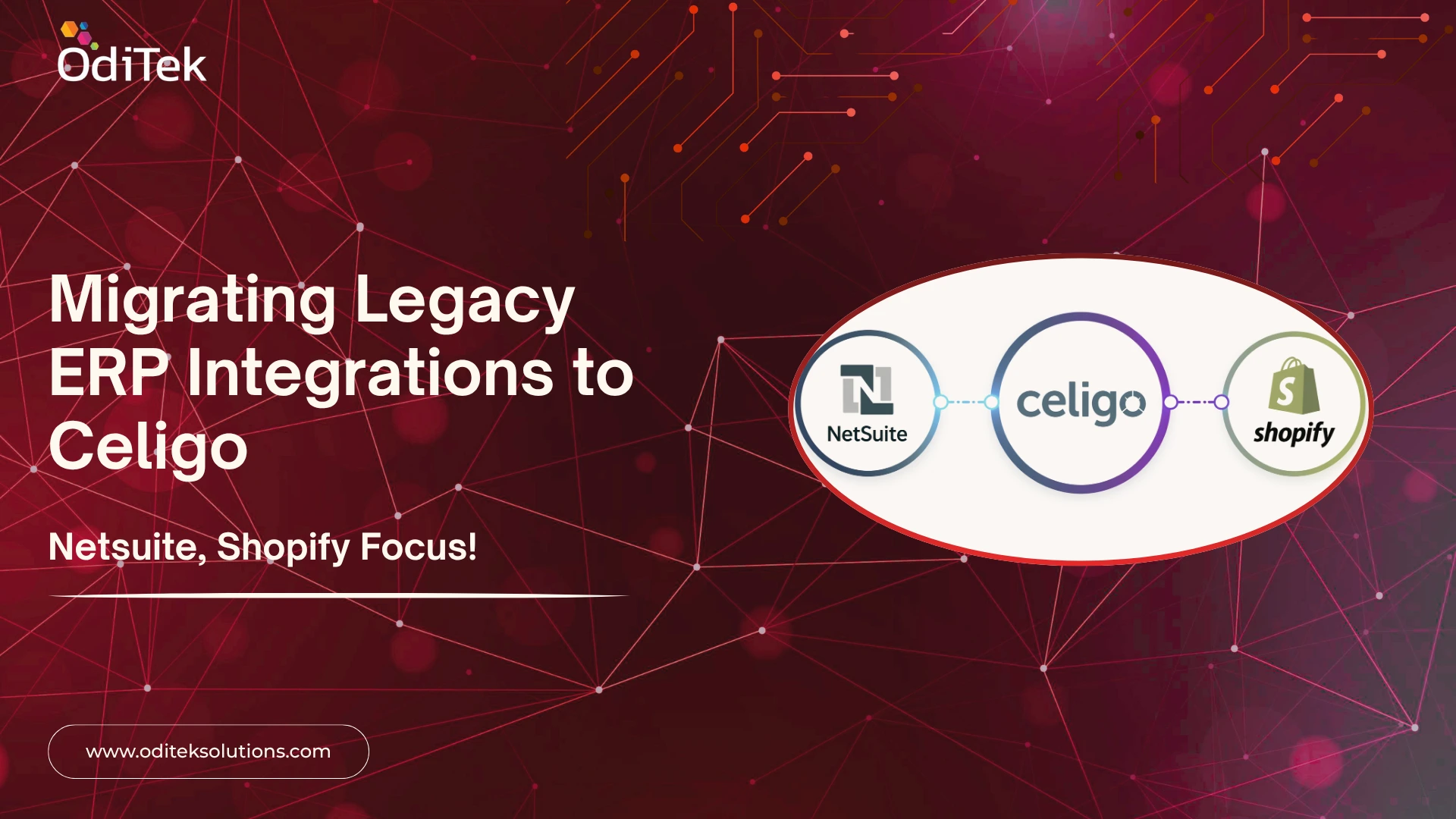
In today’s fast-paced digital ecosystem, businesses relying on outdated systems are increasingly prioritizing ERP to Celigo migration to modernize their integration landscape. Legacy ERP environments, often built on rigid architectures and batch-driven workflows, struggle to support real-time data exchange, eCommerce scalability, and cloud-native operations.
This is where Celigo iPaaS (Integration Platform as a Service) becomes a game-changer, especially for organizations leveraging NetSuite and Shopify integrations.
Why Businesses Are Moving Toward ERP to Celigo Integration
Traditional ERP systems typically rely on point-to-point integrations, custom scripts, or middleware that lack scalability and flexibility. As businesses grow, these systems create data silos and operational inefficiencies.
With ERP to Celigo integration, organizations can:
• Enable real-time data synchronization between NetSuite and Shopify
• Automate workflows such as order-to-cash and inventory updates
• Reduce dependency on custom-coded integrations
• Improve data accuracy and operational visibility
This shift is a key driver behind the rise in ERP migration Celigo initiatives across industries.
Understanding Legacy ERP Challenges
Before diving into ERP to Celigo migration, it’s important to understand the limitations of legacy systems:
Batch processing delays often hinder real-time operations, while heavy reliance on custom integrations drives up maintenance costs. At the same time, limited support for API-driven architectures restricts agility, and scaling alongside modern eCommerce platforms like Shopify becomes increasingly difficult. The absence of centralized monitoring and robust error handling further complicates system management. Together, these challenges make migrating from legacy ERP systems a strategic necessity rather than just an option.
Why Choose Celigo for ERP Integration?
Celigo stands out as a robust ERP integration platform, offering prebuilt connectors and automation tools tailored for NetSuite and Shopify.
Key Capabilities:
• Integrator.io platform for low-code integration development
• Prebuilt NetSuite–Shopify connectors
• Support for real-time, batch, and event-driven integrations
• Built-in error handling, logging, and monitoring
• Scalable cloud-native architecture
This makes ERP automation Celigo highly efficient for modern enterprises.
ERP to Celigo Migration: Technical Approach
A successful ERP to Celigo migration involves a structured and technically sound approach:
1. Assessment & Discovery
• Identify existing ERP workflows, APIs, and dependencies
• Evaluate current data models and integration patterns
2. Architecture Redesign
• Shift from monolithic ERP integrations to modular, API-led connectivity
• Implement event-driven triggers for real-time updates
3. Data Migration & Mapping
• Execute ERP data migration Celigo using transformation rules
• Normalize data across NetSuite and Shopify schemas
4. Integration Development
• Build workflows using Celigo’s low-code interface
• Leverage prebuilt connectors and reusable components
5. Testing & Deployment
• Perform end-to-end validation (E2E testing)
• Monitor performance using Celigo dashboards
ERP to Celigo Conversion & Upgrade
Many organizations consider ERP to Celigo conversion or ERP to Celigo upgrade as part of their broader digital transformation strategy.
The conversion process includes replacing legacy middleware with Celigo to modernize integration capabilities, rebuilding existing integrations using an API-first architecture for greater flexibility and scalability, and migrating from on-premise ERP systems to cloud-based platforms to improve accessibility, performance, and overall efficiency.
The upgrade delivers improved data throughput and reduced latency, ensuring faster and more efficient data processing across systems. It also enhances workflow automation, minimizing manual intervention and streamlining operations. Additionally, the solution offers better scalability to handle high transaction volumes, enabling businesses to grow without compromising performance or reliability.
Role of ERP to Celigo Converters & Tools
To streamline migration, businesses often explore ERP to Celigo converters and Celigo migration tools. These tools play a crucial role in streamlining integration processes by automating data mapping and schema transformation, which eliminates the need for manual intervention. They significantly accelerate integration development by enabling faster configuration and deployment, while also reducing the risk of human errors during migration, ensuring more accurate and reliable data handling.
However, due to differences in system architecture, a partial re-engineering approach is usually required rather than a direct lift-and-shift.
NetSuite & Shopify Integration Use Case
One of the most common scenarios for ERP to Celigo integration is connecting NetSuite ERP with Shopify eCommerce.
Key Workflows:
• Order Sync: Shopify orders → NetSuite sales orders
• Inventory Updates: NetSuite → Shopify stock levels
• Customer Data Sync: Unified customer records
• Financial Reconciliation: Automated billing and invoicing
This eliminates manual intervention and ensures real-time operational efficiency.
ERP Cloud Migration & Modernization
With the rise of ERP cloud migration, businesses are transitioning from on-prem systems to cloud-based platforms using Celigo.
This enables:
• Scalable infrastructure
• Seamless multi-channel integrations
• Improved system resilience and uptime
As a result, ERP to Celigo modernization and ERP to Celigo transformation initiatives are becoming central to digital strategies.
Business Benefits of ERP to Celigo Migration
Organizations adopting ERP to Celigo migration services achieve the solutions that enables significantly faster integration deployment, often reducing implementation time by up to 50%. By streamlining processes and minimizing manual effort, they also help lower operational costs while improving overall efficiency. Enhanced data accuracy and strong governance ensure that information flows consistently and reliably across systems.
In addition, real-time data updates contribute to a better customer experience by providing timely and accurate information. This responsiveness, combined with flexible integration capabilities, allows businesses to scale their eCommerce operations more effectively and adapt quickly to changing market demands.
Final Takeaway
The shift toward ERP to Celigo migration is more than a technical upgrade, it’s a strategic move toward building a connected, automated, and scalable enterprise ecosystem. By leveraging Celigo’s iPaaS capabilities, businesses can overcome the limitations of legacy systems and unlock the full potential of NetSuite and Shopify integrations.
Is your legacy ERP system equipped to handle real-time, scalable eCommerce integrations, or is it time to make the switch to Celigo?
To know more, contact us and follow our Celigo integration page for more insights.