Boomi vs MuleSoft is a common comparison or platform evaluation topic for enterprises evaluating integration platforms for connecting applications, APIs, data sources, and business processes. Both platforms support enterprise integration, API management, workflow automation, data transformation, and hybrid connectivity, but their architectural approaches and implementation models differ.
For organizations selecting an Integration Platform as a Service (iPaaS), the right choice depends on integration complexity, existing technology architecture, developer skill sets, scalability requirements, governance, and total cost of ownership.
Leading iPaaS Platforms for Enterprise Integration
Enterprises have several integration platforms to consider depending on their technology landscape and business requirements.
Boomi, MuleSoft, Workato, Informatica, SnapLogic, Jitterbit, and Celigo provide capabilities across application integration, data integration, API connectivity, automation, and workflow orchestration.
However, platforms differ in their development models, runtime architecture, connector ecosystems, API capabilities, transformation approaches, governance features, and deployment options. Evaluate these differences against the organisation’s existing architecture and long-term integration roadmap.
Boomi vs MuleSoft: Architectural Comparison
A Boomi vs MuleSoft comparison is especially relevant when an organization is evaluating enterprise-grade application integration, API connectivity, and hybrid integration.
Boomi follows a cloud-native integration approach with visual process development for designing integration workflows, data mappings, APIs, and automation processes. Its distributed runtime architecture supports integration execution across cloud and on-premises environments.
MuleSoft’s Anypoint Platform follows an API-led connectivity approach, supporting API design, integration flows, application connectivity, and API lifecycle management through its broader platform ecosystem.
The practical distinction is not simply about whether one platform can perform a particular integration. It is also about how an organisation wants to design, develop, deploy, govern, monitor, and maintain its integration landscape.
Development Experience and Connectivity
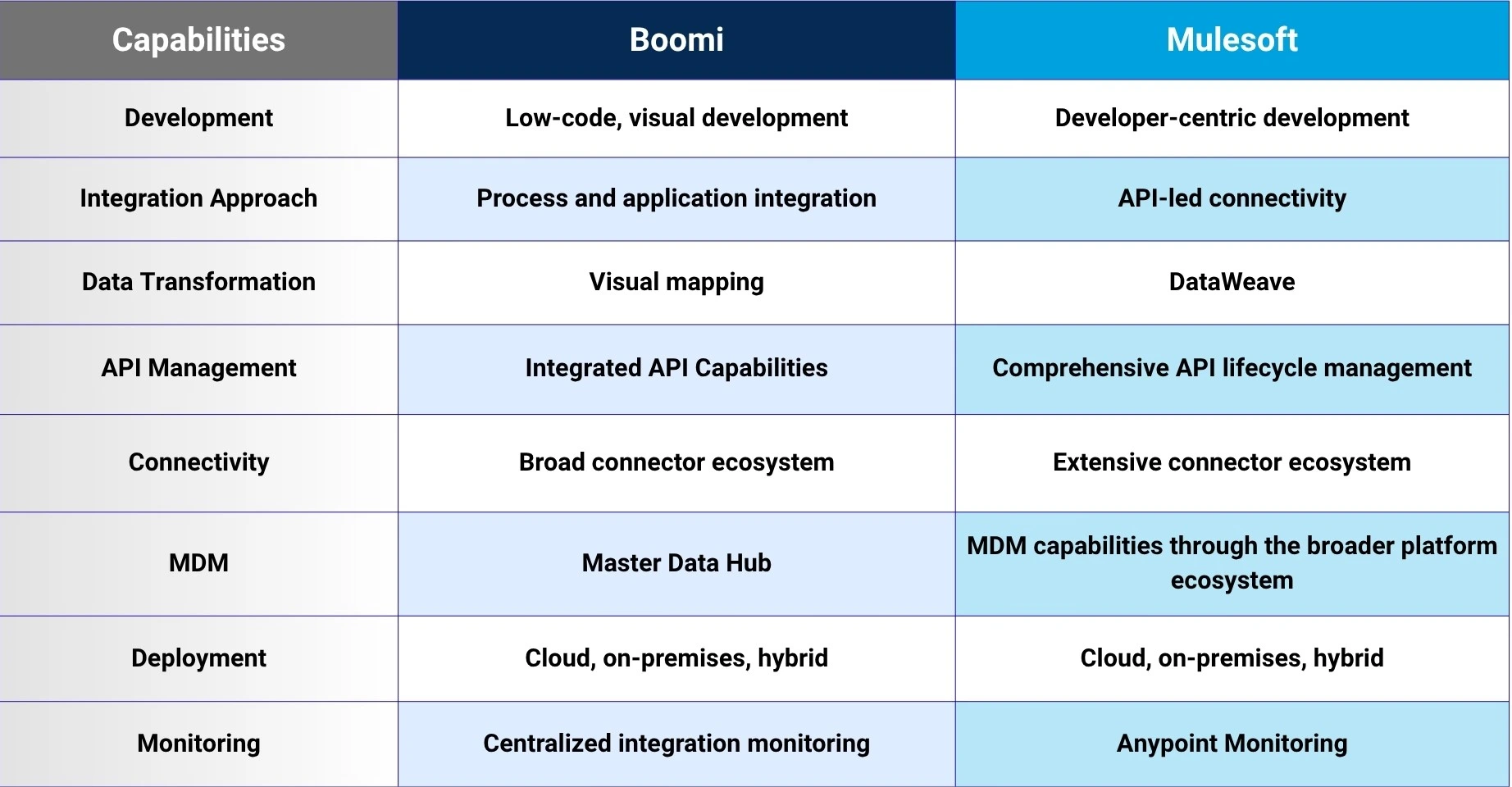
Boomi’s visual, low-code development model uses reusable components and connectors, which can reduce custom coding for many standard integration scenarios.
MuleSoft provides developer focused tooling, Mule applications, and DataWeave for advanced transformation and customization.
Both platforms offer extensive connectivity across SaaS applications, databases, APIs, file systems, and enterprise applications. Rather than comparing connector counts alone, enterprises should evaluate support for their actual application landscape, authentication methods, data formats, and integration requirements.
API Management and Data Management
MuleSoft has a strong API-led architecture covering API design, security, deployment, lifecycle management, analytics, and governance.
Boomi also provides API management alongside integration and workflow automation, allowing APIs, applications, and processes to be managed within a broader integration environment.
For data governance, Boomi provides Master Data Hub, which supports synchronization and management of master data across connected systems. This can be valuable for organizations managing customer, product, supplier, or employee data across multiple applications.
Deployment and Scalability
Both platforms support hybrid integration architectures.
Boomi’s distributed runtime model allows integrations to run across different environments while being centrally managed. MuleSoft provides deployment options such as CloudHub and Runtime Fabric.
When evaluating deployment, enterprises should consider network topology, latency, data residency, security, high availability, and disaster recovery requirements.
Pricing Model
Both platforms generally use subscription-based enterprise pricing, but the final cost depends on the capabilities, usage, runtime requirements, deployment model, and support selected.
Boomi pricing can vary based on platform capabilities, integration requirements, runtimes, and usage. MuleSoft pricing can depend on Anypoint Platform capabilities, APIs, capacity, deployment, and support requirements.
For an accurate comparison, organizations should request a scoped commercial proposal based on integration volume, applications, APIs, environments, and expected growth.
Total cost should also account for implementation, development, maintenance, monitoring, and scaling, not just the license price.
Security and Governance
Enterprise integrations frequently process sensitive customer, financial, operational, and employee data. Security must therefore be considered throughout the integration lifecycle.
Important controls include:
• OAuth 2.0, JWT, and other authentication mechanisms
• TLS-encrypted communication
• Credential and secret management
• Data validation
• Audit logging
• Monitoring and alerting
Both Boomi and MuleSoft provide enterprise security and governance capabilities. Implementation should align these controls with organizational security policies, identity infrastructure, compliance requirements, and data protection standards.
Key Technical Differences:
MuleSoft Alternatives for Enterprise Integration
Organizations researching MuleSoft alternatives can evaluate platforms such as Boomi, Workato, Informatica, SnapLogic, Jitterbit, and Celigo.
An alternative should not be selected based solely on feature count. Integration volume, application landscape, API strategy, transformation complexity, implementation requirements, existing developer expertise, and total cost of ownership can influence the final platform decision.
For organizations looking for a unified approach to application connectivity, API integration, workflow automation, data transformation, and hybrid deployment, Boomi represents an option worth evaluating within the broader iPaaS landscape.
Where Does Boomi Fit Best?
Boomi can be relevant for organizations looking to consolidate multiple integration requirements within a cloud based platform.
Its combination of application connectivity, visual process development, data transformation, API capabilities, workflow orchestration, monitoring, and distributed runtime deployment supports integration architectures spanning cloud and on-premises systems.
Conclusion
Boomi and MuleSoft both are capable enterprise integration platforms with different architectural strengths. MuleSoft emphasizes API-led integration, while Boomi combines low-code integration, broad connectivity, APIs, and data management within a unified platform.
For enterprises seeking faster development, simplified implementation, hybrid connectivity, and centralized management, Boomi can be a strong fit. The final selection should consider architecture, technical resources, integration complexity, governance, and total cost of ownership.
Looking to choose the right iPaaS for your enterprise? Visit our service page or contact us today.
Frequently Asked Questions
1. What is the difference between MuleSoft and Boomi?
Boomi emphasizes low-code integration and application connectivity, while MuleSoft focuses strongly on API-led connectivity and developer oriented integration.
2. What are the advantages of Boomi over MuleSoft?
Boomi can provide advantages for organizations seeking low code development, visual integration design, broad connectivity, rapid implementation, and integrated data management.
3. Is Boomi cheaper than MuleSoft?
Pricing varies based on capabilities, usage, deployment, and enterprise requirements. Both use subscription based models, so a customized quotation is recommended.
4. Are Boomi and MuleSoft suitable for hybrid integration?
Yes. Both support cloud, on-premises, and hybrid deployment architectures for connecting enterprise applications and data sources.