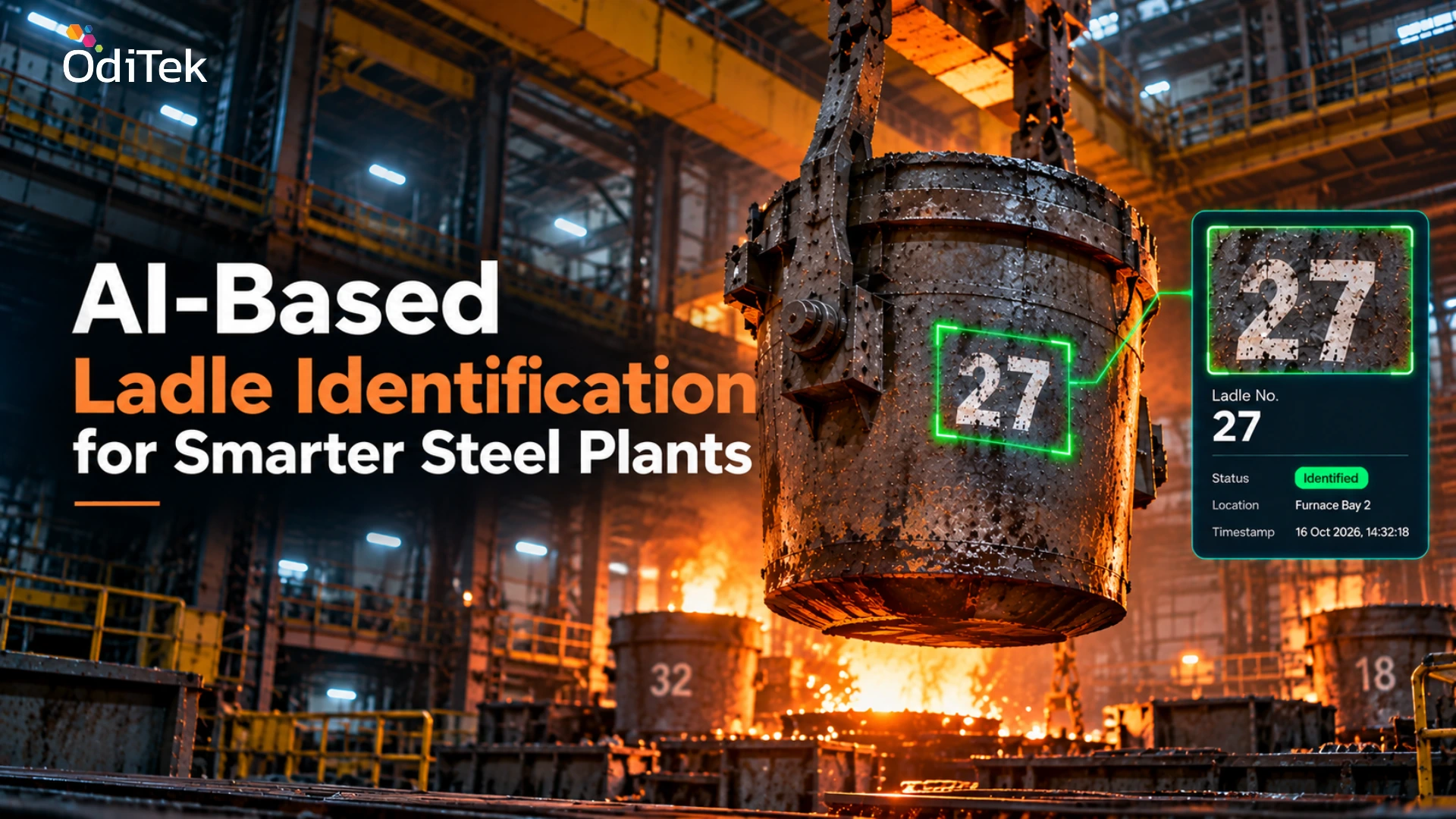
AI-Based Ladle Identification uses cameras and Vision AI to detect each ladle, read its number and log its movement automatically, replacing manual tracking in steel plants. A ladle can change hands a dozen times before a heat is cast, and every transfer should be recorded: which ladle, where, and when. When that record depends on someone watching and writing it down, gaps and mistakes creep in.
The result is a live, timestamped digital record of every ladle across your monitored zones, with no manual data entry. This blog explains how the technology works, where it helps most, and how to implement it successfully on a real shop floor.
Why Ladle Tracking Matters in Steel Plants
Ladles carry molten metal between furnaces, refining stations and casting, so knowing exactly where each one is, and what it has been through, directly affects quality, safety and throughput.
Reliable ladle traceability supports:
•Heat and quality traceability: linking every heat to the exact ladle that carried it, which makes root-cause analysis far easier when a quality issue appears.
•Ladle life and refractory management: tracking how many heats each ladle has handled so that maintenance and relining are planned on data, not guesswork.
•Safety and control: knowing which ladle is in which bay, and flagging unexpected movement.
•Turnaround time: spotting where ladles wait and where delays build up in the cycle.
Manual tracking struggles with all four. It depends on operators observing and recording events in a hot, noisy and fast-moving environment, which makes it slow and hard to audit.
What Is AI-Based Ladle Identification?
AI-Based Ladle Identification is a computer vision application that identifies ladles from camera footage. It detects a ladle in the frame, reads the identification number painted or marked on it, and ties that reading to a camera location and a timestamp.
A Vision AI solution can:
•Detect ladles in live camera feeds.
•Read ladle numbers using image recognition and optical character recognition (OCR).
•Record the timestamp and camera location of every identification event.
•Track ladle movement through predefined monitoring zones.
•Flag unreadable numbers, unidentified ladles and unexpected movement for review.
•Send detection data to dashboards and connected industrial applications such as MES.
The goal is not just to spot a ladle in an image. It is to turn video into reliable operational data that your teams can search, report on and act on.
How Automated Ladle Number Detection Works
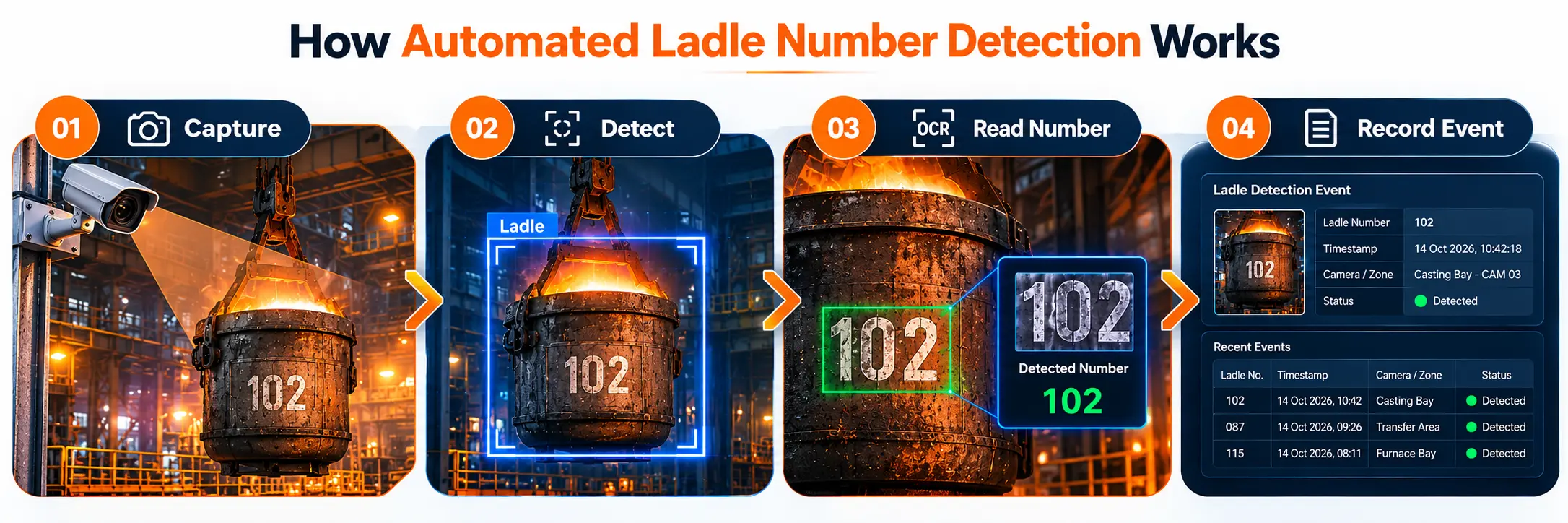
Automated Ladle Number Detection pairs camera monitoring with AI models trained on your plant’s own ladles, markings and lighting. A typical workflow has four stages:
Step 1: Image and video capture
Industrial cameras, or existing CCTV where the view is suitable, capture ladles at key points such as furnace bays, transfer areas, crane paths and casting sections.
Step 2: Ladle detection
The Vision AI model scans each video frame and finds the ladle, separating it from cranes, structures and other plant activity.
Step 3: Ladle number recognition
Once the ladle is located, an OCR or number-recognition model reads the characters. Image enhancement helps with glare, dust, heat haze and changing angles, and a confidence score is attached to every reading.
Step 4: Event recording
The system stores the recognized number, timestamp, camera or zone and detection details. Connected to a plant application, these events become digital logs and reports.
How an AI-Based Ladle Tracking System Improves Plant Operations
An AI-Based Ladle Tracking System gives you a digital view of where each ladle has been detected and when it moved between monitored locations. Instead of relying on operators to observe and write things down, the data comes straight from the camera feeds.
•Location monitoring: detect ladles at predefined production and transfer zones.
•Movement tracking: record events as ladles move between monitored areas.
•Digital identification records: link each recognized number to a timestamp and camera location.
•Exception detection: flag unreadable numbers, unidentified ladles and unexpected zone events for operator review.
•Operational reporting: generate ladle-wise movement histories on demand.
For tracking across several locations, cameras need adequate coverage and the system must match detections to the same ladle from one camera to the next. This is handled with identity-matching logic that is designed into the solution from the start.
What Are the Benefits of Automated Ladle Number Recognition?
Automated ladle number recognition improves identification accuracy, record-keeping and visibility across the plant.
Key benefits include:
1.Less manual effort: Operators no longer log every identification event by hand and can focus on production and on exceptions.
2.More consistent identification: The same recognition process runs on every feed, around the clock, removing the variation of handwritten records. Low-confidence readings are routed for quick human verification.
3.Stronger traceability: A timestamped, location-linked history of every ladle supports audits, quality reviews and investigations into discrepancies.
4.Faster access to data: Authorized users can pull up any ladle’s history from a dashboard instead of searching through separate logs.
5.Better operational visibility: Teams see ladle activity across zones in near real time, with alerts for missing identification or unexpected movement.
6.Data-driven decisions: Historical records reveal recurring delays and bottlenecks, and combined with other plant data they support wider process improvement.
Challenges and Best Practices for Implementing Vision AI for Ladle Identification
Steel plants are tough for computer vision: heat, molten-metal glare, smoke, dust, steam, moving cranes and limited camera angles all affect what a camera can see. These challenges are well understood, and a good implementation plans for them from day one.
1.Choose camera positions carefully: Capture ladle markings clearly at key monitoring points. Check viewing angles, movement paths and lighting before fixing locations.
2.Train on real plant data: Use images and video of your own ladles, number formats, angles, lighting conditions and partial obstructions so the model is proven on actual conditions.
3.Optimize number recognition: Use clear, high-contrast markings and the right image processing. Set confidence thresholds and a quick manual verification step for uncertain reads.
4.Define tracking zones: Decide which locations matter, which events get logged, and how movement between zones is linked.
5.Integrate with existing systems: Connect events to your MES, dashboards or other applications according to your plant architecture.
6.Start with a pilot: Begin with a few cameras and zones, measure recognition accuracy, missed detections and false identifications, then scale with confidence.
Why Choose OdiTek Solutions?
OdiTek Solutions builds AI-powered software for industrial monitoring and automation. Its Vision AI platform, REG-EYE, turns camera feeds into detections and operational events that plant teams can use.
For AI-Based Ladle Identification, OdiTek designs the solution around your plant, covering:
•AI-powered visual detection: identify ladles in your camera feeds.
•Ladle number recognition: read ladle numbers with confidence scoring and verification for uncertain results.
•Event-based monitoring: record timestamps and monitored locations for every detection.
•Dashboards and reports: present ladle events and histories in a clear, searchable view.
•Integration: connect event data with your existing business and industrial applications.
Every project starts with a site assessment and a pilot, so feasibility and expected performance are proven on your shop floor before full rollout.
Final Thoughts
AI-Based Ladle Identification lets steel manufacturers move from manual, error-prone logging to automatic, timestamped ladle records. With stronger traceability, less manual effort and clearer visibility across zones, plants can run tighter, better-documented operations.
The best results come from the whole system working together: the right camera placement, clear markings, a model trained on your conditions, solid tracking logic and proper integration.
Ready to see it in action? Visit our Vision AI page and contact us today to explore more.
Frequently Asked Questions (FAQs)
1. What is AI-Based Ladle Identification?
AI-Based Ladle Identification uses computer vision to detect ladles and read their identification numbers from camera footage. Each detection is recorded as a timestamped event, supporting monitoring and traceability in steel plants.
2. How does AI identify ladle numbers in steel plants?
The AI first detects the ladle in the camera image and locates its number. An OCR or number-recognition model then reads the characters, with a confidence score for each reading. Uncertain results are flagged for quick manual verification.
3. What is an Automated Ladle Number Detection system?
It is a camera-based solution that detects ladles and automatically reads their numbers using AI and image recognition. Results are stored as digital identification events that can be searched and reported on.
4. What are the benefits of an AI-Based Ladle Tracking System?
It reduces manual record-keeping, improves identification consistency, builds timestamped movement histories and gives better visibility of ladle activity across production zones.
5. Can Vision AI track ladles in challenging steel plant environments?
Yes. Vision AI can be designed for heat, glare, smoke and moving equipment through careful camera placement, training on real plant data and image enhancement. A site assessment and pilot confirm the accuracy you can expect before full deployment.
6. Can existing CCTV cameras be used for ladle identification?
Often, yes, if they give a clear view of the ladle and its marking. A site assessment will show whether existing cameras are enough or whether a few dedicated cameras are needed at key points.