
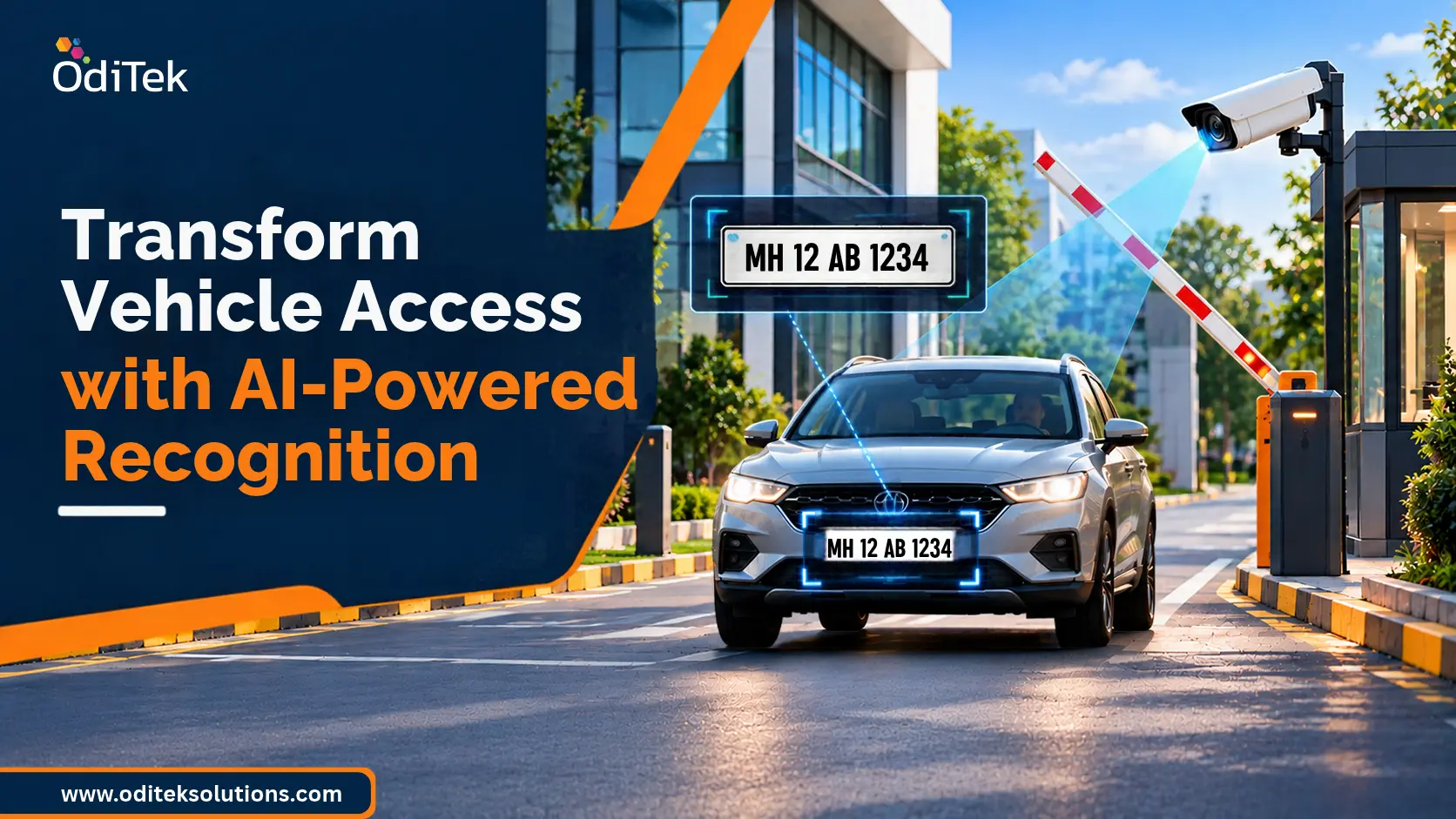
License Plate Recognition System technology is transforming how enterprises monitor vehicles, manage entry points, and strengthen security across their facilities. From corporate campuses and industrial plants to warehouses, commercial buildings, and parking facilities, businesses need reliable ways to identify vehicles and control access without depending entirely on manual checks.
Traditional vehicle entry procedures often involve security personnel verifying registration numbers, checking passes, and maintaining entry logs. These processes can be time-consuming and may leave room for human error. An automated system can simplify these tasks by identifying license plates through camera footage and comparing the captured information against authorized vehicle records.
By combining artificial intelligence (AI), computer vision, and automated monitoring, enterprises can improve visibility, streamline vehicle movement, and maintain more consistent access control. Understanding how this technology works and where it delivers value can help businesses make informed security investments.
What Is a License Plate Recognition System?
A License Plate Recognition System is a technology that automatically detects and reads vehicle registration plates from images or video streams. It uses optical character recognition (OCR) and image-processing techniques to convert the characters on a license plate into digital information that software can process.
The system can be integrated with existing CCTV cameras, access barriers, parking management platforms, and security applications, depending on the deployment requirements.
A typical solution includes the following components:
•Camera infrastructure: Captures images of vehicles approaching an entrance, exit, or monitoring zone.
•AI-powered image processing: Detects the vehicle and identifies the license plate within the captured image.
•Character recognition: Converts the plate characters into readable digital data.
•Database integration: Checks the recognized plate against authorized vehicle lists, visitor records, or watchlists.
•Automated alerts and reporting: Records vehicle movements and generates notifications when configured conditions are met.
The technology is also known as a number plate recognition system. When recognition and processing happen automatically, it is commonly called an automatic license plate recognition system (ALPR).
Although recognition accuracy depends on factors such as lighting, camera placement, plate condition, and vehicle speed, a properly configured solution can help enterprises automate routine vehicle identification tasks.
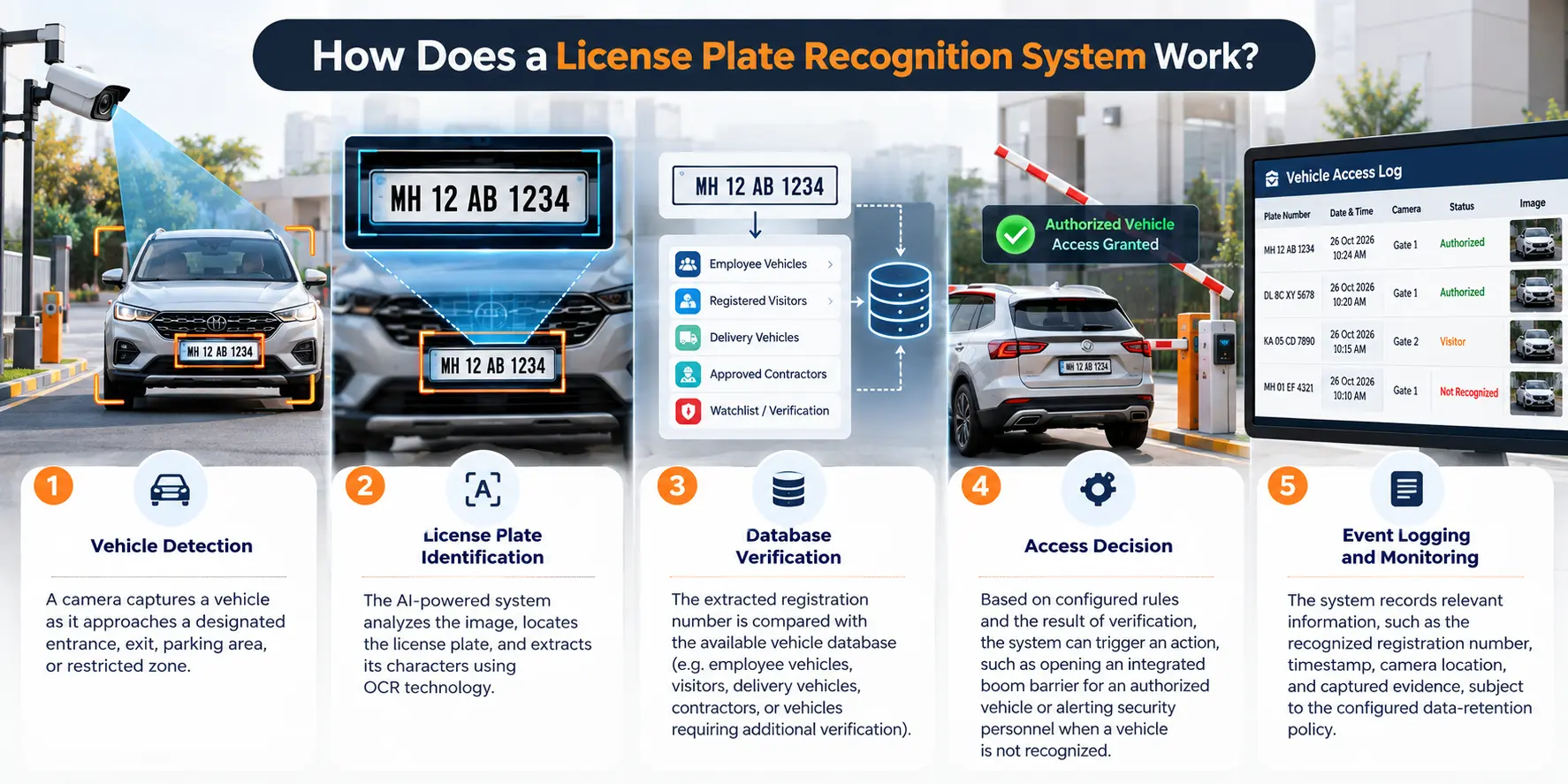
How Does a License Plate Recognition System Work?
A license plate recognition system follows a sequence of steps to identify vehicles and support security decisions.
Step 1: Vehicle detection
A camera captures a vehicle as it approaches a designated entrance, exit, parking area, or restricted zone.
Step 2: License plate identification
The AI-powered system analyzes the image, locates the license plate, and extracts its characters using OCR technology.
Step 3: Database verification
The extracted registration number is compared with the available vehicle database. The database may contain employee vehicles, registered visitors, delivery vehicles, approved contractors, or vehicles requiring additional verification.
Step 4: Access decision
Based on configured rules and the result of verification, the system can trigger an action. For example, it may signal an integrated boom barrier to open for an authorized vehicle or alert security personnel when a vehicle is not recognized.
Step 5: Event logging and monitoring
The system records relevant information, such as the recognized registration number, timestamp, camera location, and captured evidence, subject to the configured data-retention policy.
This automated workflow reduces repetitive manual checks and gives security teams better visibility into vehicle activity. For sensitive locations, enterprises can combine plate recognition with visitor authorization, security personnel approval, or additional identity checks.
How a License Plate Recognition System Improves Enterprise Security
Enterprise security requires more than monitoring entrances. Organizations must also identify suspicious activity, maintain records, and respond to potential threats across multiple locations.
A License Plate Recognition System can strengthen these processes in several ways:
1.Automated vehicle identification: Security personnel can identify registered vehicles without manually recording every registration number. This supports faster verification and more consistent monitoring.
2.Detection of unauthorized vehicles: When an unregistered vehicle approaches a controlled entrance, the system can notify security teams or initiate a configured verification procedure.
3.Monitoring restricted areas: Cameras installed near sensitive zones can help identify vehicles entering areas where access is restricted. Alerts can be configured for unauthorized entry or other defined conditions.
4.Improved incident investigation: Searchable vehicle records and associated camera footage can help investigators review when and where a vehicle was observed. This can be useful when investigating unauthorized entry, theft, or other security incidents.
5.Centralized security visibility: Enterprises operating multiple facilities can integrate vehicle events into a central monitoring platform, subject to system compatibility. This allows security teams to review activity across different locations more efficiently.
However, license plate recognition should be treated as one layer of a broader security strategy. Plate recognition alone does not establish the identity of a driver or passenger, and unfamiliar vehicles should not automatically be treated as threats without appropriate verification.
License Plate Recognition Parking System for Access Control
Parking facilities are among the most practical applications of vehicle recognition technology. A license plate recognition parking system can automate vehicle entry, exit, and registration while reducing reliance on paper tickets and manual recordkeeping.
For corporate offices, residential complexes, shopping centers, hospitals, and industrial facilities, the technology can support a more organized parking experience.
Key applications include:
•Automatic entry and exit: Recognize registered vehicles and trigger compatible barriers according to configured access rules.
•Employee parking management: Maintain lists of approved employee vehicles and apply access permissions based on schedules or designated parking areas.
•Visitor vehicle registration: Associate a vehicle with a visitor record or approved appointment to simplify verification at the gate.
•Parking occupancy monitoring: Combine recognition events with parking sensors or other systems to improve visibility into space availability.
•Vehicle movement records: Maintain timestamped entry and exit logs for operational reporting and security reviews.
What are the benefits of using a License Plate Recognition System for parking and access control? The primary benefits include less manual data entry, faster processing of registered vehicles, improved record accuracy, and better visibility into vehicle movements.
For these benefits to materialize, the solution must be integrated with the parking or access control infrastructure and configured to handle exceptions such as unreadable plates, duplicate registrations, and temporary visitor access.
Key Benefits and Use Cases Across Industries
Beyond parking facilities, an automatic license plate recognition system can support vehicle monitoring across different business environments.
1.Manufacturing and industrial plants:
Monitor vehicles entering production areas, loading zones, weighbridges, and restricted operational spaces. Recognition events can help correlate vehicle movements with dispatch or material-handling records when integrated with relevant systems.
2.Warehouses and logistics centers:
Record the arrival and departure of trucks, support gate verification, and help security teams review vehicle activity during loading and unloading operations.
3.Corporate campuses:
Manage employee, contractor, and visitor vehicle access while maintaining searchable records of entry and exit events.
4.Commercial properties:
Improve parking operations and provide a more consistent entry process for registered customers, tenants, and service providers.
5.Ports and transportation facilities:
Monitor vehicle movement at designated checkpoints and support operational workflows involving multiple gates or vehicle categories.
Across these environments, the benefits of license plate recognition extend beyond convenience. Businesses can reduce repetitive administrative work, improve traceability, and make better use of existing camera infrastructure.
The actual results depend on factors such as the number of monitored entry points, camera quality, traffic conditions, integration requirements, and the accuracy of the vehicle database. Organizations should evaluate these factors before deploying the technology at scale.
Why Choose Us?
At OdiTek Solutions, we help businesses explore technology-driven approaches to security, automation, and operational visibility. Our AI-powered video intelligence capabilities can support use cases involving vehicle identification, surveillance monitoring, and event detection.
With REG-EYE, our video intelligence platform, organizations can explore solutions that turn camera feeds into actionable information for operational and security teams.
Depending on the project requirements, our capabilities can support:
•AI-powered vehicle monitoring: Identify vehicles and capture relevant events across designated monitoring areas.
•Automated security workflows: Connect recognition events with configured alerts and operational processes.
•Integration with existing infrastructure: Assess how video intelligence can work with compatible cameras, access control systems, and enterprise applications.
•Centralized monitoring: Improve visibility into events across supported locations through integrated monitoring workflows.
•Customized enterprise solutions: Align implementation with site-specific requirements, operational constraints, and security objectives.
Every deployment has different requirements. Camera positioning, lighting, recognition performance, database quality, network conditions, and integration compatibility must be evaluated to determine the right solution.
If your organization is considering a License Plate Recognition System for enterprise security, parking automation, or vehicle access management, OdiTek Solutions can help you assess the use case and identify a suitable implementation approach.
Final Thoughts
A License Plate Recognition System offers enterprises a practical way to improve vehicle identification, strengthen access control, and simplify parking management. By automating registration plate recognition and connecting the results with existing security workflows, organizations can reduce manual effort while maintaining more consistent vehicle records.
The technology is especially valuable for facilities with frequent vehicle movement, multiple entry points, restricted areas, or complex parking requirements. Combining license plate recognition with human oversight, reliable camera infrastructure, and appropriate access control measures can help organizations build a more effective security environment.
Ready to strengthen vehicle security and automate access management with AI? Explore OdiTek’s ALPR System to discover our Vision AI solutions, or contact our team today to discuss your requirements.
Frequently Asked Questions (FAQs)
1. What is a License Plate Recognition System used for?
A License Plate Recognition System identifies and reads vehicle registration plates from camera footage. Enterprises use it for vehicle monitoring, parking management, access control, security surveillance, and maintaining vehicle entry and exit records.
2. How does a License Plate Recognition System improve enterprise security?
It helps identify registered vehicles, flag vehicles that do not match configured authorization rules, monitor restricted areas, and maintain searchable records for investigations. Integration with access control systems can also support automated entry decisions.
3. What is the difference between a number plate recognition system and an automatic license plate recognition system?
Both terms describe technology that reads vehicle registration plates from images or video. An automatic license plate recognition system emphasizes automated detection and character extraction, often as part of a wider workflow involving databases, alerts, and access control.
4. What are the benefits of a License Plate Recognition System for parking and access control?
Key benefits include faster vehicle verification, reduced manual ticketing and data entry, improved entry and exit records, streamlined access for registered vehicles, and better visibility into parking activity. Results depend on the deployment and its integration with existing systems.
5. Can a License Plate Recognition System integrate with existing CCTV cameras and boom barriers?
Yes, integration may be possible when the cameras, processing platform, and barrier controllers meet the solution’s technical requirements. Compatibility, camera image quality, available interfaces, network connectivity, and access control rules should be evaluated before implementation.