AI PaaS is reshaping enterprise integration as businesses increasingly rely on cloud applications, APIs, data platforms, and AI tools.
By connecting these systems efficiently, organizations can improve productivity, automate workflows, streamline operations, and deliver better customer experiences.
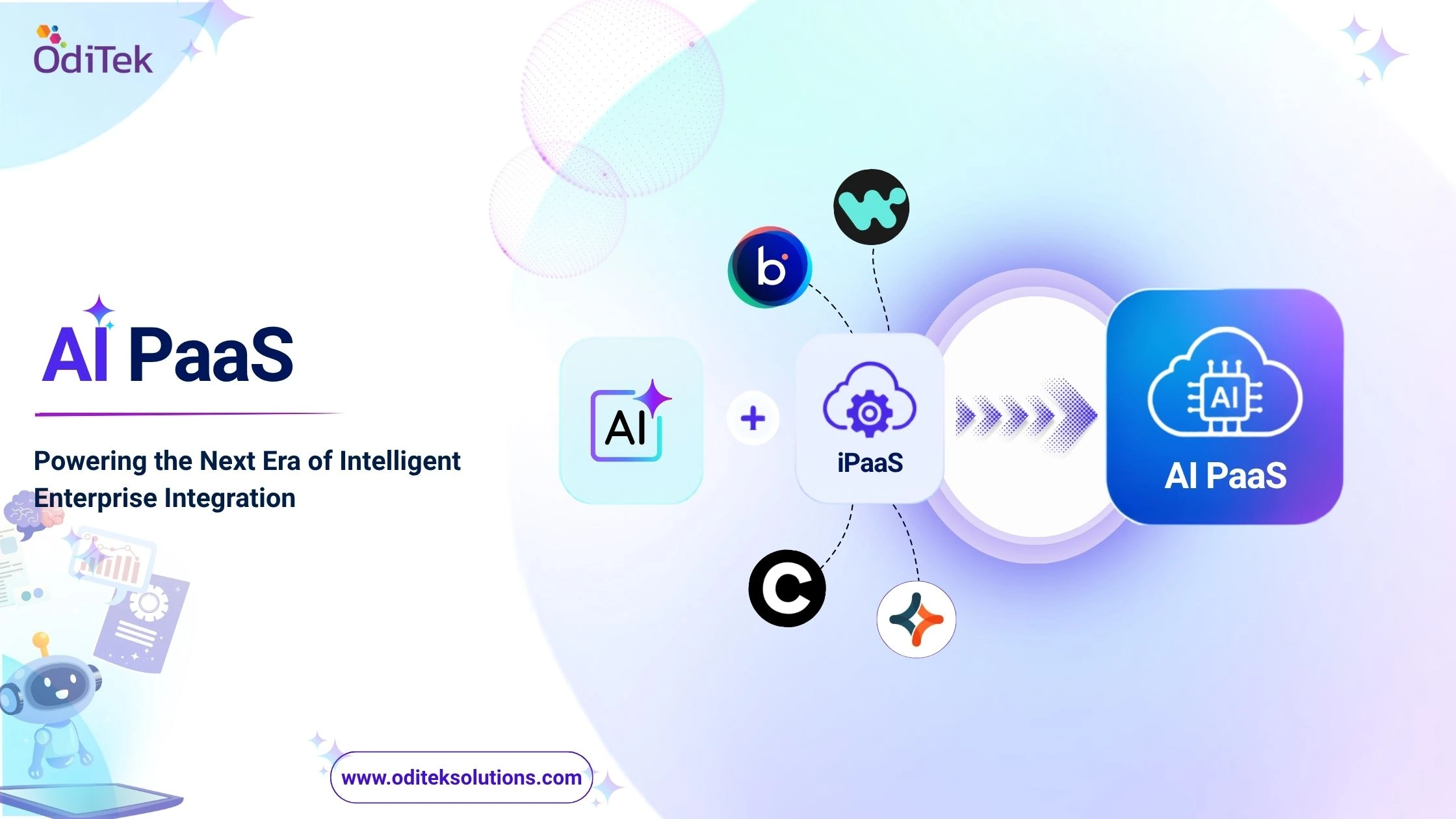
When combined with Integration Platform as a Service (iPaaS), AI PaaS helps businesses build smarter, more scalable, and connected digital ecosystems.
By bringing artificial intelligence into integration platforms, organizations can move beyond basic connectivity toward intelligent, automated, and adaptive business processes.
What is AI PaaS?
AI PaaS (Artificial Intelligence Platform as a Service) is a cloud-based platform that provides the infrastructure, tools, APIs, and development capabilities required to build, deploy, and manage AI-powered applications.
Unlike traditional development environments, an AI PaaS platform can simplify access to machine learning models, generative AI capabilities, data processing, APIs, and automation tools. This enables businesses to develop intelligent solutions without managing complex AI infrastructure from scratch.
When AI capabilities are combined with integration technologies, enterprises can connect applications while allowing intelligent systems to analyze data, identify patterns, and support automated decision-making.
AI + iPaaS: The Next Step in Enterprise Integration
Traditional iPaaS solutions primarily focus on connecting applications and moving data between systems. The combination of AI+iPaaS takes this capability further.

AI can enhance integration workflows by helping platforms understand data, recommend workflows, detect anomalies, and automate repetitive integration tasks. Instead of simply transferring information from one application to another, intelligent integration can determine what should happen next.
For example, an enterprise could connect its CRM, ERP, customer-support platform, and analytics system through iPaaS. AI can then analyze incoming information, classify customer requests, identify unusual transactions, or trigger appropriate workflows. This creates an integration environment that is more responsive, scalable, and intelligent.
AI Agents in Modern iPaaS Platforms
AI+iPaaS is evolving from deterministic workflow automation toward agentic automation, where AI agents can reason, use enterprise data and tools, make decisions, and execute multi-step actions across connected systems.
Boomi AI
Boomi Agentstudio enables organizations to design, deploy, govern, and orchestrate AI agents. Agents can use enterprise data, APIs, integrations, MCP-enabled tools, and knowledge bases to perform goal-oriented, multi-step tasks with built-in guardrails and observability.
AI by Workato
Workato provides Agent Studio for building and governing AI agents called Genies. Genies use LLMs, knowledge bases, and Skills to understand context, call workflows, and execute multi-step actions across enterprise applications.
AI by Workato performed as a utility connector for embedding AI capabilities such as text analysis, classification, summarization, and translation into recipes.
Celigo AI
Celigo AI Agents can reason, decide, and act across enterprise systems. Celigo’s Agent Builder provides low-code tools, multi-step logic, MCP connectivity, and runtime governance, including guardrails, approvals, and audit trails. AI agents can also be embedded directly into Celigo flows and APIs.
Jitterbit AI
It enables organizations to build custom AI agents using Jitterbit Studio, connect them to enterprise systems through pre-built connectors, and expose agents through APIs. Jitterbit also provides pre-built agents through its Marketplace for autonomous business-process automation.
Benefits of Combining AI and iPaaS:
1. Intelligent Automation
AI can automate decisions within integration workflows, reducing manual intervention and accelerating business processes.
2. Better Data Processing
AI can classify, summarize, transform, and analyze large volumes of data flowing between connected systems.
3. Faster Integration Development
AI-assisted recommendations and automation can reduce the effort required to design and maintain integration workflows.
4. Improved Anomaly Detection
AI can identify unusual data patterns or integration failures and help teams respond before they become larger operational issues.
5. Scalable Business Operations
Cloud-based integration combined with AI enables organizations to scale workflows as applications, data sources, and business requirements grow.
How Can AI and iPaaS Improve Enterprise Integration?
Enterprise integration spans SaaS applications, legacy systems, databases, APIs, and cloud services.
AI-powered iPaaS adds intelligence to this integration layer, helping with:
• Data mapping and transformation
• Workflow generation and optimization
• Intelligent routing and exception handling
• Monitoring and troubleshooting
With AI agents in iPaaS, integration is moving beyond predefined workflows toward more adaptive, goal-driven automation. Agents can understand requirements, interact with connected systems, execute multi-step workflows, and assist with operational decisions.
At OdiTek, we leverage AI agents within modern iPaaS platforms to enhance integration and automation.These AI capabilities help us:
• Accelerate integration development
• Reduce manual effort and errors
• Simplify workflow design and implementation
• Improve integration efficiency and delivery speed
By combining iPaaS AI agents with APIs, connectors, workflows, and enterprise systems, we can streamline complex integration processes and deliver scalable, reliable solutions more efficiently.
What Does the Future Hold?
The future of AI PaaS is moving toward autonomous, context-aware integration. AI agents can increasingly generate and modify workflows, map and transform data, monitor integrations, detect anomalies, resolve exceptions, and execute multi-step actions across connected applications.
For enterprises, the focus is shifting from simple connectivity to agent-driven integration, where AI can understand context and execute actions across systems.
At OdiTek, we are leveraging AI agents within modern iPaaS platforms to reduce manual effort, accelerate workflow development, and streamline complex processes.
Key Takeaways
The convergence of AI and iPaaS represents an important shift in enterprise technology. Organizations can move from simple system connectivity toward intelligent integration that supports automation, faster decisions, and scalable digital operations.
For businesses looking to modernize their integration strategy, adopting AI-powered platforms can be a strategic step toward building smarter and more adaptable technology ecosystems.
Explore how OdiTek can help you leverage AI PaaS for scalable, intelligent business automation by visiting our solution page or connecting with us today.
Frequently Asked Questions
1. What is AI PaaS used for?
AI PaaS is used to develop, deploy, and manage AI-powered applications and services using cloud-based infrastructure, tools, APIs, and pre-built capabilities.
2. What are the benefits of combining AI and iPaaS?
Combining AI with iPaaS can improve automation, data processing, workflow optimization, anomaly detection, and operational scalability.
3. How can AI and iPaaS improve enterprise integration?
They can make integration workflows more intelligent by assisting with data transformation, routing, monitoring, automation, and decision-making across connected enterprise applications.
4. Is an AI PaaS platform suitable for enterprises?
Yes. It can help enterprises develop and scale AI solutions while reducing the complexity of managing AI infrastructure and integrating intelligent capabilities into existing technology ecosystems.
5. How does AI+iPaaS differ from traditional integration?
Traditional integration primarily connects systems and transfers data. AI+iPaaS adds intelligence that can analyze information, automate decisions, optimize workflows, and identify potential issues.