Businesses today rely on multiple software platforms to manage daily operations. From customer relationship management and finance to inventory and marketing, every department often uses a different application. While these tools improve productivity individually, they can create Business Integration Challenges when they fail to communicate with one another. As data becomes scattered across systems, manual work increases, decision-making slows down, and customer experiences begin to suffer.
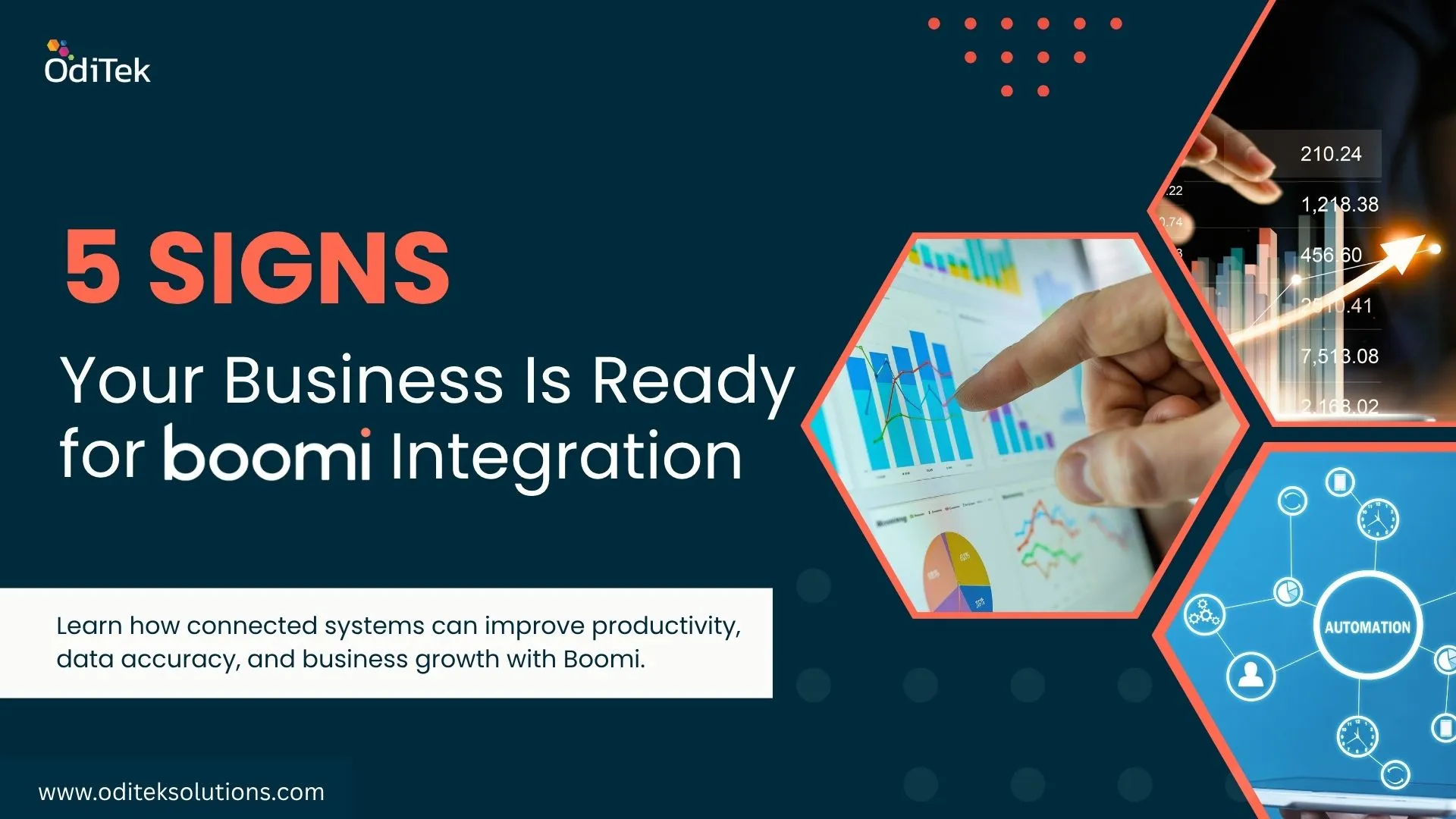
Boomi Integration addresses these problems by securely connecting business applications and automating data flow between them. In this blog, we’ll explore five signs that indicate your business may be ready for Boomi integration and how it can help improve operational efficiency, reduce manual work, and support long-term growth.
Why Business Integration Challenges Are Holding Companies Back
Modern businesses generate data from dozens of applications every day. However, when these systems operate independently, employees often spend valuable time switching between platforms, updating records manually, or correcting inconsistent information.
These disconnected systems don’t just slow internal processes—they also affect customer satisfaction, reporting accuracy, and overall business agility. Without proper integration, organizations struggle to maintain consistent information across departments, making it difficult to respond quickly to changing business needs.
A modern integration platform like Boomi helps eliminate these gaps by creating secure, automated connections between applications, databases, cloud services, and on-premise systems.
5 Signs Your Business Needs Boomi Integration Today
1. Your Teams Spend Too Much Time Entering Data Manually
If employees repeatedly copy information from one application to another, your business is losing valuable time. Manual data entry not only reduces productivity but also increases the likelihood of errors, duplicate records, and outdated information.
It automates these repetitive processes by synchronizing information across connected applications. Instead of manually updating customer details, invoices, or inventory records, your systems remain updated automatically.
This level of Business Process Automation allows employees to focus on higher-value work rather than repetitive administrative tasks.
2. Your Business Systems Don’t Communicate with Each Other
Many growing businesses use separate platforms for sales, accounting, HR, inventory, customer support, and marketing. While each application serves a specific purpose, disconnected systems often create information silos.
For example, your sales team may update customer information in the CRM while the finance team continues working with outdated records in the ERP system.
Boomi simplifies ERP and CRM Integration, allowing both systems to exchange information automatically. This ensures every department works with accurate, consistent, and up-to-date data without requiring manual intervention.
As a result, collaboration improves, reporting becomes more reliable, and customers receive a more consistent experience.
3. You Need Real-Time Business Insights
Business decisions are only as good as the information behind them. If reports are generated using outdated or manually consolidated data, leadership may struggle to make timely decisions.
Real-Time Data Integration enables information to move instantly between connected systems. Sales performance, inventory updates, customer activity, and financial data become available almost immediately, helping teams respond faster to changing conditions.
Whether it’s identifying supply chain issues or monitoring customer orders, having access to live data helps organizations make more informed decisions with greater confidence.
4. Your Existing Integrations Are Difficult to Maintain
Many organizations rely on custom-built integrations that become increasingly difficult to manage over time. Every software update may require additional development, testing, or troubleshooting. This creates unnecessary maintenance costs and slows future technology upgrades.
Boomi offers modern Data Integration Solutions using a low-code integration platform that simplifies development, deployment, and ongoing management. Businesses can create scalable integrations without relying heavily on complex coding, making it easier to adapt as technology evolves.
The result is a more flexible integration environment that reduces long-term maintenance efforts.
5. Business Growth Is Creating More Complexity
Growth is exciting, but it also introduces new operational challenges. Expanding into new markets, adopting additional software, acquiring companies, or increasing transaction volumes often makes integration far more complex.
Without a scalable integration platform, businesses frequently experience delays, inconsistent data, and operational bottlenecks.
Boomi is designed to scale alongside business growth. As new applications are introduced, they can be integrated into existing workflows without rebuilding the entire infrastructure. This flexibility allows businesses to continue growing without creating disconnected processes or unnecessary manual work.
Key Benefits of Boomi Integration
Beyond solving integration issues, Boomi helps organizations create more efficient and connected business operations.
Some of the practical business benefits include:
• Automates repetitive business processes to reduce manual work.
• Synchronizes data across multiple applications in real time.
• Improves collaboration between departments through connected systems.
• Reduces data duplication and improves overall accuracy.
• Scales easily as business applications and users grow.
• Enhances operational efficiency by eliminating repetitive workflows.
• Strengthens security through centralized and governed data movement.
• Supports faster reporting and better business decision-making.
• Lowers integration maintenance costs with a low-code platform.
• Delivers a better customer experience through consistent and updated information.
Real-World Use Cases of Boomi Integration
Organizations across industries use Boomi to simplify complex business processes and improve operational efficiency.
Retail and E-commerce
Retail businesses connect online stores, inventory systems, payment platforms, and shipping providers to ensure product availability, order updates, and customer information remain synchronized.
Manufacturing
Manufacturers integrate ERP systems, production software, warehouse management, and supplier platforms to improve inventory visibility and streamline operations.
Healthcare
Healthcare providers securely connect patient management systems, billing platforms, and laboratory applications to improve data accessibility while maintaining compliance.
Financial Services
Banks and financial organizations integrate customer databases, payment systems, and reporting tools to improve transaction accuracy and accelerate service delivery.
Professional Services
Consulting firms and service providers automate project management, invoicing, CRM, and resource planning to reduce administrative work and improve operational visibility.
How Oditek Solutions Helps Businesses Simplify Integration
Implementing an integration platform requires more than simply connecting applications. Businesses need a solution that aligns with existing workflows, supports future growth, and maintains secure data movement across systems.
Oditek Solutions helps organizations implement Boomi Integration by designing scalable integration architectures that connect cloud applications, on-premise systems, ERPs, CRMs, databases, and third-party platforms. Their approach focuses on reducing integration complexity while improving automation, operational efficiency, and data consistency across the business.
Whether you’re modernizing legacy systems, enabling Real-Time Data Integration, or simplifying ERP and CRM Integration, the goal is to create connected business processes that support long-term digital transformation.
Conclusion
As businesses adopt more digital tools, keeping systems connected becomes essential rather than optional. If your organization is dealing with manual data entry, disconnected applications, delayed reporting, or increasing operational complexity, these are strong indicators that it’s time to modernize your integration strategy.
Addressing Business Integration Challenges with Boomi helps create a connected ecosystem where data flows seamlessly, routine tasks are automated, and teams can make faster, more informed decisions. With the right integration partner, businesses can improve efficiency today while building a scalable foundation for future growth.
Looking to overcome business integration challenges with a smarter integration strategy? Visit our Boomi Integration services page to explore scalable solutions tailored to your business.
Frequently Asked Questions
1. What are Business Integration Challenges?
Business Integration Challenges refer to the difficulties organizations face when different software applications, databases, or business systems cannot share data efficiently. These challenges often result in manual processes, inconsistent information, slower operations, and limited business visibility.
2. How does Boomi support Real-Time Data Integration?
Boomi enables applications to exchange information as changes occur, ensuring systems stay synchronized without manual updates. Businesses can access current data for reporting, customer service, inventory management, and decision-making with the help of Boomi Real-Time Data Integration
3. Can Boomi integrate ERP and CRM systems?
Yes. Boomi simplifies ERP and CRM Integration by securely connecting platforms so customer, sales, financial, and operational data remain consistent across departments. This reduces duplicate work and improves collaboration.
4. What types of businesses benefit from Boomi Integration?
Businesses of all sizes across industries—including manufacturing, retail, healthcare, finance, logistics, and professional services—can benefit from Boomi. Any organization using multiple applications or cloud services can improve efficiency through modern Data Integration Solutions.
5. How does Business Process Automation improve daily operations?
Business Process Automation reduces repetitive manual tasks by allowing systems to exchange information automatically. This minimizes errors, speeds up workflows, improves employee productivity, and lets teams focus on higher-value activities.
6. When should a business consider implementing Boomi Integration?
A business should consider Boomi when manual data entry becomes time-consuming, systems no longer communicate effectively, reporting is delayed, or business growth introduces more applications and complex workflows. Implementing integration early helps prevent operational bottlenecks as the organization scales.