
Your ecommerce store may look great today, but what happens when your product catalog grows, customer journeys become more complex, traffic spikes during a major sale, or your business expands into new markets?
That is where the right technology foundation makes a difference. Adobe Commerce website development gives businesses the flexibility to build customized shopping experiences, manage complex ecommerce operations, and create a store that can evolve alongside the business. But development is only one part of the journey. Ongoing optimization and reliable technical support are equally important for keeping the store fast, secure, and ready for what comes next.
In this guide, we’ll explore the Adobe Commerce platform, the key capabilities it offers, what goes into building and optimizing a store, and why continued support matters after launch.
Understanding the Adobe Commerce Platform
The Adobe Commerce platform brings core commerce operations, customer experiences, and extensibility into one environment. Businesses can manage products, pricing, promotions, customer accounts, orders, and storefront content while extending functionality through APIs and available extensions.
For growing brands, the Adobe Commerce platform can support multiple websites, stores, languages, currencies, and business models from a shared commerce foundation. Its B2B capabilities can also support company accounts, shared catalogs, quick ordering, and quote workflows.
Adobe Commerce Website Development: Build a Store Around Your Business
A successful project starts with business requirements rather than templates. During Adobe Commerce website development, teams typically define the information architecture, product catalog structure, user journeys, checkout flow, integrations, content model, and performance requirements.
A practical development process can include:
• Requirement discovery and solution planning
• UX/UI design and responsive storefront development
• Custom theme and feature development
• Catalog, pricing, promotions, and checkout configuration
• API-based connections with business systems
• Quality assurance, security checks, performance testing, and launch preparation
The goal is not simply to launch a store. It is to build an ecommerce experience that is easy to manage, relevant to customers, and ready to evolve.
What built-in tools does Adobe Commerce provide?
One of the advantages of Adobe Commerce is that businesses do not have to build every ecommerce capability from the ground up. The platform comes with tools that address important areas of the customer and merchant experience, from content creation and product discovery to personalization and payments.
Some of the key capabilities include:
• Page Builder: Helps teams create and manage rich storefront content, landing pages, banners, and promotional layouts without depending on developers for every content change.
• Live Search: Makes it easier for customers to find relevant products through fast search, intelligent suggestions, and more effective product discovery.
• Product Recommendations: Uses shopper behavior and catalog data to surface relevant products and create more personalized shopping experiences.
• Payment Services: Provides a streamlined way to manage online payment capabilities as part of the checkout experience.
• B2B features: Supports business-focused requirements such as company accounts, shared catalogs, negotiated pricing, and purchasing workflows.
These built-in capabilities can shorten development time while giving merchants more control over everyday ecommerce operations. At the same time, the Adobe Commerce platform can be extended through customization and additional capabilities when standard features are not enough for a specific business requirement.
Optimize Your Store After Development
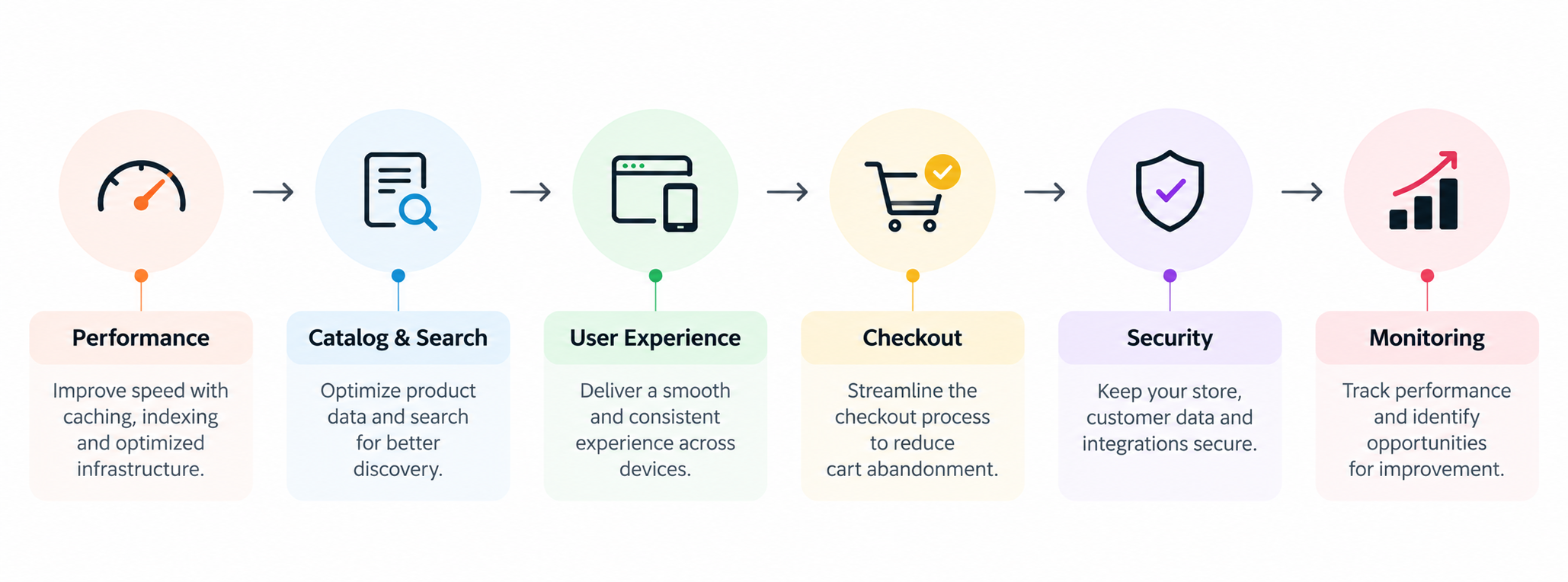
Launching a store is only the beginning. A strong optimization program should examine page speed, Core Web Vitals, caching, indexing, database performance, images, checkout flow, mobile usability, and conversion paths.
Adobe Commerce website development should therefore be approached with performance in mind from the start. Ongoing monitoring, optimization, bug fixing, updates, and user support are important parts of maintaining a healthy ecommerce environment.
Regular reviews can identify slow pages, technical bottlenecks, broken customer journeys, and opportunities to improve search and merchandising.
Why Adobe Commerce Support Matters
A commerce store can be affected by platform updates, third-party extensions, integration issues, security concerns, configuration changes, and unexpected performance problems. Adobe Commerce support helps businesses address these issues while keeping day-to-day operations moving.
Good Adobe Commerce support can cover areas such as:
• Bug investigation and resolution
• Version and patch planning
• Performance monitoring and optimization
• Security and configuration checks
• Extension troubleshooting
• Storefront and checkout fixes
• Ongoing technical enhancements
Ongoing maintenance can include bug fixing, catalog management, configuration, feature enhancements, indexing, monitoring, and upgrades.
What makes Adobe Commerce different from other ecommerce platforms?
The biggest distinction is flexibility. The Adobe Commerce platform is designed to support complex commerce requirements while allowing businesses to customize the storefront and extend the underlying functionality. It also supports multiple business models, flexible frontend architecture, a broad extension ecosystem, and scalable commerce operations.
That flexibility can be valuable for businesses with large catalogs, B2B requirements, multiple storefronts, custom workflows, or a need for differentiated digital experiences.
Why Choose OdiTek?
OdiTek can support businesses across the ecommerce lifecycle, from planning and development to optimization and ongoing Adobe Commerce support. Our approach focuses on understanding business requirements first, then aligning the storefront, functionality, performance, and maintenance strategy around those needs.
With the right technical approach, Adobe Commerce website development becomes more than a store-building exercise. It becomes a foundation for creating a dependable ecommerce experience that can adapt as products, customers, and business requirements change. A proactive Adobe Commerce support strategy can then help protect that investment as the store evolves.
Final Thoughts
Building an ecommerce store is a long-term investment, and choosing the right technology is only one part of the process. The real value comes from combining thoughtful development, strong performance, continuous optimization, and dependable technical maintenance.
A well-planned commerce experience can make everyday operations easier, improve customer journeys, and give businesses the flexibility to adapt as their needs grow.
Discover our Magento development expertise and see how we can support your eCommerce goals.
Talk to our team to get started with a Magento solution designed around your business requirements.
Frequently Asked Questions (FAQs)
1. Can built-in ecommerce features be customized?
Yes. Standard features can be extended to support custom checkout flows, pricing rules, product experiences, and business workflows.
2. When should customization be considered?
After mapping business requirements against existing capabilities. This helps identify where custom development is actually needed.
3. What areas should be reviewed for optimization?
Page speed, caching, database performance, indexing, images, mobile experience, navigation, and checkout should be reviewed regularly.
4. Is technical assistance needed after launch?
Yes. Ongoing assistance helps address updates, extension issues, performance problems, security concerns, and new business requirements.
5. How can businesses prepare for future growth?
Use a flexible architecture, organized product data, scalable development practices, and regular performance improvements from the beginning.
6. What does a development team do after launch?
They can handle enhancements, technical fixes, performance improvements, compatibility issues, and ongoing store updates.