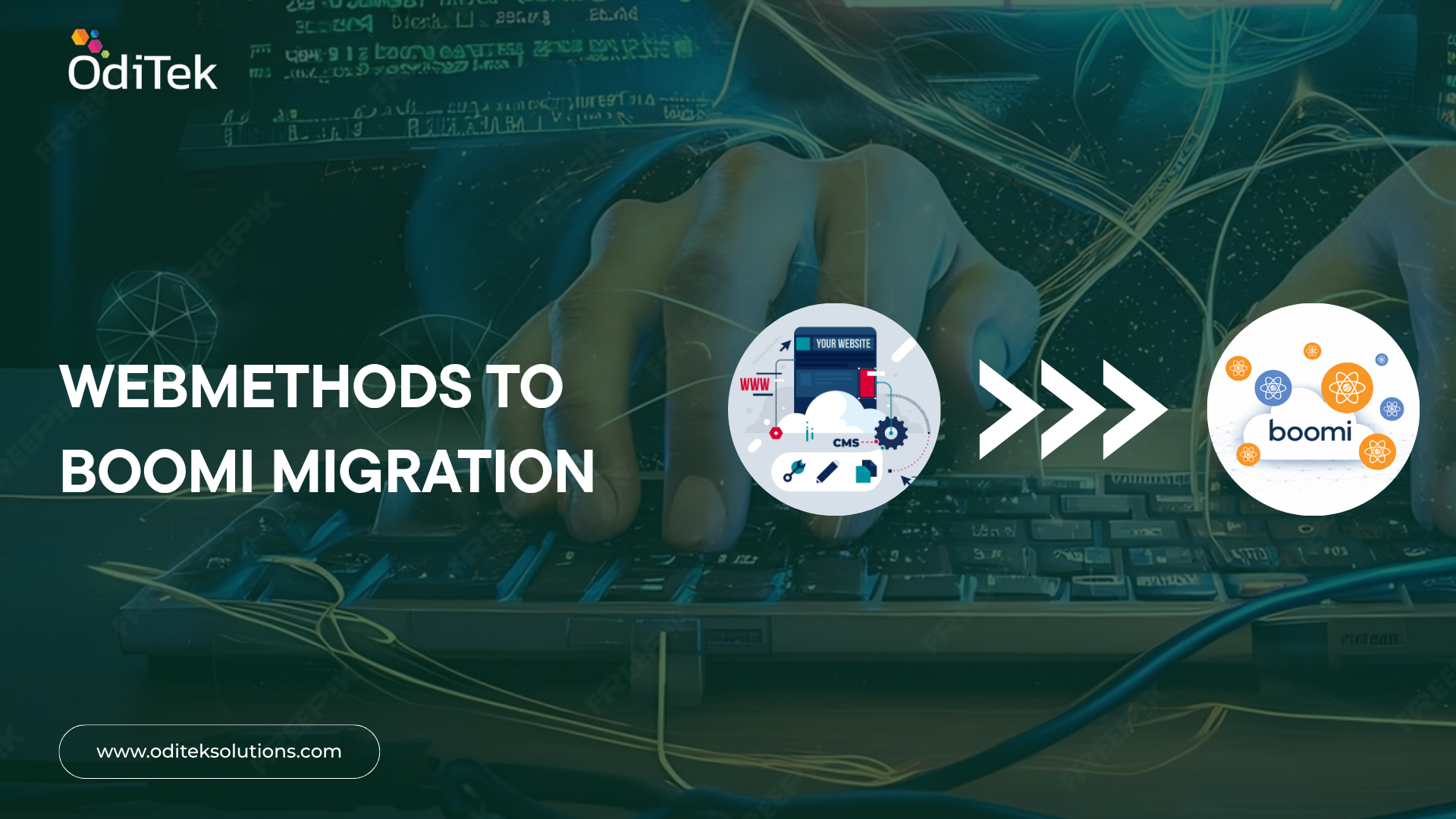
webMethods to Boomi migration is rapidly becoming a strategic priority for enterprises looking to modernize their integration ecosystem and transition from legacy ESB architectures to cloud-native iPaaS platforms. In today’s API-driven economy, organizations require real-time data orchestration, scalable microservices architecture, and low-latency integrations, capabilities that traditional middleware platforms struggle to deliver efficiently.
Understanding webMethods vs Boomi
The comparison between webMethods vs Boomi goes beyond features, it reflects a shift in integration philosophy. WebMethods, a legacy Enterprise Service Bus (ESB) developed by Software AG, is built around centralized orchestration, tightly coupled services, and heavy reliance on on-premise infrastructure. It typically uses Integration Server (IS), Universal Messaging (UM), Trading Networks, and Broker for message routing and transformation. While robust, it often leads to complex dependency management and slower deployment cycles.
In contrast, Boomi is a cloud-native Integration Platform as a Service (iPaaS) designed for loosely coupled, distributed integration architectures. It leverages Atom, Molecule, and Atom Cloud runtimes, enabling horizontal scalability and lightweight deployment. Boomi supports RESTful APIs, event-driven processing, and hybrid integration patterns, making it ideal for modern enterprises.
Why Enterprises Replace webMethods with Boomi?
Organizations are increasingly choosing to replace webMethods with Boomi due to several architectural and operational limitations:
• Monolithic ESB constraints impacting scalability and flexibility
• High Total Cost of Ownership (TCO) due to licensing and infrastructure
• Complex CI/CD pipelines and deployment dependencies
• Limited compatibility with containerization (Docker/Kubernetes)
• Challenges in implementing real-time event streaming and API-first strategies
Boomi addresses these issues with:
• Low-code development environment with drag-and-drop process design
• Native API management and lifecycle governance
• Pre-built connectors for SaaS, ERP, CRM, and databases
• Support for event-driven architecture (EDA) using webhooks and message queues
• Seamless hybrid and multi-cloud integration capabilities
webMethods to Boomi Conversion: Technical Deep Dive
A webMethods to Boomi conversion is not a simple lift-and-shift; it involves re-architecting integration patterns.
Key Component Mapping:
• Flow Services (webMethods IS) → Boomi Process Components
• Trading Networks → Boomi B2B/EDI Integration
• Universal Messaging / Broker → Event-driven integrations (Kafka, queues, webhooks)
• Adapter Services → Boomi Connectors
• Canonical XML models → JSON/XML profiles with transformation shapes
During webmethods to boomi conversion, organizations must also refactor:
• Synchronous SOAP services → Asynchronous REST APIs
• Batch processing → Real-time streaming pipelines
• Centralized orchestration → Distributed microservices orchestration
To accelerate this process, teams may use webmethods to boomi converters, which help extract metadata, mappings, and service logic. However, due to architectural differences, a degree of manual refactoring and optimization is inevitable.
WebMethods Upgrade to Boomi: A Modernization Strategy
Rather than continuing with incremental upgrades, enterprises are opting for a full webmethods upgrade to boomi as part of their digital transformation roadmap.
This upgrade enables organizations to adopt API-led connectivity frameworks, allowing for more modular and reusable integration architectures. It also supports the implementation of microservices and containerized deployments, making systems more scalable and flexible. Additionally, businesses can transition to event-driven and reactive systems, ensuring real-time data processing and responsiveness. Alongside these advancements, organizations benefit from improved observability and monitoring through Boomi’s AtomSphere platform, providing better visibility, performance tracking, and operational control over integrations.
webMethods to Boomi Migration Strategy
A successful webmethods to boomi migration requires a structured and phased approach:
1. Discovery & Assessment
• Inventory existing IS packages, services, and integrations
• Identify tightly coupled dependencies and technical debt
2. Target Architecture Design
• Define API-first and event-driven architecture (EDA)
• Choose between hybrid, cloud-native, or multi-cloud deployment models
3. Data Mapping & Transformation
• Rebuild transformations using Boomi’s Map and Data Process shapes
• Optimize for canonical data models and schema evolution
4. Migration Execution
• Use a phased rollout strategy (pilot → core systems → enterprise-wide)
• Prioritize low-risk integrations before mission-critical workloads
5. Testing & Validation
• Perform end-to-end integration testing (E2E)
• Validate data integrity, latency, and throughput
6. Optimization & Governance
• Implement API governance policies
• Monitor performance using Boomi dashboards and logging frameworks
webMethods Alternative: Why Boomi Leads the Shift
As a leading webMethods alternative, Boomi stands out due to its ability to deliver a rapid development lifecycle powered by reusable components, enabling faster integration deployment and reduced time-to-market. It supports a wide range of integration patterns, including real-time, batch, and event-driven integrations, making it highly adaptable to modern enterprise needs.
Additionally, Boomi offers an extensive connector ecosystem that simplifies connectivity across SaaS, ERP, CRM, and on-prem systems. With built-in capabilities such as Master Data Management (MDM) and API management, organizations can ensure data consistency and governance across applications. Furthermore, its support for composable enterprise architecture allows businesses to build scalable, modular, and future-ready integration frameworks. This makes Boomi a strong candidate for organizations looking to future-proof their integration strategy.
Business Impact of Migration
Enterprises adopting webmethods to boomi migration report:
• 40–60% reduction in development time
• Lower operational and infrastructure costs
• Faster time-to-market for new integrations
• Improved data visibility and decision-making
• Enhanced scalability and system resilience
Conclusion
The transition from webMethods vs Boomi is more than a platform upgrade—it’s a shift toward agile, cloud-native, and API-driven integration ecosystems. By embracing webmethods to boomi conversion, organizations can eliminate legacy bottlenecks, enable real-time data exchange, and align their IT infrastructure with modern business demands.
Is Your Current Integration Platform Equipped for the Future, or Is It Time for a Smarter Shift?
In an era where enterprises rely on real-time data synchronization, API-led connectivity, and event-driven architectures, the limitations of legacy ESB platforms become increasingly evident. If your current integration environment struggles with scalability, high latency, complex dependency management, or delayed deployment cycles, it may be hindering your organization’s ability to innovate and respond to market demands.
Transitioning through a webMethods to Boomi migration enables businesses to adopt a cloud-native, loosely coupled integration framework that supports microservices, hybrid deployments, and seamless application connectivity. By embracing Boomi’s low-code development, distributed runtime architecture, and robust API management capabilities, enterprises can future-proof their integration strategy, accelerate digital transformation, and stay competitive in a rapidly evolving technological landscape.
To know more, contact us and follow our Boomi expertise for more insights.