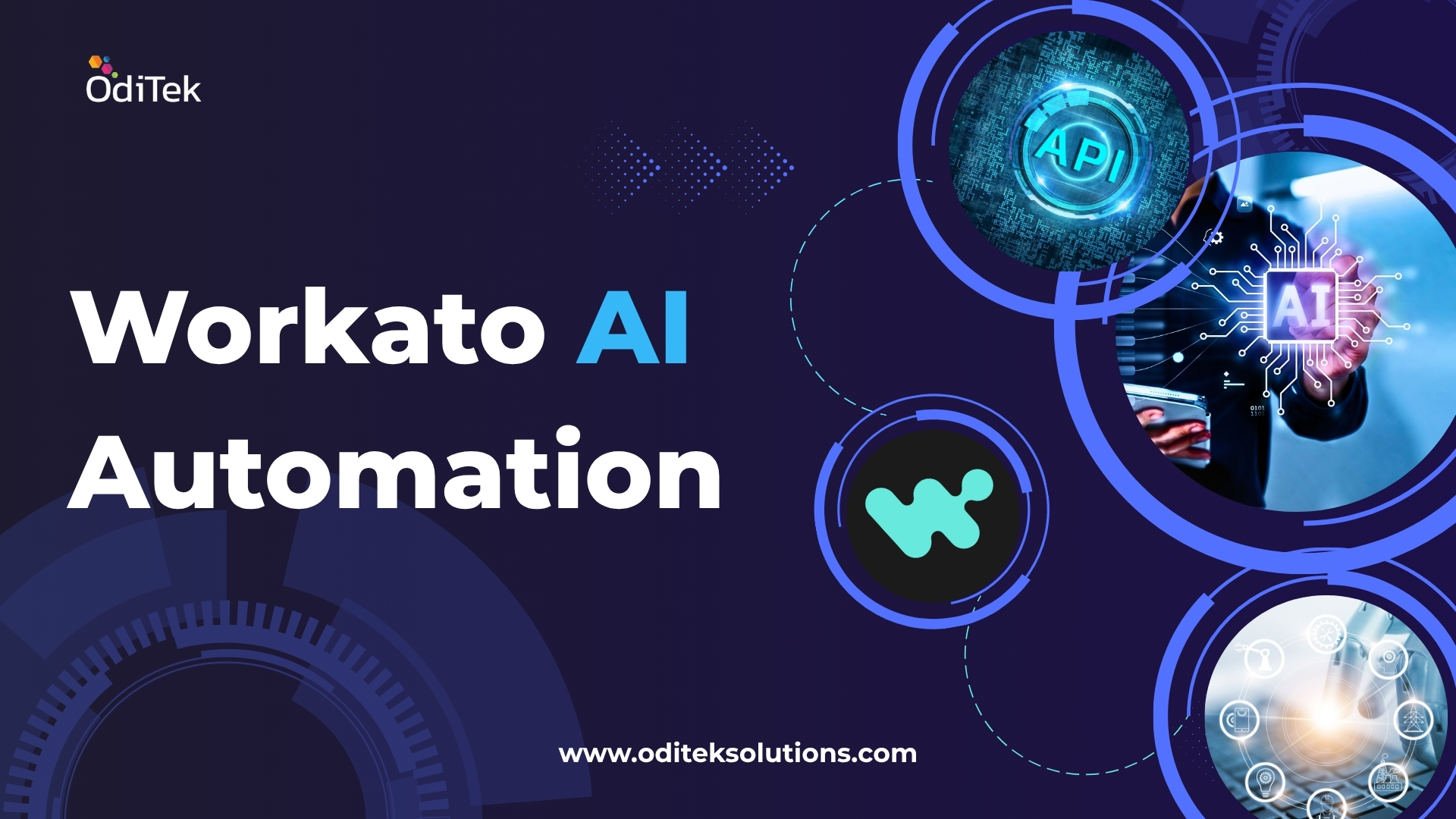
Workato AI Automation is transforming the way businesses manage operations by combining artificial intelligence with enterprise automation. As organisations handle increasing volumes of data across multiple applications, manual processes, disconnected systems, and delayed decision-making can limit efficiency and growth.
Workato addresses these challenges by enabling intelligent workflows that streamline business processes, improve productivity, and accelerate data driven decision making.
From customer service and HR to finance and IT, businesses are increasingly adopting AI-powered automation to eliminate repetitive tasks while empowering employees to focus on strategic initiatives.
What is Workato AI Automation?
Workato AI Automation is an AI-enabled enterprise automation platform that combines low-code integration with Large Language Models (LLMs), machine learning capabilities, and intelligent workflow orchestration.
It enables businesses to automate workflows while using AI for intelligent decision-making, content generation, data analysis, document processing, and predictive actions.
Unlike traditional automation that follows predefined rules, AI-powered automation understands context, analyses information, and recommends or executes the next best action.
Organisations can integrate AI models with enterprise applications without extensive coding, making automation smarter, faster, and more scalable.
How Does AI Improve Automation in Workato?
One of the most common questions organisations ask is “How does AI improve automation in Workato?” To answer this let’s see how AI automation works in general.
Unlike conventional workflow automation, AI introduces intelligence into every stage of business execution.
Workato enhances automation by:
1. AI-driven decision intelligence for faster, context-aware workflow execution.
2. Natural Language Processing (NLP) to classify requests and extract key business data.
3. Large Language Models (LLMs) to generate contextual responses and automate content processing.
4. Machine Learning (ML) to predict outcomes and optimise business workflows.
5. Event-driven automation to trigger real-time actions across integrated enterprise applications.
Instead of merely transferring information between applications, Workato interprets business context and executes intelligent workflows with minimal human intervention.
Workato AI Integration Across Enterprise Systems
Workato AI integration enables seamless connectivity between enterprise applications, APIs, databases, and cloud platforms. By orchestrating data flows in real time, it eliminates data silos, automates cross-functional processes, and ensures consistent information across business systems.
ERP Integration
Workato integrates ERP systems with finance, procurement, inventory, and supply chain applications to automate critical business transactions. This minimizes manual intervention while improving operational visibility and process efficiency.
Key capabilities include:
1. Automated purchase and approval workflows
2. Real-time inventory and financial data synchronization
3. Intelligent order processing and reconciliation
CRM Automation
By connecting CRM platforms with AI-powered workflows, Workato enables sales teams to automate customer lifecycle management and improve pipeline visibility. AI also assists in lead prioritisation and customer engagement.
Common use cases:
1. Lead qualification and opportunity scoring
2. AI-generated sales insights and summaries
3. Automated customer communication
HR Automation
Workato streamlines employee lifecycle management by integrating HRIS, payroll, identity management, and collaboration platforms. AI reduces administrative overhead while ensuring compliance across HR operations.
Typical workflows include:
1. Employee onboarding and user provisioning
2. Payroll and HR data synchronisation
3. Policy, compliance, and leave management
IT Service Management
For IT operations, Workato orchestrates workflows across ITSM, monitoring, and security platforms. Event-driven automation accelerates incident resolution and strengthens operational governance.
Core automation areas:
1. Incident and change management
2. Identity and access provisioning
3. Security alert orchestration
7 Reasons Businesses Prefer Workato for AI Automation
Organizations adopt Workato AI Automation because it combines enterprise integration with AI-native automation capabilities.
1. AI-Native Workflow Orchestration
Integrates generative AI, business logic, and workflow automation into a unified platform.
2. Enterprise Integration Architecture
Supports thousands of enterprise connectors, REST APIs, SOAP services, GraphQL endpoints, databases, and cloud applications.
3. Low-Code Development
Citizen developers and integration specialists can rapidly build production-grade workflows with reusable recipes.
4. Event-Driven Automation
Processes execute instantly through API events, webhooks, queues, and real-time triggers.
5. Enterprise Security & Governance
Supports OAuth 2.0, SAML, RBAC, audit logging, encryption, and enterprise compliance requirements.
6. AI-Augmented Decision Intelligence
Uses LLMs and AI models to improve business decisions through contextual analysis and predictive recommendations.
7. Scalable Automation Platform
Supports enterprise-wide automation across HR, Finance, Sales, IT, Operations, Procurement, and Customer Experience.
Best Practices for AI Automation Implementation
Successful Automation begins with a well-defined integration strategy. Organisations should identify high-impact business processes and design scalable workflows that support real-time data exchange across enterprise applications.
A robust API-first architecture, standardised data models, and secure authentication mechanisms ensure seamless interoperability while maintaining governance and compliance. Regular monitoring also helps optimize workflow performance and quickly resolve integration issues.
To maximize automation outcomes, organizations should focus on:
1. Building reusable automation recipes for faster deployment.
2. Securing integrations with enterprise authentication and access controls.
3. Continuously monitoring and optimizing workflows using operational analytics.
By following these practices, businesses can build intelligent, scalable, and resilient automation solutions that deliver long-term operational efficiency and higher ROI.
Conclusion
Artificial intelligence is reshaping how modern enterprises integrate applications, automate workflows, and make business decisions. By combining AI capabilities with enterprise integration and workflow orchestration, organizations can eliminate manual processes, improve data accuracy, and accelerate operational efficiency across departments.
With seamless connectivity between business systems, real-time data synchronization, and intelligent process automation, Workato enables organizations to build scalable and future-ready digital ecosystems.
As businesses continue to embrace AI-driven transformation, adopting an intelligent automation platform can help improve productivity, enhance customer experiences, and support sustainable business growth in an increasingly connected enterprise environment.
How OdiTek Solves Business Challenges with Workato AI Automation
Q1. Why should businesses choose OdiTek for Workato AI Automation?
OdiTek builds secure, reusable, and scalable Workato recipes that help businesses reduce manual work, improve process accuracy, and scale automation across multiple departments.
Q2. How can OdiTek automate customer service with Workato AI?
OdiTek builds workflows that use AI to classify customer queries, route tickets, generate response summaries, and trigger follow-up actions by integrating CRM, helpdesk, email, chat, and knowledge base platforms.
Q3. How can OdiTek improve finance operations using Workato AI Automation?
OdiTek automates invoice ingestion, approval routing, PO matching, reconciliation, ERP posting, and financial reporting using AI-powered Workato workflows.
Q4. How can OdiTek automate HR operations with Workato AI?
OdiTek connects HRIS, payroll, identity management, and collaboration tools to automate onboarding, employee data updates, leave approvals, policy reminders, payroll sync, and offboarding.
Q5. How can businesses start Workato AI Automation with OdiTek?
OdiTek helps businesses assess existing processes, identify automation opportunities, define integration requirements, and build a scalable Workato AI automation roadmap.
Q6. How does OdiTek build scalable AI automation with Workato?
OdiTek designs modular workflows, reusable recipes, API orchestration layers, and standardized data models so automation can expand across departments without rebuilding from scratch.
Transform your business with intelligent Workato AI Automation with us by visiting our Workato Integration Service Page or Contact with us.