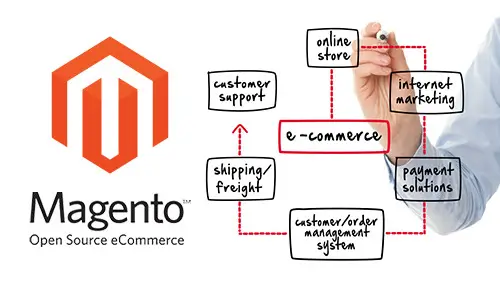
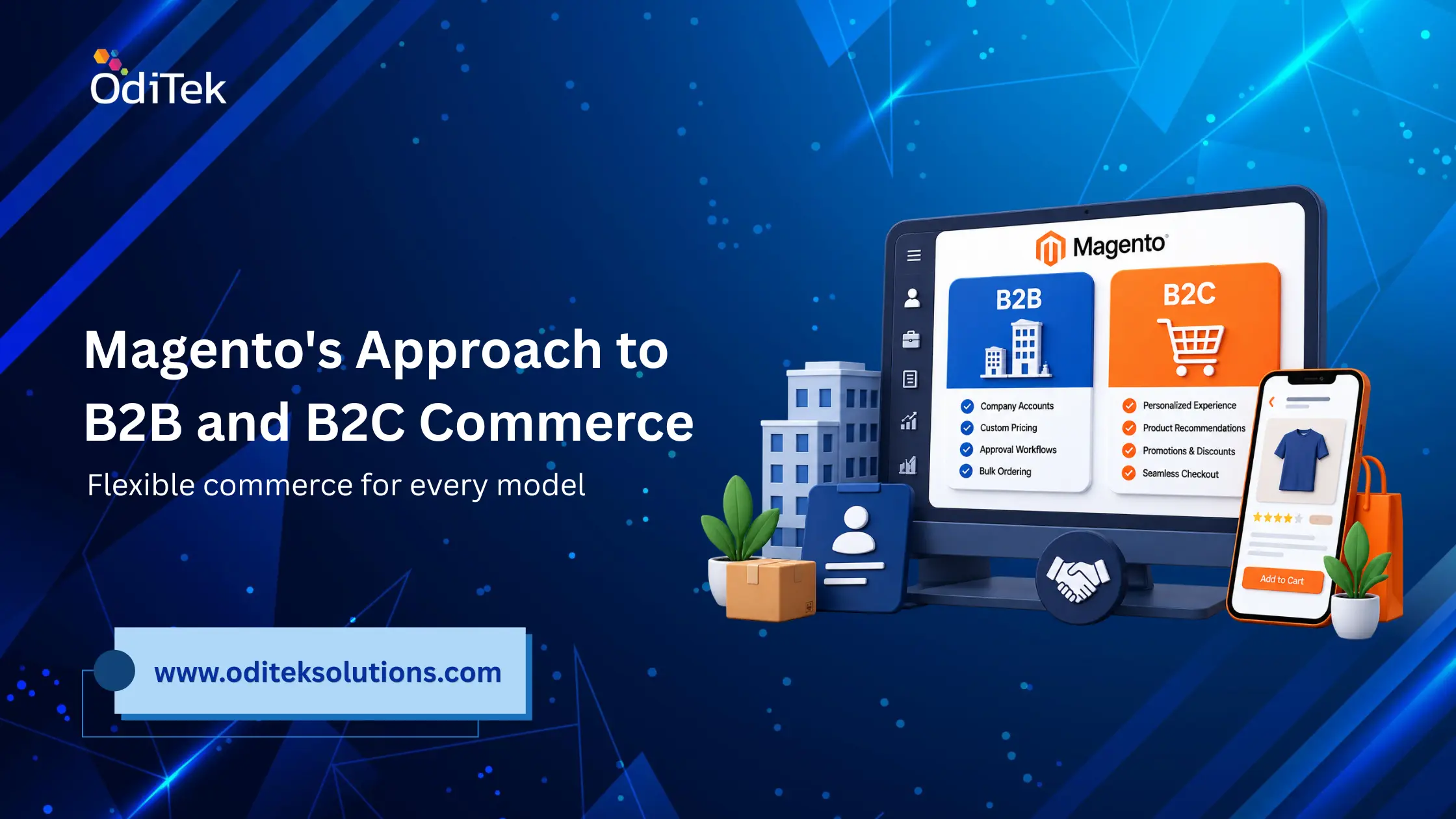
Whether a business sells to organizations or individual consumers, its eCommerce platform needs to support the way its customers actually buy. B2B businesses often require company accounts, negotiated pricing, bulk ordering, and approval workflows, while B2C businesses typically prioritize engaging storefronts, personalized shopping, promotions, and frictionless checkout.
The challenge is finding a platform capable of supporting these different requirements without limiting businesses to a rigid commerce model. The Magento Commerce Platform offers the flexibility to address both B2B and B2C requirements through configurable features, customer experiences, catalogs, pricing, and integrations. This makes it a versatile choice for businesses looking to build an eCommerce operation around their specific audience and business model.
How the Magento Commerce Platform Supports Different Commerce Models?
B2B and B2C businesses have different priorities throughout the buying journey. B2B commerce often involves organizations, multiple buyers, negotiated pricing, and structured purchasing processes. B2C commerce focuses more on individual shoppers, product discovery, promotions, and convenience.
Magento allows businesses to configure their commerce environment around these differences. Key capabilities include:
• Customer account structures
• Product catalogs and pricing
• Purchasing workflows
• Promotions and personalization
• Storefront experiences
• Third-party integrations
This flexibility allows businesses to choose the functionality relevant to their particular commerce model.
What makes Magento the right platform for B2B and B2C commerce?
The strength of Magento lies in its flexibility. Rather than requiring every business to follow the same purchasing structure, it allows commerce experiences to be configured around specific customer and operational requirements.
For B2B businesses, this can mean supporting company accounts, custom pricing, buyer permissions, and approval workflows. For B2C businesses, the focus can shift toward promotions, product discovery, personalized experiences, and streamlined checkout.
The platform can also be integrated with the systems that support broader business operations, making it suitable for businesses with different technology environments and commerce requirements.
Supporting B2B Commerce with Flexible Purchasing Capabilities
B2B customers often need more than a standard product catalog and checkout. They may purchase on behalf of a company, work within specific budgets, or require approval before placing an order.
For Magento B2B eCommerce, businesses can use capabilities such as:
Company accounts: Organize buyers under a business account with defined structures.
Custom pricing: Offer pricing based on customer relationships or agreements.
Buyer permissions: Assign purchasing roles and control who can place or approve orders.
Approval workflows: Support internal purchasing processes before an order is finalized.
Bulk and quick ordering: Make repeat and high-volume purchases more efficient.
Flexible payment options: Accommodate different business purchasing requirements.
These capabilities help B2B businesses digitize complex purchasing processes while giving buyers greater control over their accounts and orders.
Creating Engaging B2C Shopping Experiences
B2C customers generally expect an eCommerce experience that is easy to navigate and quick to complete. A well-organized catalog, relevant promotions, product recommendations, and a smooth checkout can all influence the shopping journey.
Magento B2C eCommerce capabilities can support these expectations through customizable storefronts and customer-focused commerce features.
Businesses can use Magento to create:
• Intuitive product categories and navigation
• Promotional and discount campaigns
• Personalized product discovery
• Customer account functionality
• Mobile-friendly shopping experiences
• Streamlined checkout journeys
The storefront can also be customized to reflect the brand’s identity, helping businesses create a shopping experience that feels consistent with their overall digital presence.
How does Magento support personalized experiences for B2B and B2C buyers?
Personalization can take different forms depending on the commerce model. B2C businesses may use browsing activity, previous purchases, and product preferences, while B2B businesses may rely on company accounts, customer-specific pricing, purchasing roles, and previous orders.
Magento allows businesses to configure catalogs, pricing, content, and purchasing experiences according to these customer requirements.
This helps businesses present more relevant products and information to different buyer groups.
Flexible Catalog and Pricing Management
Product and pricing requirements can vary significantly between B2B and B2C businesses.
A B2B organization may need customer-specific pricing, contract-based products, or restricted catalogs. A B2C retailer may require promotional pricing, product variants, seasonal offers, and customer-focused merchandising.
The Magento Commerce Platform gives businesses control over how products and pricing are structured, helping teams manage product information while presenting appropriate selections and pricing to their customers.
Streamlining the B2B Purchasing Journey
For B2B businesses, the purchasing journey often extends beyond selecting a product and paying for it. Buyers may need to submit orders for approval, repeat previous purchases, or work within company purchasing policies.
Magento can support these requirements through features designed around organizational purchasing.
Key capabilities include:
• Company accounts and buyer roles
• Shared catalogs
• Purchase orders
• Approval processes
• Quick ordering
• Bulk purchasing
By digitizing these processes, businesses can reduce unnecessary steps and provide buyers with a more efficient way to manage their purchases.
Building a Seamless B2C Customer Journey
B2C customers typically want to move from product discovery to purchase with as little friction as possible. Magento supports this through customizable storefront experiences that can prioritize navigation, product information, promotions, and checkout.
Businesses can optimize areas such as:
• Product search and discovery
• Product pages
• Promotional offers
• Customer accounts
• Cart and checkout
• Post-purchase interactions
This gives Magento B2C eCommerce businesses the flexibility to create storefronts aligned with their brand and target audience.
Connecting Magento with Business Systems
An eCommerce store often needs to exchange information with ERP, CRM, payment, inventory, shipping, and marketing systems.
The Magento Commerce Platform can integrate with these business applications to connect information across the commerce ecosystem. B2B businesses can connect account and order information with internal systems, while B2C businesses can support inventory, fulfilment, customer, and marketing operations.
Why Choose OdiTek for Magento Development?
The right implementation partner can help businesses turn Magento’s capabilities into a solution aligned with their business model. OdiTek Solutions focuses on developing Magento solutions around specific B2B and B2C requirements.
Our approach includes:
• Requirement-focused development: Aligning the solution with business objectives.
• Custom functionality: Building features around specific workflows.
• B2B and B2C implementation: Configuring experiences for different buyer types.
• Third-party integrations: Connecting Magento with essential business systems.
• Storefront customization: Creating experiences aligned with the brand.
• Ongoing support: Maintaining and enhancing Magento implementations.
Frequently Asked Questions (FAQs)
1. What are the main differences between Magento B2B and B2C features?
B2B implementations typically focus on company accounts, custom pricing, purchasing permissions, approval workflows, and bulk ordering. B2C implementations place greater emphasis on product discovery, promotions, personalization, customer accounts, and streamlined checkout.
2. Can Magento support custom pricing for B2B customers?
Yes. Magento can support customer-specific and business-specific pricing requirements, making it possible to create different pricing structures for B2B buyers based on agreements, customer groups, or purchasing relationships.
3. How does Magento simplify bulk ordering for B2B buyers?
Magento can support quick ordering and bulk purchasing capabilities, helping business buyers add multiple products or large quantities more efficiently than using a standard consumer-oriented shopping process.
4. What Magento features help improve B2C customer engagement?
B2C businesses can use features such as personalized product recommendations, promotions, customer accounts, product discovery, intuitive navigation, and streamlined checkout to create more engaging shopping experiences.
5. Can Magento support different purchasing workflows for B2B and B2C businesses?
Yes. Magento can be configured around the purchasing requirements of each commerce model. B2B implementations can include approval and account-based workflows, while B2C implementations can focus on a simpler, more direct purchase journey.
Conclusion
B2B and B2C businesses have different expectations from their eCommerce platforms. B2B organizations need tools that can handle structured purchasing relationships, account-level controls, negotiated pricing, and complex ordering processes. B2C businesses need engaging storefronts, personalized experiences, promotions, and convenient checkout.
Magento accommodates these differences through a flexible set of commerce capabilities rather than prescribing one way of selling online. From Magento B2B eCommerce features such as approval workflows and custom pricing to Magento B2C eCommerce capabilities focused on engagement and streamlined shopping, businesses can shape the platform around their specific requirements.
With the right strategy, customization, and integrations, Magento can provide a strong foundation for businesses seeking to build an eCommerce experience that fits the way their customers actually shop and buy.
Discover our Magento development expertise and see how we can support your eCommerce goals.
Talk to our team to get started with a Magento solution designed around your business requirements.